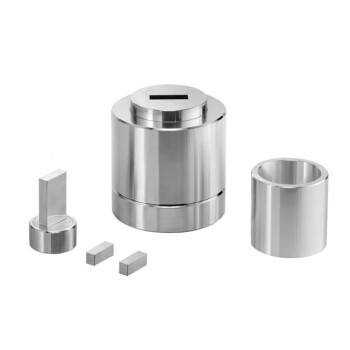
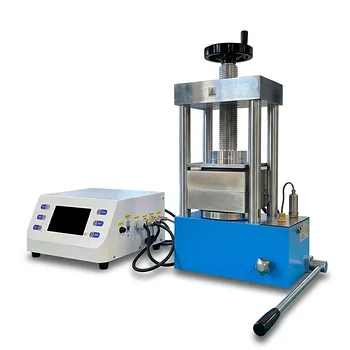
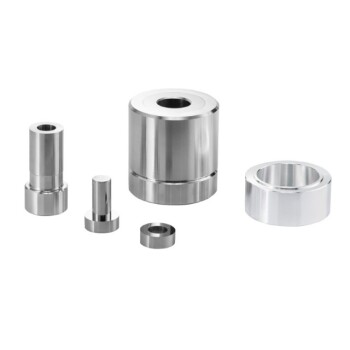
A laboratory hydraulic press functions as the critical densification tool in the preparation of LZTC electrolyte pellets for performance testing. It applies high pressure, specifically around 250 MPa, to consolidate loose electrolyte powders into dense, cohesive circular pellets.
The press transforms loose powder into a unified solid, effectively minimizing internal porosity and maximizing particle-to-particle contact. This microstructural change is the primary mechanism for lowering grain boundary resistance, allowing you to measure the material's true ionic conductivity rather than artifacts caused by voids or poor connectivity.
The Mechanics of Densification
From Loose Powder to Solid Pellet
The fundamental role of the hydraulic press is to mechanically force loose particles into a consolidated state. In the context of LZTC preparation, the press applies a specific high pressure, such as 250 MPa.
This intense pressure overcomes the friction between powder particles. It packs them tightly together to form a mechanically stable disk, often referred to as a "green pellet" before sintering.
Eliminating Internal Porosity
Loose powders naturally contain significant voids (air gaps) between particles. These voids act as insulators, blocking the path of ions and degrading performance data.
The hydraulic press drastically reduces this internal porosity. By squeezing the air out and forcing material into the voids, it increases the macroscopic density of the pellet.
Impact on Electrochemical Performance
Reducing Grain Boundary Resistance
The most critical function of the press regarding performance testing is the reduction of grain boundary resistance.
In solid-state electrolytes, ions must hop from one particle to the next. If the contact point (grain boundary) is loose or narrow, resistance spikes.
By applying high pressure, the press establishes superior physical contact between particles. This creates a wider, more continuous pathway for ions to travel, directly facilitating high ionic conductivity.
Enabling Accurate Data Collection
To evaluate LZTC electrolytes effectively, the measured data must reflect the intrinsic properties of the material, not the quality of the sample preparation.
If a pellet is loosely packed, testing will show artificially low conductivity. The high-pressure densification ensures that the data collected represents the material's true potential.
Understanding the Trade-offs
The Importance of Optimal Pressure
While pressure is vital, precision is equally important. The goal is to achieve a specific density without introducing defects.
Insufficient pressure results in a pellet with low "green density." This leads to high porosity even after sintering, resulting in poor structural integrity and unreliable conductivity readings.
Uniformity is key. The pressure must be applied evenly to ensure the density is consistent across the entire pellet. Variations in density can lead to warping or cracking during subsequent handling or sintering phases.
Making the Right Choice for Your Goal
To maximize the utility of your laboratory hydraulic press for LZTC preparation, consider your specific testing objectives:
- If your primary focus is measuring maximum ionic conductivity: Prioritize pressures near 250 MPa to minimize grain boundary resistance and ensure tight inter-particle contact.
- If your primary focus is post-sintering structural integrity: Ensure the press delivers enough force to create a high-density "green pellet" that will not crumble or warp during high-temperature processing.
Ultimately, the hydraulic press is not just a shaping tool; it is the gatekeeper that determines whether your LZTC pellet achieves the connectivity required for high-performance conduction.
Summary Table:
| Feature | Function in LZTC Preparation | Impact on Performance |
|---|---|---|
| Pressure Level | Applies high force (~250 MPa) | Consolidates powder into dense "green" pellets |
| Porosity Control | Eliminates internal air gaps | Increases macroscopic density and structural integrity |
| Grain Boundaries | Enhances particle-to-particle contact | Dramatically reduces grain boundary resistance |
| Data Accuracy | Standardizes sample density | Ensures measurements reflect intrinsic ionic conductivity |
Elevate Your Solid-State Battery Research with KINTEK
Precise densification is the cornerstone of reliable LZTC electrolyte testing. KINTEK specializes in high-performance laboratory hydraulic presses, including pellet, hot, and isostatic models, designed to deliver the uniform pressure necessary for superior ionic conductivity results.
Our extensive portfolio supports your entire workflow—from crushing and milling systems for powder preparation to high-temperature muffle and vacuum furnaces for sintering, and battery research tools for final performance analysis. We provide the high-quality equipment and PTFE or ceramic consumables required to eliminate sample contamination and ensure data integrity.
Ready to achieve maximum density and accuracy in your lab? Contact KINTEK today to find the perfect hydraulic press for your application!
Related Products
- Automatic Laboratory Hydraulic Pellet Press Machine for Lab Use
- Laboratory Hydraulic Press Split Electric Lab Pellet Press
- Laboratory Hydraulic Pellet Press for XRF KBR FTIR Lab Applications
- Laboratory Manual Hydraulic Pellet Press for Lab Use
- Laboratory Hydraulic Press Lab Pellet Press Machine for Glove Box
People Also Ask
- What is the role of a laboratory hydraulic pellet press and stainless steel molds in the fabrication of RuO2/NbC anodes?
- What role does a laboratory pellet press play in the enhancement of biomass energy products? Optimize Fuel Efficiency
- What is the purpose of using a laboratory pellet press when evaluating the electronic conductivity of carbon powders? Guide
- How does a laboratory hydraulic pellet press contribute to SiCw/2024 aluminum composite preforms? Optimize Densification
- What is the significance of applying 200 MPa of pressure with a laboratory hydraulic pellet press for composite ceramics?