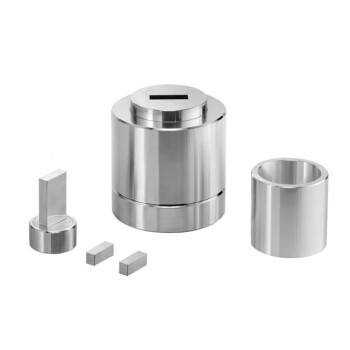
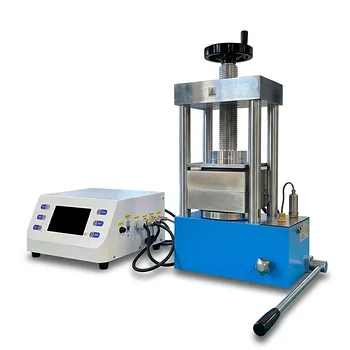
A laboratory hydraulic press serves a singular, critical function in biomass analysis: it transforms loose, dried biomass powder into solid, uniform pellets or discs to ensure accurate physicochemical characterization. By applying controlled high pressure, the press creates a stable sample with consistent density, which is a mandatory prerequisite for analytical techniques such as Fourier-Transform Infrared Spectroscopy (FTIR) and X-ray fluorescence (XRF).
By converting variable powders into dense, homogeneous discs, the hydraulic press eliminates the physical irregularities that cause data errors. This step is essential for reducing signal scattering and ensuring that the analysis reflects the true composition of the substrate, rather than the artifacts of sample preparation.
The Physics of Sample Preparation
Creating Structural Uniformity
Biomass samples typically begin as dried, loose powders. To analyze them effectively, this powder must be consolidated into a single, cohesive unit.
The hydraulic press applies significant force—often reaching levels such as 22 tons—to compress the material. This transforms the chaotic arrangement of particles into a smooth, dense pellet or disc.
Eliminating Voids and Irregularities
The primary mechanical goal is the removal of air pockets and spacing between particles.
By forcing the particles together, the press eliminates voids that naturally occur in loose powders. In some cases, such as in XRF analysis, a binder is mixed with the powder before compression to ensure the pellet holds its shape under stress.
Why High Density is Critical for Data
Reducing Signal Scattering
The accuracy of spectroscopic analysis depends heavily on how light or X-rays interact with the sample.
If a sample is loose or porous, the signal (whether optical or X-ray) scatters unpredictably off the particle edges. Compressing the sample into a dense disc eliminates this scattering interference in the optical path.
Improving Signal-to-Noise Ratio
A smooth, dense surface allows for a cleaner excitation of the sample atoms.
In XRF analysis, for example, the reduction of scattering directly improves the signal-to-noise ratio. This enhancement allows for high-precision quantitative analysis of mineral elements that might otherwise be obscured by background noise.
The Role in Process Optimization
Enabling Accurate Composition Analysis
The ultimate goal of using a press is not just to make a pellet, but to secure reliable data on the substrate's makeup.
Reliable FTIR or XRF data reveals the precise chemical structure and elemental composition of the biomass.
Guiding Pre-treatment Decisions
Accurate data feeds directly into the engineering cycle.
By understanding the exact composition of the biomass via these pressed samples, researchers can guide the optimization of pre-treatment processes. This ensures that the conversion of biomass into usable energy or chemicals is as efficient as possible.
Understanding Critical Variables
The Importance of Pressure Precision
While high pressure is necessary, pressure control is equally vital.
If the pressure applied is inconsistent between samples, the density will vary. This inconsistency creates variables that can skew comparative data, making it difficult to determine if differences are due to the biomass itself or the preparation method.
The Necessity of Binders
Not all biomass powders self-adhere under pressure.
While the press provides the force, certain samples (like specific seed pods) require a chemical binder to form a stable pellet. It is critical to select a binder that does not interfere with the specific spectral range you are analyzing.
Making the Right Choice for Your Goal
To ensure your preparation method aligns with your analytical objectives, consider the following:
- If your primary focus is FTIR Analysis: Prioritize precise pressure control to create a disc with uniform density, ensuring the optical path is clear of scattering interference.
- If your primary focus is XRF Elemental Analysis: Ensure your press can achieve high tonnage (e.g., 22 tons) to completely eliminate inter-particle voids and maximize the signal-to-noise ratio.
Consistency in the physical preparation of your sample is the invisible foundation of accurate chemical analysis.
Summary Table:
| Feature | Function in Biomass Analysis | Impact on Data Quality |
|---|---|---|
| High Pressure (up to 22T) | Compresses loose powder into dense, uniform pellets | Eliminates air voids and structural irregularities |
| Structural Consolidation | Creates a smooth, cohesive sample surface | Reduces signal scattering for clearer optical paths |
| Density Uniformity | Ensures consistent sample thickness and mass | Enhances signal-to-noise ratio for accurate quantification |
| Process Optimization | Provides reliable chemical/elemental composition data | Guides more efficient biomass pre-treatment strategies |
Elevate Your Biomass Research with KINTEK Precision
Don't let inconsistent sample preparation compromise your analytical results. KINTEK specializes in high-performance laboratory equipment, offering a robust range of hydraulic presses (pellet, hot, isostatic) designed to produce the uniform, high-density discs required for FTIR, XRF, and battery research.
Whether you are refining pre-treatment processes or performing complex elemental analysis, our crushing and milling systems, high-temperature furnaces, and specialized consumables like PTFE and ceramics provide the reliability your lab needs. Unlock the full potential of your biomass samples—contact KINTEK today to find the perfect pressing solution for your application.
References
- Gayathri Priya Iragavarapu, Naresh Kumar Amradi. Bioprocessing of Waste for Renewable Chemicals and Fuels to Promote Bioeconomy. DOI: 10.3390/en16093873
This article is also based on technical information from Kintek Solution Knowledge Base .
Related Products
- Automatic Laboratory Hydraulic Pellet Press Machine for Lab Use
- Laboratory Manual Hydraulic Pellet Press for Lab Use
- Automatic Laboratory Hydraulic Press for XRF & KBR Pellet Press
- Laboratory Manual Hydraulic Pellet Press for Lab Use
- Laboratory Hydraulic Press Lab Pellet Press Machine for Glove Box
People Also Ask
- What is the role of a laboratory hydraulic pellet press and stainless steel molds in the fabrication of RuO2/NbC anodes?
- What role does a laboratory pellet press play in the enhancement of biomass energy products? Optimize Fuel Efficiency
- What is the purpose of using a laboratory pellet press when evaluating the electronic conductivity of carbon powders? Guide
- How does a laboratory hydraulic pellet press contribute to SiCw/2024 aluminum composite preforms? Optimize Densification
- What is the significance of applying 200 MPa of pressure with a laboratory hydraulic pellet press for composite ceramics?