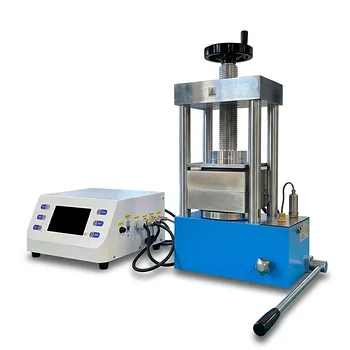
The primary function of a laboratory hydraulic press is to transform raw Polyhydroxyalkanoate (PHA) granules into uniform, dense films through melt pressing or thermoforming. By applying precise, simultaneous heat and pressure, the equipment melts the polymer and shapes it into a consistent sheet with controllable thickness.
The laboratory hot press acts as a critical bridge between raw material synthesis and application testing. It allows researchers to produce standardized film samples necessary for validating PHA's mechanical limits and barrier properties before attempting industrial-scale food packaging production.
The Mechanics of Film Formation
Transforming Granules to Sheet
The process begins with PHA in its raw form, typically as granules or pellets. The press uses heated plates to raise the temperature of the polymer above its melting point.
Once the material is molten, the hydraulic system applies significant force. This compresses the liquefied polymer into a flat, continuous film, eliminating air pockets and ensuring structural integrity.
Precision Thickness Control
For food packaging, film thickness must be exact to ensure consistent performance.
The hydraulic press allows operators to set specific parameters to achieve a uniform gauge. This control is vital for creating samples that yield reproducible data during testing.
Why This Step is Critical for Packaging
Validating Barrier Properties
A key requirement for food packaging is the ability to block moisture and oxygen.
The primary reference notes that the press is vital for testing water vapor barrier capabilities. By creating a dense, void-free film, researchers can accurately measure how well the PHA protects food from spoilage.
Testing Mechanical Strength
Packaging films must withstand handling, stretching, and puncturing.
Films produced on a hot press are used to test the thermoplastic properties and mechanical strength of the specific PHA formulation. This ensures the material is durable enough to function as a wrapper or container.
Understanding the Limitations
Batch vs. Continuous Processing
It is important to recognize that a laboratory press operates as a batch process. It creates single, static sheets of film one at a time.
This differs from industrial food packaging production, which typically uses continuous extrusion processes. While the material properties remain similar, the processing method is strictly for low-volume characterization.
Thermal Sensitivity
PHA is a biopolymer that can degrade if exposed to excessive heat for too long.
While the press offers control, the operator must be careful not to overheat the sample during the "melt pressing" phase. Improper temperature settings can compromise the very mechanical properties you are trying to measure.
Making the Right Choice for Your Goal
To maximize the utility of a laboratory hydraulic press in PHA development, consider your specific objective:
- If your primary focus is Material Characterization: Use the press to create standardized, dense coupons to rigorously test tensile strength and water vapor transmission rates.
- If your primary focus is Prototyping: Use the press to produce small batches of film to visually assess clarity, texture, and flexibility for packaging concepts.
The laboratory hot press is the definitive tool for proving that a specific PHA formulation is viable for the demanding environment of food packaging.
Summary Table:
| Feature | Function in PHA Film Production |
|---|---|
| Thermal Control | Melts PHA granules uniformly above their melting point without degradation. |
| Hydraulic Pressure | Compresses molten polymer into dense, void-free sheets for structural integrity. |
| Thickness Gauge | Ensures precise, reproducible film thickness for standardized testing. |
| Barrier Testing | Creates samples to measure water vapor and oxygen transmission rates (WVTR/OTR). |
| Mechanical Analysis | Facilitates testing of tensile strength, flexibility, and thermoplastic limits. |
Elevate Your Biopolymer Research with KINTEK Precision
Transitioning from PHA synthesis to high-performance food packaging requires absolute precision. KINTEK specializes in advanced hydraulic presses (pellet, hot, and isostatic) and crushing and milling systems designed to meet the rigorous demands of material science.
Whether you are validating water vapor barriers or testing mechanical durability, our laboratory hot presses ensure your PHA films meet industrial standards. Beyond pressing, KINTEK offers a complete suite of solutions including high-temperature furnaces, cooling solutions (ULT freezers, freeze dryers), and PTFE consumables to support your entire R&D lifecycle.
Ready to produce flawless film samples? Contact our laboratory equipment experts today to find the perfect hydraulic press for your PHA research and prototyping needs.
References
- Lorena Atarés, María Vargas. Production of Polyhydroxyalkanoates for Biodegradable Food Packaging Applications Using Haloferax mediterranei and Agrifood Wastes. DOI: 10.3390/foods13060950
This article is also based on technical information from Kintek Solution Knowledge Base .
Related Products
- Hydraulic Diaphragm Lab Filter Press for Laboratory Filtration
- Laboratory Hydraulic Press Split Electric Lab Pellet Press
- Automatic Laboratory Hydraulic Pellet Press Machine for Lab Use
- Heated Hydraulic Press Machine with Integrated Manual Heated Plates for Lab Use
- Laboratory Hydraulic Press Lab Pellet Press Machine for Glove Box
People Also Ask
- What are the advantages and disadvantages of presses? A Guide to Lab Filter Presses for R&D
- How is a laboratory hydraulic press used in the preparation of modified biochar samples for FTIR analysis? Expert Guide
- What are the safety precautions for filter press? Essential Steps to Prevent High-Pressure Hazards
- What is the capacity of a filter press? A Guide to Volumetric & Throughput Metrics
- What is an example of a hydraulic press? Discover the Power of Laboratory Sample Preparation