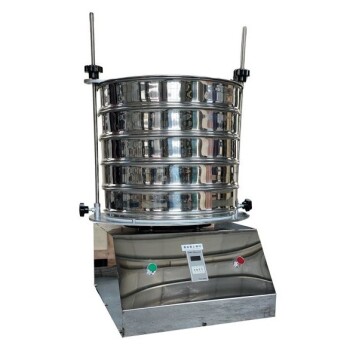
A standard test sieve or vibratory shaker functions as a precision classification tool in the pre-treatment of magnesium slag. Its primary role is to separate dried slag into distinct fractions based on particle size, allowing operators to isolate specific ranges that contain the highest concentration of elemental magnesium.
By isolating specific particle sizes rich in elemental magnesium, sieving transforms raw slag into an enriched feedstock. This pre-selection step is critical for maximizing the efficiency and economic viability of the subsequent vacuum distillation process.
The Mechanics of Enrichment
Classification by Particle Size
The fundamental operation of the vibratory shaker is to categorize raw material. By passing dried magnesium slag through a series of screens, the equipment separates the bulk material into various grades.
This process is not merely about uniformity; it is about chemical potential. The equipment ensures that only material meeting specific dimensional criteria moves forward to the recovery phase.
Targeting the Magnesium-Rich Zone
Research indicates that magnesium is not evenly distributed across all slag particle sizes. Specific ranges, notably -18 to +60 mesh, have been identified as being particularly rich in elemental magnesium.
The sieving process is designed to target and capture this "sweet spot." By discarding the ranges that contain little magnesium, the shaker effectively concentrates the valuable material before any chemical or thermal processing begins.
Impact on Downstream Processing
Optimizing Vacuum Distillation
The primary beneficiary of this pre-treatment is the vacuum distillation process. This is an energy-intensive recovery method where efficiency is paramount.
By feeding the distillation equipment with pre-selected, enriched material, you avoid wasting energy on processing low-grade slag. This direct targeting significantly improves the overall recovery efficiency of the system.
Enhancing Economic Viability
The use of a test sieve or shaker directly influences the economics of the operation. Processing raw, unclassified slag results in higher energy costs per unit of recovered magnesium.
Enriching the feedstock through sieving ensures that resources are expended only on material with high recovery potential. This makes the entire recovery cycle more economically viable.
Understanding the Trade-offs
The Necessity of Pre-Drying
It is important to note that the reference specifically mentions dried magnesium slag. Sieving damp or wet slag is ineffective, as moisture causes particles to agglomerate and blind the mesh screens.
Therefore, introducing a sieve requires a commitment to proper upstream drying processes. Without dry feed, the classification will be inaccurate, negating the benefits of enrichment.
Specificity vs. Volume
Focusing on a specific mesh range (e.g., -18 to +60) implies that a portion of the bulk slag will be rejected. While this increases the quality of the feedstock, it reduces the total volume entering the distillation phase.
Operators must balance the loss of total volume against the gains in efficiency. However, because the rejected material is low in elemental magnesium, this trade-off is generally favorable for the final yield.
Making the Right Choice for Your Goal
To maximize the benefits of sieving in magnesium recovery, align your approach with your specific operational targets:
- If your primary focus is Process Efficiency: Prioritize the strict isolation of the -18 to +60 mesh range to ensure your vacuum distillation equipment processes only the most potent material.
- If your primary focus is Cost Reduction: Implement sieving to remove low-grade fractions early, thereby reducing the energy consumption required per ton of recovered magnesium.
Effective pre-treatment through precise sizing is the single most effective way to turn raw waste into a valuable, process-ready resource.
Summary Table:
| Process Step | Equipment Function | Targeted Outcome |
|---|---|---|
| Classification | Precision screen separation | Categorize slag by particle size grades |
| Enrichment | Vibratory mesh isolation | Target the magnesium-rich -18 to +60 mesh zone |
| Optimization | Feedstock pre-selection | Increase efficiency of vacuum distillation |
| Economic Gains | Waste reduction | Lower energy consumption per unit recovered |
Maximize Your Magnesium Recovery Potential with KINTEK
Transform industrial slag into high-value resources with precision equipment from KINTEK. Our high-performance vibratory shakers and standard test sieves are engineered to deliver the exact particle size classification required for effective magnesium enrichment.
Beyond pre-treatment, KINTEK provides a comprehensive ecosystem for advanced material science, including crushing and milling systems, vacuum and atmosphere furnaces, and high-temperature high-pressure reactors. Whether you are optimizing battery research, refining metals, or managing laboratory consumables like PTFE and ceramics, our experts are ready to enhance your lab's efficiency and economic viability.
Ready to refine your process? Contact KINTEK today for a customized solution!
Related Products
- Laboratory Test Sieves and Sieving Machines
- Custom PTFE Teflon Parts Manufacturer for PTFE Mesh F4 Sieve
- Three-dimensional electromagnetic sieving instrument
- Side Window Optical Electrolytic Electrochemical Cell
- Reference Electrode Calomel Silver Chloride Mercury Sulfate for Laboratory Use
People Also Ask
- What are laboratory test sieves used for? A Guide to Particle Size Analysis
- How do you calculate the sieve test? Master Particle Size Distribution for Quality Control
- How does a lab test sieve contribute to biomass charcoal powder preparation? Achieve Uniform Particle Size
- What are the specifications for test sieves? A Guide to ASTM & ISO Standards for Accurate Particle Analysis
- What materials are required for sieving? Achieve Accurate Particle Size Analysis