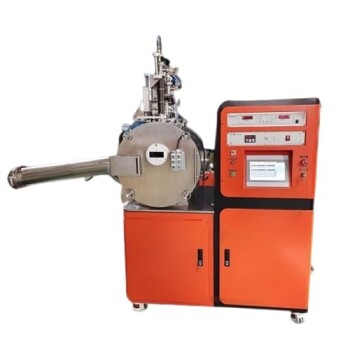
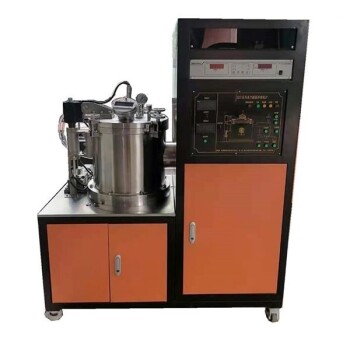
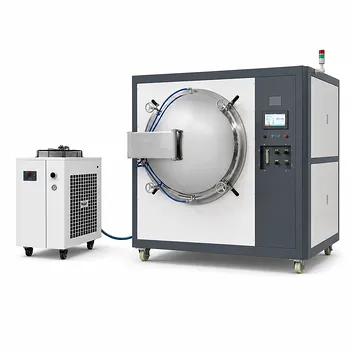
The vacuum induction arc furnace serves as the primary synthesis tool for Alumina-Forming Austenitic (AFA) steel, designed to melt complex elemental mixtures within a protected, pure argon inert atmosphere. Its fundamental role is to generate the extreme temperatures required to fully fuse iron, nickel, chromium, and aluminum while utilizing repeated remelting cycles to guarantee a uniform chemical composition throughout the alloy ingot.
Core Takeaway: The furnace does not simply melt metal; it acts as a stabilization chamber. It balances the intense heat required to fuse refractory elements with a controlled pressure environment that prevents the loss of volatile components and protects reactive additives from oxidation.
Achieving Chemical Homogeneity
The primary challenge in creating AFA steel is ensuring that elements with vastly different melting points and densities mix perfectly.
The Role of Repeated Remelting
A single melt is rarely sufficient to create a usable alloy. The process involves repeatedly flipping and remelting the ingot, typically no fewer than five times.
The High-Temperature Stirring Effect
During these remelting cycles, the furnace utilizes the stirring effect generated by the arc. This natural agitation drives the movement of molten metal, breaking down clusters of un-melted material and ensuring that elements like iron, nickel, and chromium are evenly distributed across the ingot.
Protecting Reactive and Volatile Elements
AFA steel relies on specific alloying elements like Aluminum (Al) and Chromium (Cr) to function, but these elements are difficult to manage under standard atmospheric conditions.
Preventing Oxidation via Inert Atmosphere
The furnace operates under a pure argon atmosphere. This inert environment is critical for protecting active metals—specifically Aluminum and Niobium—which are prone to rapid oxidation. By excluding oxygen, the furnace prevents the formation of unwanted oxides and inclusions that would weaken the final material.
Suppressing Chromium Evaporation
High temperatures can cause certain elements to vaporize and escape the melt. To counter this, the furnace maintains a specific argon pressure, typically at least 0.3 atm. This pressure suppresses the intense evaporation of Chromium, ensuring the final chemical composition matches the intended design ratios.
Understanding the Trade-offs
While the vacuum induction arc furnace is essential for purity, the process requires strict parameter control to avoid defects.
The Risk of Element Loss
Even with pressure controls, operating at excessive temperatures or insufficient pressure can lead to the loss of high-vapor-pressure elements. If Chromium evaporates, the alloy's corrosion resistance will be compromised, leading to a deviation from the target composition.
Managing Microscopic Segregation
While the furnace ensures macroscopic uniformity through stirring, microscopic segregation (dendritic segregation) can still occur during solidification. The melting process is often just the first step; subsequent heat treatments (homogenization annealing) are usually required to smooth out these microscopic inconsistencies.
Making the Right Choice for Your Goal
When utilizing a vacuum induction arc furnace for AFA steel preparation, focus on these operational priorities:
- If your primary focus is Compositional Accuracy: strictly maintain an argon pressure of at least 0.3 atm to prevent the volatilization of Chromium.
- If your primary focus is Structural Uniformity: ensure the ingot is flipped and remelted a minimum of five times to maximize the arc's stirring effect.
- If your primary focus is Material Purity: verify the integrity of the vacuum and argon purity to prevent the oxidation of Aluminum and Niobium.
The vacuum induction arc furnace is the gatekeeper of quality, transforming raw elemental ingredients into a chemically stable, high-purity alloy foundation.
Summary Table:
| Process Feature | Functional Role in AFA Steel Production | Benefit to Material Properties |
|---|---|---|
| Inert Argon Atmosphere | Prevents oxidation of reactive elements like Al and Nb | Ensures high purity and prevents weak oxide inclusions |
| 0.3 atm Pressure Control | Suppresses the evaporation of volatile Chromium (Cr) | Maintains precise chemical composition and corrosion resistance |
| Repeated Remelting (5x+) | Flips and fuses the ingot multiple times | Eliminates elemental clusters for macroscopic uniformity |
| Arc Stirring Effect | Drives natural agitation within the molten metal | Ensures even distribution of Ni, Cr, and Fe throughout the alloy |
Elevate Your Advanced Material Research with KINTEK
Precision in AFA steel synthesis requires the highest standards of thermal and atmospheric control. At KINTEK, we specialize in providing state-of-the-art laboratory equipment designed for the most demanding metallurgical applications. From high-performance vacuum induction melting and arc furnaces to our precision crushing, milling, and sieving systems, we provide the tools necessary to achieve perfect chemical homogeneity.
Whether you are developing next-generation alloys or conducting fundamental battery research, our comprehensive portfolio—including high-temperature reactors, autoclaves, and specialized ceramic crucibles—is engineered to support your innovation.
Ready to achieve superior material stability? Contact our technical experts today to discover how KINTEK’s laboratory solutions can streamline your preparation process and ensure the integrity of your high-performance alloys.
References
- O.M. Velikodny, O.C. Tortika. STRUCTURE AND PROPERTIES OF AFA STEEL FE-NI-CR-AL WITH VARIABLE ALUMINUM CONTENT. DOI: 10.46813/2024-150-062
This article is also based on technical information from Kintek Solution Knowledge Base .
Related Products
- Non Consumable Vacuum Arc Induction Melting Furnace
- Vacuum Induction Melting Spinning System Arc Melting Furnace
- Vacuum Arc Induction Melting Furnace
- 600T Vacuum Induction Hot Press Furnace for Heat Treat and Sintering
- Lab-Scale Vacuum Induction Melting Furnace
People Also Ask
- What are the advantages of induction melting furnace? Achieve Purity, Efficiency, and Safety
- What is the use of induction melting furnace? Achieve Fast, Clean, and Precise Metal Melting
- What is the temperature range of the induction melting furnace? Find the Right Heat for Your Metals
- How do specialized industrial-grade small melting furnaces address challenges in precision jewelry casting? Expert Guide
- How do vacuum induction or arc melting furnaces facilitate the synthesis of U-Al-C MAX phases? Precision Heat & Purity