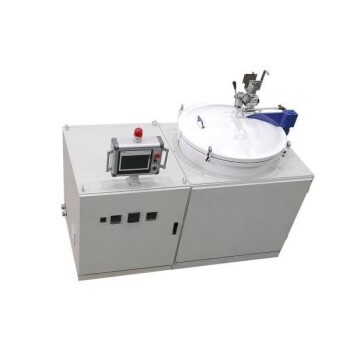
A vacuum induction melting (VIM) furnace functions as a specialized synthesis environment that generates heat via electromagnetic induction within a strictly controlled high-vacuum chamber. This apparatus is essential for synthesizing Aluminum-Magnesium-Zinc (AlMgZn) cross-over alloys because it prevents the molten aluminum from reacting with oxygen or absorbing hydrogen, thereby ensuring precise chemical composition and exceptional purity.
The core value of the VIM furnace lies in its ability to isolate reactive metals from environmental contamination. It transforms the melting process from a simple phase change into a high-precision purification step, enabling the creation of defect-free specimens required for advanced scientific study.
The Critical Role of Environmental Control
Eliminating Oxidation
Aluminum and magnesium are highly reactive metals.
When melted in open air, they instantly form oxides that degrade the material's structural integrity. The VIM furnace creates a high-vacuum environment that removes oxygen from the equation entirely, preventing these reactions before they can start.
Preventing Hydrogen Absorption
Molten aluminum has a high affinity for hydrogen, which leads to porosity and brittleness in the final alloy.
The vacuum environment effectively degasses the melt. This ensures the final AlMgZn alloy is free of hydrogen-induced defects, which is a prerequisite for high-performance applications.
Achieving Research-Grade Purity
For applications like radiation tolerance research, standard industrial purity is insufficient.
The VIM process facilitates the production of initial specimens with extremely high purity. By controlling the atmosphere, researchers can attribute material behaviors specifically to the alloy's design rather than accidental impurities.
Mechanics of Synthesis and Containment
Electromagnetic Induction Heating
The furnace utilizes electromagnetic induction to generate heat directly within the metal charge.
This method provides rapid, uniform heating. It also induces a natural stirring action within the melt, which ensures the aluminum, magnesium, and zinc are thoroughly fused into a homogeneous alloy.
The Function of the Graphite Crucible
The choice of containment is as critical as the heating method.
High-purity graphite crucibles are specifically selected for AlMgZn synthesis due to their chemical stability and high-temperature resistance.
Preventing Melt Contamination
Graphite is chemically inert relative to active metal melts like aluminum and magnesium.
Unlike other ceramic containers, graphite does not react violently with the melt. This prevents the introduction of foreign impurities during the heating process, preserving the precise stoichiometry of the alloy.
Understanding the Trade-offs
Managing Volatility Under Vacuum
While the vacuum prevents oxidation, it also lowers the boiling point of volatile elements like Magnesium (Mg) and Zinc (Zn).
If the pressure is too low or the temperature too high, there is a risk of these elements evaporating out of the alloy (a principle used in distillation). Precise control of pressure and temperature is required to keep these elements in the melt rather than extracting them as vapor.
Complexity of Process Control
VIM is not a "set it and forget it" method.
It requires rigorous management of heating rates and isothermal holding periods. Operators must balance the need for degassing (which benefits from high vacuum) with the need to retain volatile alloying elements (which requires careful pressure management).
Making the Right Choice for Your Goal
When selecting synthesis parameters for AlMgZn alloys, align your approach with your end-use requirements:
- If your primary focus is Research Baselines: Prioritize high-vacuum levels to maximize purity and eliminate hydrogen, even if it requires strictly monitoring volatile loss.
- If your primary focus is Alloy Complexity: Focus on the induction stirring capabilities to ensure the thorough fusion of Magnesium and Zinc into the Aluminum matrix without segregation.
Ultimately, the VIM furnace is the gatekeeper of quality, transforming reactive raw ingredients into a stable, high-fidelity material ready for critical analysis.
Summary Table:
| Feature | Function in AlMgZn Synthesis | Primary Benefit |
|---|---|---|
| High-Vacuum Chamber | Eliminates oxygen and atmospheric gases | Prevents oxidation and hydrogen-induced porosity |
| Induction Heating | Rapid, uniform heat with natural stirring | Ensures a homogeneous alloy with precise stoichiometry |
| Graphite Crucible | Chemically inert containment | Prevents melt contamination and ensures research-grade purity |
| Pressure Control | Manages volatility of Mg and Zn | Minimizes evaporation loss of volatile alloying elements |
Elevate Your Alloy Research with KINTEK Precision
Unlock the full potential of your material synthesis with KINTEK’s advanced vacuum induction melting (VIM) furnaces. Whether you are developing high-purity AlMgZn specimens for radiation research or complex alloys for aerospace, our high-precision systems provide the environmental control needed to eliminate defects and ensure chemical integrity.
Our laboratory solutions include:
- High-Temperature Furnaces: Muffle, tube, rotary, vacuum, and CVD/PECVD systems.
- Processing Equipment: Crushing, milling, sieving, and high-performance hydraulic presses.
- Specialized Reactors: High-temperature high-pressure reactors and autoclaves.
- Essential Consumables: High-purity graphite crucibles, ceramics, and PTFE products.
Don't let impurities compromise your scientific results. Contact KINTEK today to discuss your specific high-temperature processing needs and discover how our comprehensive range of laboratory equipment can streamline your workflow.
References
- Matheus A. Tunes, Stefan Pogatscher. Prototypic Lightweight Alloy Design for Stellar‐Radiation Environments. DOI: 10.1002/advs.202002397
This article is also based on technical information from Kintek Solution Knowledge Base .
Related Products
- Lab-Scale Vacuum Induction Melting Furnace
- Vacuum Induction Melting Spinning System Arc Melting Furnace
- Vacuum Heat Treat Furnace and Levitation Induction Melting Furnace
- Vacuum Arc Induction Melting Furnace
- Non Consumable Vacuum Arc Induction Melting Furnace
People Also Ask
- How do vacuum induction or arc melting furnaces facilitate the synthesis of U-Al-C MAX phases? Precision Heat & Purity
- What types of metals are typically processed in a vacuum induction melting furnace? High-Purity Alloys for Critical Applications
- Why use VIM for rare earth steel? Essential Precision for Melting Reactive Lanthanum and Cerium
- What is the primary function of a vacuum induction melting furnace in Ni-Mo-Cr-Fe master alloy prep? Ensure High Purity
- What are the advantages of a vacuum induction melting furnace? Achieve High-Purity Alloys with Precision VIM