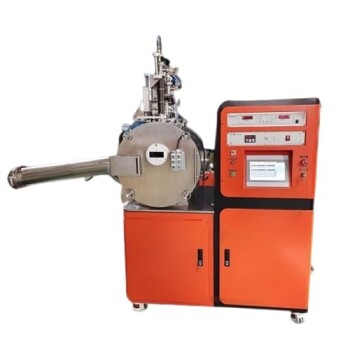
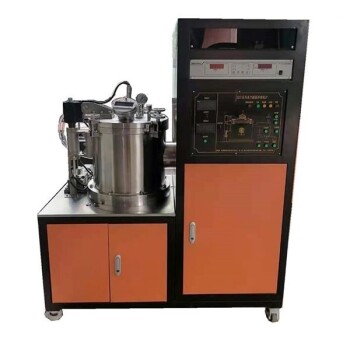
The Vacuum Induction Melting (VIM) furnace functions as a precision synthesis environment specifically designed to purify and homogenize low-alloy FeCrAl steel. Its primary operational role is to utilize a high-vacuum atmosphere to eliminate gaseous impurities and enable the exact addition of trace reactive elements, such as Titanium (Ti) and Zirconium (Zr), without the risk of oxidation.
Core Takeaway VIM is not merely a melting tool; it is a quality assurance mechanism. By creating a high-purity environment, it ensures the FeCrAl alloy achieves the specific chemical composition required to form a dense, protective alumina layer, which is the material's only defense against corrosion in high-temperature liquid lead applications.
The Critical Role of Atmosphere Control
Elimination of Impurities
The most immediate function of the VIM furnace is the active removal of unwanted gases. Under high vacuum, dissolved gases such as oxygen, nitrogen, and hydrogen are drawn out of the molten metal.
This purification is critical for FeCrAl steel because gaseous impurities can compromise the structural integrity of the final alloy, leading to porosity or brittleness.
Protection of Reactive Elements
Low-alloy FeCrAl steel relies on specific active elements to function. The VIM environment dramatically lowers the oxygen partial pressure.
This prevents the oxidative loss of key alloying elements like Aluminum (Al) and Chromium (Cr). Without this vacuum protection, these elements would react with oxygen in the air, forming slag rather than integrating into the steel matrix.
Achieving Compositional Precision
Exact Control of Trace Additives
The primary reference highlights that VIM allows for the precise control of trace active elements, specifically Titanium (Ti) and Zirconium (Zr).
These elements are highly reactive and difficult to manage in open-air melting. VIM ensures that the exact calculated amounts of Ti and Zr are retained in the final product, which is essential for the alloy's intended microstructural properties.
Homogenization via Induction
Beyond the vacuum, the "Induction" aspect of VIM plays a vital physical role. The electromagnetic field used to melt the steel creates eddy currents within the liquid metal.
These currents produce a natural stirring effect. This "electromagnetic stirring" ensures that the Titanium, Zirconium, Chromium, and Aluminum are distributed completely uniformly throughout the ingot, preventing segregation.
The Ultimate Goal: Surface Protection
Enabling the Alumina Layer
The metallurgical purpose of using VIM for this specific steel is to facilitate surface protection. The high purity and precise composition achieved allow the steel to form a dense alumina layer.
Resistance to Liquid Lead
This alumina layer is the functional shield of the material. It allows the FeCrAl alloy to withstand exposure to high-temperature liquid lead. Without the purity ensured by VIM, this protective layer could be porous or inconsistent, leading to rapid material failure in corrosive lead environments.
Understanding the Trade-offs
Process Complexity and Cost
While VIM produces superior purity, it is a batch process that is significantly more expensive and time-consuming than conventional melting methods. It requires specialized equipment to maintain high vacuum levels and manage the induction power source.
Volatility Management
While the vacuum removes unwanted gases, it can also lead to the evaporation of desirable elements that have high vapor pressures (like Manganese) if not carefully managed. Operators must balance the vacuum level to remove impurities without depleting the alloy of necessary volatile components.
Making the Right Choice for Your Goal
The use of VIM is dictated by the severity of the environment the steel will face.
- If your primary focus is Corrosion Resistance: VIM is mandatory to ensure the purity required for a defect-free alumina layer capable of surviving liquid lead exposure.
- If your primary focus is Experimental Reliability: VIM is essential to guarantee that your test data reflects the exact alloy design targets without interference from random impurities or oxidation.
In summary, the VIM furnace transforms FeCrAl steel from a simple mixture of metals into a high-performance engineering material capable of surviving extreme nuclear or industrial environments.
Summary Table:
| Feature | VIM Functional Benefit for FeCrAl Steel |
|---|---|
| High Vacuum | Eliminates gaseous impurities (O, N, H) and prevents oxidation of Al & Cr. |
| Induction Stirring | Ensures complete chemical homogenization and prevents elemental segregation. |
| Reactive Element Control | Allows precise addition of trace elements like Ti and Zr without loss to slag. |
| Material Outcome | Facilitates the formation of a dense, protective alumina layer for liquid lead resistance. |
Elevate Your Advanced Metallurgy with KINTEK
Precision in FeCrAl steel synthesis requires more than just heat; it requires an environment of absolute control. KINTEK specializes in state-of-the-art Vacuum Induction Melting (VIM) furnaces and specialized laboratory equipment designed for the most demanding material science applications.
Whether you are developing corrosion-resistant alloys for nuclear reactors or researching high-temperature performance, our high-vacuum solutions—alongside our comprehensive range of tube furnaces, crushing systems, and induction melting tools—provide the reliability your data deserves.
Ready to achieve superior alloy homogenization?
Contact KINTEK today to discuss your project requirements!
References
- Peter Dömstedt, Peter Szakálos. Corrosion Studies of Low-Alloyed FeCrAl Steels in Liquid Lead at 750 °C. DOI: 10.1007/s11085-019-09896-z
This article is also based on technical information from Kintek Solution Knowledge Base .
Related Products
- Lab-Scale Vacuum Induction Melting Furnace
- Vacuum Induction Melting Spinning System Arc Melting Furnace
- Vacuum Heat Treat Furnace and Levitation Induction Melting Furnace
- Vacuum Arc Induction Melting Furnace
- Non Consumable Vacuum Arc Induction Melting Furnace
People Also Ask
- How do vacuum induction or arc melting furnaces facilitate the synthesis of U-Al-C MAX phases? Precision Heat & Purity
- Why use VIM for rare earth steel? Essential Precision for Melting Reactive Lanthanum and Cerium
- What is the primary function of a vacuum induction melting furnace in Ni-Mo-Cr-Fe master alloy prep? Ensure High Purity
- What types of metals are typically processed in a vacuum induction melting furnace? High-Purity Alloys for Critical Applications
- What is the function of a vacuum induction melting furnace? Essential Guide for High-Purity FeCrAl Alloy Production