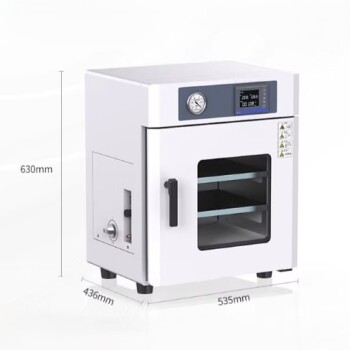
The vacuum oven serves as the critical final drying stage in the preparation of Fluorinated Helical Carbon Nanotube (F-HCNT) electrodes. Its primary function is to perform "deep drying," which involves the complete removal of residual processing solvents like N-Methyl-2-pyrrolidone (NMP) and any adsorbed moisture from the electrode coating. By operating under a vacuum, the oven facilitates rapid solvent evaporation at lower temperatures, preventing the oxidation of active materials and ensuring the structural stability required for accurate electrochemical testing.
The vacuum oven is indispensable because it eliminates trace contaminants—specifically moisture and organic solvents—that would otherwise trigger parasitic chemical reactions or physical delamination during battery cycling. It bridges the gap between a wet slurry coating and a stable, high-performance solid-state electrode.
Ensuring Chemical and Structural Stability
Complete Removal of Residual Solvents
During the coating process, solvents such as N-Methyl-2-pyrrolidone (NMP) are used to create a uniform slurry. The vacuum oven uses reduced pressure to lower the boiling point of these solvents, allowing them to evaporate completely from the electrode micropores without requiring excessive heat that might damage the nanotubes.
Eradication of Trace Moisture
Even minute amounts of adsorbed moisture can be catastrophic for high-performance batteries. In the presence of moisture, electrolyte salts like LiPF6 can hydrolyze into hydrofluoric acid (HF), which corrodes the internal components; the vacuum oven ensures the F-HCNT remains dry enough to prevent this degradation.
Prevention of Material Oxidation
F-HCNTs and current collectors can be sensitive to oxygen at elevated temperatures. The vacuum environment removes atmospheric oxygen, allowing for high-temperature drying (e.g., 100°C) without the risk of oxidizing the active carbon structures or the aluminum foil substrate.
Optimizing Physical Electrode Integrity
Enhancing Adhesion and Contact
As solvents evaporate, the vacuum oven facilitates the uniform migration of volatiles from the interior of the electrode to the surface. This controlled process prevents the electrode layer from cracking or peeling, ensuring tight electrochemical contact between the F-HCNT, conductive carbon black, and the PVDF binder.
Securing the Interface with Current Collectors
Proper vacuum drying ensures that the active material maintains strong adhesion to the current collector (such as aluminum foil or carbon felt). Without this thorough drying, residual solvent pockets can form, leading to "dead zones" in the electrode where electron transfer is inhibited.
Protecting the Lithium Anode
For electrodes intended for use with lithium metal anodes, the vacuum oven is a vital safety tool. Removing all traces of moisture prevents violent exothermic reactions between water and lithium during the battery assembly process.
Understanding the Trade-offs
Temperature vs. Structural Integrity
While higher temperatures accelerate drying, they can also cause the PVDF binder to migrate excessively or the F-HCNT functional groups to destabilize. Finding the "specific temperature" mentioned in the protocol is a delicate balance between processing speed and material performance.
Vacuum Depth and Processing Time
Achieving a "deep vacuum" requires more sophisticated equipment and longer wait times. However, cutting this time short often leaves latent solvents trapped in the lower layers of the coating, which leads to poor cycle life and premature battery failure.
Making the Right Choice for Your Project
How to Apply This to Your Electrode Preparation
- If your primary focus is Maximum Cycle Life: Prioritize an extended drying duration in the vacuum oven to ensure that HF-producing moisture is entirely eliminated from the F-HCNT pores.
- If your primary focus is Scalable Production: Optimize the vacuum level to lower the required temperature, which speeds up the evaporation of NMP while protecting the binder's distribution.
- If your primary focus is Material Research: Use the vacuum oven to ensure the stability of surface functional groups on the modified nanotubes by avoiding exposure to high-temperature air.
By meticulously controlling the vacuum drying environment, you ensure that the F-HCNT electrode transitions from a processed material into a reliable, high-performance electrochemical component.
Summary Table:
| Key Function | Mechanism | Impact on Electrode Quality |
|---|---|---|
| Solvent Removal | Lowers boiling point of NMP | Prevents micropore clogging and layer cracking |
| Moisture Eradication | Deep drying under vacuum | Eliminates HF formation and electrolyte degradation |
| Oxidation Prevention | Oxygen-free environment | Protects F-HCNT and current collector integrity |
| Adhesion Optimization | Controlled volatile migration | Ensures tight contact between active material and substrate |
| Safety Assurance | Complete drying | Prevents exothermic reactions with lithium anodes |
Elevate Your Battery Research Precision with KINTEK
Achieving high-performance F-HCNT electrodes requires absolute control over the drying environment. KINTEK specializes in advanced laboratory equipment designed to meet the rigorous demands of material science and energy storage research.
Our comprehensive range of vacuum ovens ensures precise temperature control and deep vacuum levels, preventing oxidation and ensuring the structural integrity of your nanotubes. Beyond drying, KINTEK offers a full suite of solutions to support your entire workflow:
- Synthesis & Treatment: High-temperature furnaces (CVD, PECVD, Muffle, and Tube) and high-pressure reactors.
- Preparation: Hydraulic pellet presses, crushing and milling systems, and high-purity crucibles.
- Electrochemical Testing: Specialized electrolytic cells, electrodes, and battery research consumables.
- Thermal Management: ULT freezers, freeze dryers, and recirculating chillers.
Don’t let trace moisture or residual solvents compromise your electrochemical data. Partner with KINTEK for reliable, high-quality laboratory solutions tailored to your specific research goals.
Contact a KINTEK Specialist Today to find the perfect vacuum oven and research tools for your lab!
References
- Gaobang Chen, Xian Jian. Helical fluorinated carbon nanotubes/iron(iii) fluoride hybrid with multilevel transportation channels and rich active sites for lithium/fluorinated carbon primary battery. DOI: 10.1515/ntrev-2023-0108
This article is also based on technical information from Kintek Solution Knowledge Base .
Related Products
- 23L Laboratory Vacuum Drying Oven
- 56L Vertical Laboratory Vacuum Drying Oven
- Vacuum Heat Treat Sintering Brazing Furnace
- 2200 ℃ Graphite Vacuum Heat Treat Furnace
- Dental Porcelain Zirconia Sintering Ceramic Vacuum Press Furnace
People Also Ask
- Why is a laboratory vacuum drying oven recommended for rice straw residues? Protect Your Biomass Integrity
- What role does a laboratory vacuum drying oven play in the preparation of modified multi-walled carbon nanotubes?
- What is the importance of using a laboratory vacuum drying oven? Preserving Slow-Release Microcapsule Integrity
- Why is a Laboratory Vacuum Drying Oven recommended for PBAT microspheres? Protect Sensitive Polymer Integrity
- What role does a laboratory vacuum drying oven play in processing nanoparticle powder samples? Protect Sample Integrity