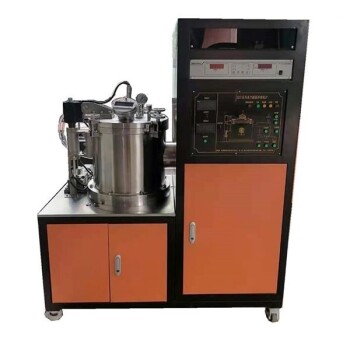
The primary function of a vacuum tube furnace in the preparation of lithiated transition metal dichalcogenides (TMDs) is to provide a sustained, high-temperature environment that drives lithium ions into the material's layered lattice. This process, known as intercalation, typically requires temperatures around 350 °C maintained for extended periods, such as 72 hours, to facilitate a phase transformation that significantly enhances electrical conductivity.
Core Takeaway: A vacuum tube furnace acts as a precision-controlled reactor that enables the intercalation of lithium ions, triggering a structural shift from the semiconducting 2H phase to the highly conductive metastable 1T' phase while maintaining material purity through a vacuum atmosphere.
Driving the Mechanism of Intercalation
Facilitating Ion Migration
The furnace provides the thermal energy necessary to overcome the van der Waals forces holding the TMD layers together. This energy allows lithium ions to penetrate the host lattice, filling the interstitial sites between layers.
Managing Extended Thermal Durations
Lithium intercalation is often a slow kinetic process that requires long-term, steady-state heating. The tube furnace ensures that the temperature remains constant over several days, which is critical for achieving a uniform distribution of lithium throughout the bulk material.
Inducing Phase Transformation
By maintaining specific thermal conditions, the furnace facilitates the partial transformation of the TMD from its native 2H phase (semiconducting) to the 1T' phase. This metastable phase is essential for applications requiring higher electron mobility and better catalytic performance.
The Role of Atmospheric and Vacuum Control
Preventing Oxidation and Impurities
Lithium is highly reactive and sensitive to oxygen and moisture. A high-vacuum environment within the furnace tube eliminates these contaminants, preventing the formation of lithium oxides or other impurities that would degrade the material's performance.
Establishing Kinetic Balance
The vacuum environment, combined with precise temperature control, ensures kinetic balance during the reaction. This stability is vital for preventing structural defects that can occur if the temperature fluctuates or if the chemical environment is inconsistent.
Controlling Vapor Pressure
In systems involving chalcogens (like sulfur or selenium), the furnace can be used to manage vapor pressure. This prevents the loss of volatile components from the TMD lattice during the high-temperature intercalation process.
Understanding the Trade-offs
Metastability and Structural Reversion
While the furnace helps create the desirable 1T' phase, this phase is inherently metastable. If the cooling process is not managed correctly or if the material is later exposed to high heat, it may revert to the less conductive 2H phase.
Precision vs. Throughput
Achieving high-quality lithiated TMDs requires a "slow and steady" approach, often occupying the furnace for 72 hours or more. This high degree of precision limits the volume of material that can be produced compared to faster, less-controlled heating methods.
Risk of Over-Intercalation
Excessive thermal energy or prolonged exposure can lead to over-intercalation, where too much lithium enters the lattice. This can cause the TMD structure to expand excessively or even collapse, destroying the two-dimensional properties of the material.
How to Apply This to Your Project
Making the Right Choice for Your Goal
- If your primary focus is Maximum Conductivity: Prioritize a furnace with high thermal stability to ensure the complete transformation to the 1T' phase without temperature dips.
- If your primary focus is Material Purity: Ensure your system is a high-vacuum tube furnace capable of reaching low-pressure states to completely eliminate oxygen and moisture.
- If your primary focus is Custom Stoichiometry: Utilize a dual-zone tube furnace to independently control the temperature of the lithium source and the TMD substrate.
By leveraging the precise temperature gradients and controlled atmospheres of a vacuum tube furnace, researchers can reliably engineer the electronic properties of transition metal dichalcogenides for next-generation electronics and energy storage.
Summary Table:
| Feature | Function in TMD Preparation | Impact on Material |
|---|---|---|
| High Temperature (~350°C) | Overcomes van der Waals forces | Enables lithium ion penetration into lattice |
| Vacuum Atmosphere | Eliminates oxygen and moisture | Prevents oxidation and ensures material purity |
| Extended Duration (72h+) | Maintains steady-state heating | Ensures uniform lithium distribution |
| Phase Control | Facilitates structural shift | Transforms 2H phase to conductive 1T' phase |
| Vapor Pressure Control | Manages volatile chalcogens | Prevents loss of sulfur or selenium components |
Elevate Your Advanced Material Synthesis with KINTEK
Precision is non-negotiable when engineering the next generation of semiconductors and energy storage materials. KINTEK specializes in providing high-performance laboratory equipment tailored for complex processes like TMD intercalation.
Whether you require high-temperature tube furnaces for precise phase transformations, CVD and PECVD systems for thin-film growth, or high-pressure reactors and autoclaves, our comprehensive portfolio is designed to meet the rigorous demands of modern research. We also offer essential consumables, including high-purity ceramics, crucibles, and PTFE products, ensuring your experiments remain uncontaminated and consistent.
Ready to optimize your lab's capabilities? Contact KINTEK today to consult with our experts and find the perfect heating and processing solutions for your specific research goals.
References
- Apostolos Panagiotopoulos, Cecilia Mattevi. 3D printed inks of two-dimensional semimetallic MoS<sub>2</sub>/TiS<sub>2</sub> nanosheets for conductive-additive-free symmetric supercapacitors. DOI: 10.1039/d3ta02508j
This article is also based on technical information from Kintek Solution Knowledge Base .
Related Products
- Vacuum Sealed Continuous Working Rotary Tube Furnace Rotating Tube Furnace
- Laboratory High Pressure Vacuum Tube Furnace
- Laboratory Vacuum Tilt Rotary Tube Furnace Rotating Tube Furnace
- Split Chamber CVD Tube Furnace with Vacuum Station Chemical Vapor Deposition System Equipment Machine
- 1200℃ Controlled Atmosphere Furnace Nitrogen Inert Atmosphere Furnace
People Also Ask
- What are the advantages of using a rotary tube furnace for MoVOx catalysts? Elevate Uniformity and Crystallinity
- What are the process advantages of using a rotary tube furnace for WS2 powder? Achieve Superior Material Crystallinity
- Why is a vacuum tube furnace with argon protection required for RGO/Cu? Ensure Conductivity and Material Purity
- Why is a rotary tube furnace preferred over a fixed tube furnace for the carbonization of asphaltenes? Superior Quality
- What is a rotary tube furnace? Achieve Superior Uniformity for Powders and Granules