The primary function of an electromagnetic stirring system is to provide continuous, uniform shear force through a non-contact driving mechanism within a sealed, high-pressure autoclave.
This system is designed to keep Ferrocolumbite powder in a constant state of suspension, ensuring that leaching reagents can penetrate mineral surfaces evenly. By eliminating physical contact through the pressure vessel wall, it maintains the integrity of the high-pressure environment while driving the reaction kinetics.
Core Takeaway By removing the need for mechanical seals, electromagnetic stirring eliminates critical variables like concentration gradients and localized overheating. This ensures the reproducibility of experimental data and guarantees the completeness of the leaching reaction.
The Mechanics of Non-Contact Agitation
Generating Uniform Shear Force
The system utilizes non-contact driving to transmit force into the sealed chamber.
This generates a continuous shear force that agitates the fluid without requiring a physical shaft to breach the pressure vessel. This is essential for maintaining high pressure safely.
Maintaining Suspension
The primary physical goal is to keep the Ferrocolumbite powder in a state of suspension.
If the powder settles, surface area exposure decreases. Continuous agitation prevents sedimentation, ensuring the solid particles remain distributed throughout the liquid phase.
Optimizing Reaction Kinetics
Eliminating Concentration Gradients
Static or poorly mixed solutions develop concentration gradients, where the reagent is depleted near the mineral surface.
The electromagnetic system provides efficient kinetic agitation that constantly refreshes the solution around the particles. This ensures the chemical potential remains uniform throughout the autoclave.
Preventing Thermal Anomalies
In high-pressure reactions, heat distribution is critical.
The stirring system eliminates localized overheating (hot spots). By circulating the fluid continuously, it ensures the temperature remains uniform, which is vital for consistent reaction rates.
Common Pitfalls to Avoid
The Risk of Inconsistent Data
Without the uniform shear force provided by this system, experimental data becomes unreliable.
The reference highlights that this specific type of agitation is what guarantees reproducibility. Failing to maintain suspension leads to variable reaction rates that cannot be replicated.
Incomplete Leaching Reactions
A major failure mode in autoclave dissolution is an incomplete reaction.
If the reagents cannot penetrate the mineral surfaces uniformly due to poor agitation, the completeness of the leaching reaction is compromised. The system is specifically engineered to ensure total reagent penetration.
Making the Right Choice for Your Process
Depending on your specific objectives for the Ferrocolumbite dissolution, the electromagnetic system addresses different critical needs.
- If your primary focus is Data Reliability: Reliance on this system provides the uniform conditions necessary to guarantee the reproducibility of your experimental data.
- If your primary focus is Process Efficiency: The system ensures complete leaching by maintaining suspension and preventing reaction-stalling concentration gradients.
Effective agitation is the bridge between a theoretical chemical reaction and a successful, reproducible industrial process.
Summary Table:
| Key Feature | Primary Function | Operational Benefit |
|---|---|---|
| Non-Contact Drive | Transmits force through sealed vessel walls | Maintains high-pressure integrity and safety |
| Uniform Shear Force | Keeps mineral powder in constant suspension | Maximizes surface area for even reagent penetration |
| Kinetic Agitation | Eliminates concentration gradients | Ensures consistent reaction rates and data reproducibility |
| Fluid Circulation | Prevents localized overheating (hot spots) | Guarantees thermal uniformity throughout the chamber |
Maximize Your Leaching Efficiency with KINTEK
Precise agitation is the difference between a failed reaction and reproducible success. KINTEK specializes in high-performance laboratory equipment, offering state-of-the-art high-temperature high-pressure reactors and autoclaves designed specifically for complex dissolution processes like Ferrocolumbite leaching.
Beyond reactors, we provide a comprehensive ecosystem for mineral and material research, including:
- Sample Preparation: Crushing and milling systems, sieving equipment, and hydraulic presses.
- Thermal Processing: Muffle, vacuum, and atmosphere furnaces.
- Lab Essentials: High-quality ceramics, crucibles, and PTFE consumables.
Whether you are scaling up industrial processes or conducting precision research, our expert solutions ensure the integrity of your high-pressure environments. Contact KINTEK today to find the perfect stirring and autoclave solution for your lab.
References
- Mario H. Rodriguez, Daniela S. Suarez. Effect of Na + ion on the dissolution of ferrocolumbite in autoclave. DOI: 10.1016/j.hydromet.2015.10.033
This article is also based on technical information from Kintek Solution Knowledge Base .
Related Products
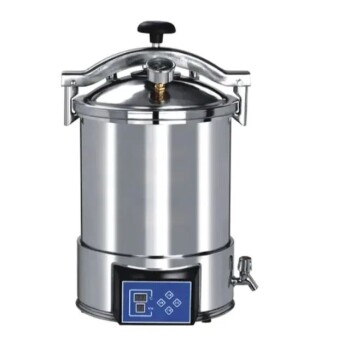
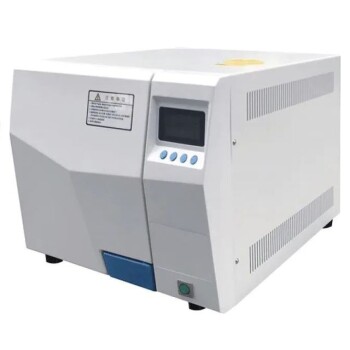
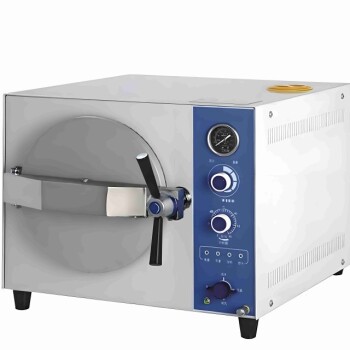
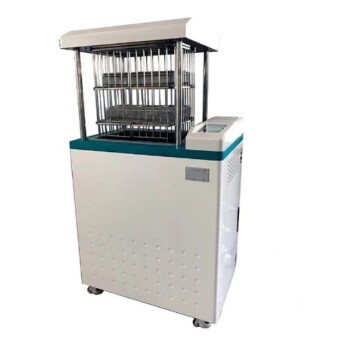
- Portable High Pressure Laboratory Autoclave Steam Sterilizer for Lab Use
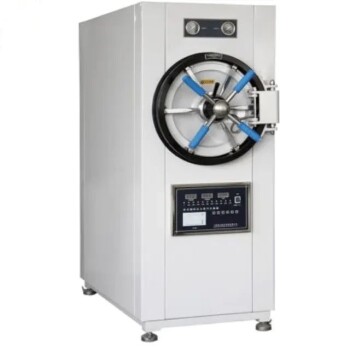
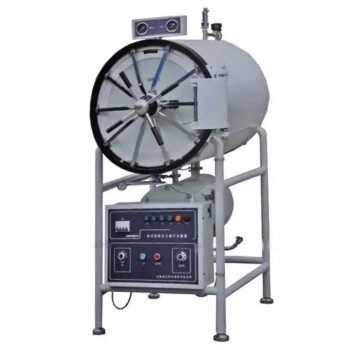
- Laboratory Horizontal Autoclave Steam Sterilizer Lab Microcomputer Sterilizer
- Desktop Fast High Pressure Laboratory Autoclave Sterilizer 16L 24L for Lab Use
- Portable Digital Display Automatic Laboratory Sterilizer Lab Autoclave for Sterilization Pressure
- Desktop Fast Laboratory Autoclave Sterilizer 35L 50L 90L for Lab Use
People Also Ask
- Why is a laboratory high-pressure autoclave sterilizer necessary? Ensure Accuracy in Antibacterial Research
- What is the role of a laboratory high-pressure autoclave in the conversion of furfural to piperidine? Optimize Yields
- What are the two types of autoclave used in the laboratory? Gravity vs. Pre-Vacuum Explained
- What precautions should be taken during autoclave in laboratory? A Complete Safety Guide to Prevent Burns and Explosions
- What extreme conditions does a laboratory autoclave simulate? Testing Wear Resistance of Nuclear Fuel Cladding