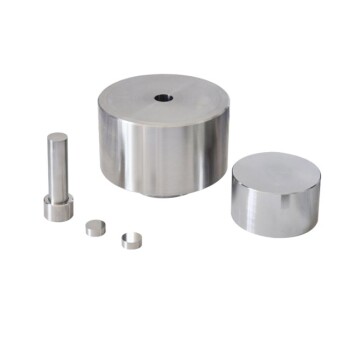
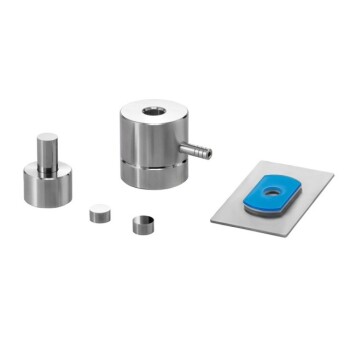
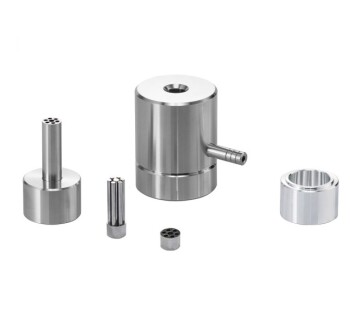
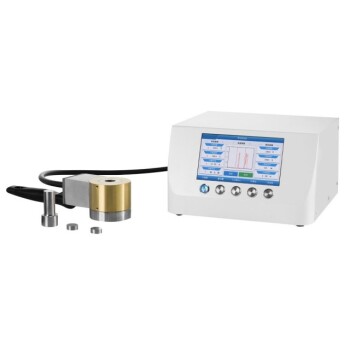
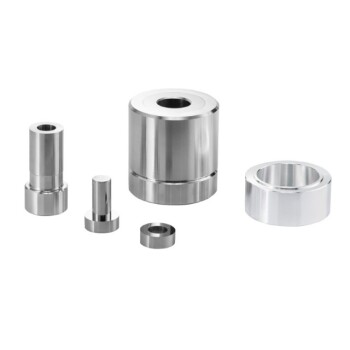
High-purity graphite molds serve a dual purpose as a thermal containment vessel and a mechanical pressure transmitter. In the specific context of vacuum hot press sintering for ZrC-SiC composites, these molds support the stacked green sheets at temperatures reaching 1650°C while simultaneously delivering the 20 MPa of uniaxial pressure necessary for densification.
The core value of high-purity graphite lies in its ability to maintain superior mechanical strength and thermal stability under extreme conditions. It ensures the layered ceramic structure achieves high density without deformation or containment failure during the critical sintering phase.
The Mechanics of Sintering ZrC-SiC
Thermal Stability and Containment
The primary function of the mold is to act as a robust container for the composite material.
For ZrC-SiC composites, the sintering process requires temperatures as high as 1650°C. The graphite mold must withstand this thermal load without melting, warping, or losing structural integrity.
It supports the "green sheets" (the stacked, pre-sintered layers), restricting lateral displacement and ensuring the final product retains its intended geometric dimensions.
Pressure Transmission and Densification
Beyond simple containment, the mold acts as the active medium for force application.
To achieve a dense, high-quality ceramic structure, a uniaxial pressure of 20 MPa is applied to the material. The graphite mold transmits this pressure from the hydraulic press directly to the powder or stacked sheets.
This mechanism forces particles into close contact within the restricted space, which is vital for determining the final densification level of the layered structure.
Why High-Purity Graphite is Essential
Superior High-Temperature Strength
Standard materials often lose strength as temperatures rise, but high-purity graphite retains excellent mechanical properties at sintering temperatures.
This characteristic allows the mold to endure the mechanical stress of the 20 MPa load without fracturing, even while heated to 1650°C.
Uniform Load Distribution
Graphite’s properties allow for the uniform distribution of axial pressure throughout the composite material.
By ensuring the entire plate receives uniform force, the mold prevents common defects such as local non-bonding, uneven thickness, or structural heterogeneity.
Understanding the Operational Constraints
Environmental Sensitivity
While chemically stable in a vacuum, graphite is highly sensitive to oxidation in air at elevated temperatures.
You must ensure that the vacuum environment is strictly maintained throughout the sintering process. Any breach in the vacuum could lead to rapid degradation of the mold and contamination of the ZrC-SiC composite.
Mechanical Limits
Although graphite is strong, it is brittle compared to metals.
While it effectively handles the compressive forces utilized in this process (20 MPa), care must be taken during handling and setup to avoid impact damage or tensile stresses that could crack the mold before sintering begins.
Making the Right Choice for Your Goal
To optimize your sintering process for ZrC-SiC composites, consider your specific objectives:
- If your primary focus is Dimensional Precision: Ensure your mold design tightly restricts lateral movement to define the exact geometry of the stacked sheets.
- If your primary focus is Maximum Density: Verify that the mold wall thickness is sufficient to transmit the full 20 MPa of pressure without elastic deformation.
By leveraging the thermal and mechanical stability of high-purity graphite, you ensure a sintered product that meets rigorous structural and densification standards.
Summary Table:
| Feature | Function in ZrC-SiC Sintering | Benefit |
|---|---|---|
| Thermal Stability | Withstands temperatures up to 1650°C | Prevents mold warping or melting during heating |
| Mechanical Strength | Transmits 20 MPa uniaxial pressure | Ensures high densification and particle contact |
| Dimensional Control | Restricts lateral displacement | Maintains precise geometry of stacked green sheets |
| Material Purity | Minimizes chemical contamination | Protects the integrity of the ceramic composite structure |
Elevate Your Advanced Ceramics Production with KINTEK
Precision in ZrC-SiC composite sintering requires high-performance equipment that can handle extreme thermal and mechanical loads. KINTEK specializes in high-quality laboratory solutions, providing the robust vacuum hot press systems, high-temperature furnaces, and precision-engineered graphite consumables necessary for superior material densification.
From high-pressure reactors and hydraulic pellet presses to specialized ceramics and crucibles, our comprehensive portfolio is designed to meet the rigorous standards of battery research and advanced material science.
Ready to optimize your sintering results? Contact KINTEK today for a customized consultation and discover how our expertise can drive your research forward.
Related Products
- 2200 ℃ Graphite Vacuum Heat Treat Furnace
- Ultra-High Temperature Graphite Vacuum Graphitization Furnace
- Vacuum Heat Treat and Molybdenum Wire Sintering Furnace for Vacuum Sintering
- Ball Press Mold for Lab
- Double Plate Heating Press Mold for Lab
People Also Ask
- What is the process of vacuum heat treating? Achieve Superior Hardening with a Clean, Bright Finish
- How does heat transmit in a vacuum? Mastering Thermal Radiation for Purity & Precision
- Why do you heat treat in a vacuum? Achieve Perfect Surface Finish and Material Integrity
- How does a vacuum heat treat furnace work? Achieve Pristine, Oxide-Free Metal Parts
- What is graphite heating? A Guide to Durable, High-Temp Industrial Furnace Solutions