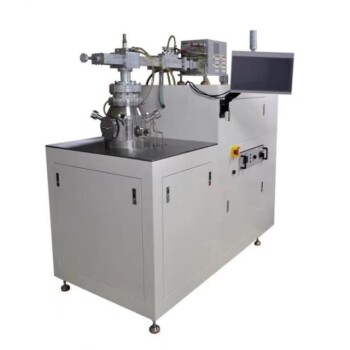
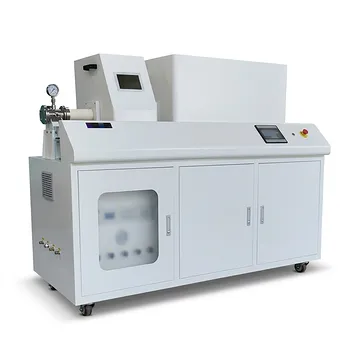
The primary function of the Chemical Vapor Deposition (CVD) system in this context is to act as a precision reactor for the in-situ growth of carbon nanotubes (CNTs) directly onto porous mullite ceramic substrates. It provides the necessary thermal energy and controlled gas environment to dissociate carbon source gases, such as methane, allowing them to reorganize on pre-loaded nickel catalysts.
Core Takeaway The CVD system does not merely coat the substrate; it fundamentally transforms the ceramic surface by engineering a randomly oriented CNT network. This process creates a composite structure with high three-dimensional open porosity, leveraging precise heat and gas flow to ensure the nanotubes grow directly from the substrate's catalytic sites.
The Mechanics of In-Situ Growth
Providing Critical Thermal Energy
The CVD system maintains a rigorous high-temperature reaction environment. This thermal energy is essential to drive the decomposition of precursor gases.
While general CVD processes can vary, high-temperature reactors often operate in ranges (e.g., 980–1020 °C) that ensure the chemical reactions necessary for crystallization occur efficiently.
Facilitating Catalyst Interaction
The process relies on the interaction between the gas phase and the solid phase. The system enables carbon atoms to dissociate from the source gas and physically reorganize.
This reorganization occurs specifically on pre-loaded nickel catalyst particles found on the mullite substrate. The CVD environment ensures these catalysts remain active to nucleate and grow the nanotubes.
Precise Gas Flow Management
Success depends on the accurate regulation of carbon source gases, such as methane (CH4). The system controls the flow rate to maintain the correct concentration of carbon available for reaction.
This management prevents the "starving" of the reaction or the oversaturation of the surface, which could lead to amorphous carbon buildup rather than structured nanotubes.
Structural Transformation of the Membrane
Creating a Random Network
Unlike simple thin-film deposition, the goal here is to construct a complex architecture. The CVD system facilitates the growth of a randomly oriented CNT network.
This orientation ensures that the nanotubes do not lie flat but extend outward or intertwine, creating a distinct physical structure on top of the ceramic.
Achieving High Open Porosity
The specific arrangement of the CNTs results in high three-dimensional open porosity. This is a critical functional attribute of the resulting composite membrane.
By controlling the growth parameters, the CVD system ensures that this porosity is preserved, avoiding a dense, impermeable layer that would defeat the purpose of a membrane.
Understanding the Trade-offs
Thermal Stress and Substrate Integrity
High-temperature processing provides the energy needed for high crystallinity and density, but it comes at a cost. Extreme heat can induce stress formation within the composite material.
There is also a risk of elements diffusing from the substrate into the film, or vice versa. In severe cases, the high thermal load required for CNT growth can lead to the degradation of the underlying mullite substrate.
Deposition Rate vs. Quality
CVD systems allow for the management of film thickness and growth rates by controlling power and time. Higher temperatures generally enhance the deposition rate.
However, prioritizing speed can compromise the uniformity of the CNT network. A balance must be struck to ensure the coating remains uniform, especially if the mullite substrate has a complex shape.
Making the Right Choice for Your Goal
To optimize the preparation of mullite-CNT composite membranes, focus on the specific parameter that aligns with your performance metrics.
- If your primary focus is membrane permeability: Prioritize gas flow precision to ensure the CNT network maintains high open porosity without becoming overly dense.
- If your primary focus is structural durability: Carefully regulate the temperature profile to maximize CNT crystallinity while minimizing thermal stress on the mullite substrate.
The CVD system is the bridge between a passive ceramic support and an active, high-performance nanocomposite.
Summary Table:
| Function | Mechanism | Impact on Membrane |
|---|---|---|
| Thermal Energy | High-temp decomposition of precursors | Drives CNT crystallization and growth |
| Gas Management | Precise regulation of CH4/Carbon sources | Prevents amorphous carbon buildup |
| Catalyst Interaction | Nickel-mediated surface reaction | Ensures in-situ growth from substrate |
| Structural Control | Random orientation of CNT network | Achieves high three-dimensional porosity |
Revolutionize Your Nanocomposite Research with KINTEK
Precision is the backbone of high-performance membrane preparation. KINTEK provides industry-leading Chemical Vapor Deposition (CVD, PECVD, and MPCVD) systems and high-temperature furnaces designed to give you absolute control over thermal energy and gas flow dynamics.
Whether you are growing CNTs on ceramic substrates or developing advanced thin films, our comprehensive portfolio—including high-temperature reactors, ceramic crucibles, and specialized cooling solutions—ensures your lab achieves maximum porosity and structural integrity every time.
Ready to optimize your in-situ growth process? Contact our laboratory specialists today to find the perfect equipment solution for your research goals.
References
- Li Zhu, Yingchao Dong. Ceramic-Based Composite Membrane with a Porous Network Surface Featuring a Highly Stable Flux for Drinking Water Purification. DOI: 10.3390/membranes9010005
This article is also based on technical information from Kintek Solution Knowledge Base .
Related Products
- Chemical Vapor Deposition CVD Equipment System Chamber Slide PECVD Tube Furnace with Liquid Gasifier PECVD Machine
- Microwave Plasma Chemical Vapor Deposition MPCVD Machine System Reactor for Lab and Diamond Growth
- 915MHz MPCVD Diamond Machine Microwave Plasma Chemical Vapor Deposition System Reactor
- Customer Made Versatile CVD Tube Furnace Chemical Vapor Deposition Chamber System Equipment
- HFCVD Machine System Equipment for Drawing Die Nano-Diamond Coating
People Also Ask
- What are the advantages of chemical vapor deposition? Achieve Superior Thin Films for Your Lab
- What types of substrates are used in CVD to facilitate graphene films? Optimize Graphene Growth with the Right Catalyst
- What is the chemical vapor deposition growth process? Build Superior Thin Films from the Atom Up
- How expensive is chemical vapor deposition? Understanding the True Cost of High-Performance Coating
- Why is Chemical Vapor Deposition (CVD) equipment uniquely suited for constructing hierarchical superhydrophobic structures?