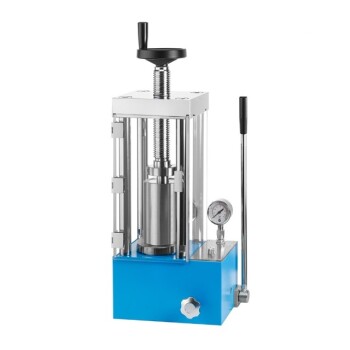
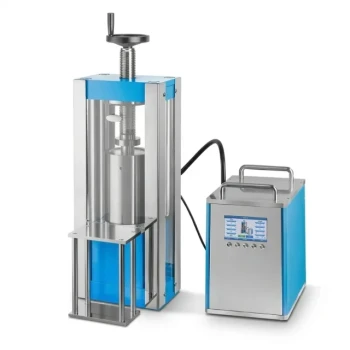
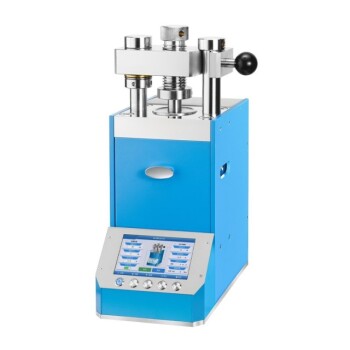
The primary function of cold pressing in this context is to mechanically integrate two distinct sulfide electrolyte powders into a single, cohesive dual-layer pellet. By applying high pressure, the laboratory hydraulic press eliminates physical gaps at the interface between the Li2S–GeSe2–P2S5 and Li2S–P2S5 layers. This fusion ensures continuous ion transport channels and provides the necessary mechanical strength for the composite to survive subsequent battery assembly.
The cold pressing process leverages the high ductility of sulfide materials to achieve full densification via plastic deformation. This creates a unified ionic pathway across different electrolyte layers without the need for high-temperature sintering, which could degrade the chemically sensitive materials.
The Mechanics of Layer Integration
Leveraging Material Ductility
Sulfide electrolytes differ significantly from oxide electrolytes due to their mechanical properties. They possess a relatively low Young's modulus (approximately 14-25 GPa) and high ductility.
When the hydraulic press applies axial pressure, these distinct powder layers do not just pack together; they undergo plastic deformation. This allows the particles to physically deform and mold into one another, creating a dense, unified structure.
Eliminating Interfacial Voids
The most critical role of the press is the removal of microscopic voids between the two different material layers.
In a dual-layer structure, any physical gap acts as a barrier to ion movement, drastically increasing impedance. Cold pressing compacts the materials to eliminate these gaps, establishing a continuous "highway" for lithium ions to travel from one layer to the next.
Ensuring Structural Integrity
Beyond electrochemical performance, the electrolyte layer acts as a physical separator in the battery.
The high-pressure molding process transforms loose powders into a solid pellet with sufficient mechanical strength. This ensures the dual-layer structure does not crack or delaminate during the handling required to assemble the full battery cell.
Why Cold Pressing is Preferred Over Sintering
Avoiding Thermal Degradation
Traditional ceramic processing often requires high-temperature sintering to fuse particles. However, sulfide electrolytes are chemically unstable at high temperatures and prone to undesirable phase transitions or side reactions.
Cold pressing achieves densification at room or moderate temperatures. This preserves the chemical integrity of the Li2S–GeSe2–P2S5 and Li2S–P2S5 phases while still achieving the necessary density.
Achieving High Relative Density
To function effectively, the solid electrolyte must achieve a relative density of over 90%.
The hydraulic press facilitates this by applying significant pressures, often ranging from 180 to 520 MPa. This intensity is required to minimize grain boundary impedance and maximize the ionic conductivity of the final pellet.
Understanding the Trade-offs
Pressure Requirements
While cold pressing avoids thermal damage, it relies entirely on mechanical force to close pores.
If the pressure applied is insufficient (below the plastic deformation threshold of the specific sulfide), voids will remain. These voids block ion transport and weaken the pellet, leading to poor battery performance.
Material Specificity
This method is highly specific to materials with high ductility, like sulfides.
Harder materials with high Young's moduli may not densify fully under cold pressing alone. Attempting to cold press brittle materials without additives often results in pellets with low density and poor mechanical stability.
Making the Right Choice for Your Goal
To maximize the efficacy of your dual-layer fabrication, consider your primary objectives:
- If your primary focus is Ion Transport Efficiency: Ensure your hydraulic press can deliver pressures upward of 360-520 MPa to maximize relative density and minimize grain boundary impedance.
- If your primary focus is Material Purity: Rely on the cold pressing capability to densify the layers at room temperature, strictly avoiding the phase changes associated with thermal sintering.
By utilizing the plastic deformation unique to sulfides, cold pressing transforms two separate powders into a single, high-performance electrolyte system.
Summary Table:
| Feature | Cold Pressing Impact on Dual-Layer Sulfides |
|---|---|
| Primary Function | Mechanical integration of powders into a cohesive pellet |
| Mechanism | Plastic deformation leveraging high ductility (Low Young's Modulus) |
| Interfacial Quality | Eliminates microscopic voids to ensure continuous ion transport |
| Structural Goal | Achieving >90% relative density and high mechanical strength |
| Pressure Range | Typically 180 MPa to 520 MPa for full densification |
| Thermal Advantage | Preserves chemical integrity by avoiding high-temperature sintering |
Elevate Your Material Research with KINTEK Precision
Achieving the perfect dual-layer electrolyte structure requires more than just pressure—it requires precision and reliability. KINTEK specializes in high-performance laboratory equipment designed for the most demanding research environments.
Whether you are fabricating advanced solid-state batteries or processing sensitive sulfide compounds, our comprehensive range of hydraulic presses (pellet, hot, and isostatic), crushing systems, and specialized consumables ensures your pellets reach maximum density without compromising material purity.
Our Value to You:
- High-Pressure Reliability: Achieve the 520 MPa+ thresholds necessary for full densification of sulfide electrolytes.
- Versatile Lab Solutions: From high-temperature high-pressure reactors to PTFE consumables and crucibles, we provide the tools for every stage of your workflow.
- Expert Support: Specialized equipment tailored for battery research, cooling solutions, and homogenizers.
Ready to optimize your lab’s throughput and material integrity? Contact KINTEK today to find the perfect hydraulic press for your application!
Related Products
- 30T 40T Split Automatic Heated Hydraulic Press Machine with Heated Plates for Laboratory Hot Press
- Laboratory Hydraulic Press Split Electric Lab Pellet Press
- Hydraulic Diaphragm Lab Filter Press for Laboratory Filtration
- Laboratory Hydraulic Press Lab Pellet Press Machine for Glove Box
- 24T 30T 60T Heated Hydraulic Press Machine with Heated Plates for Laboratory Hot Press
People Also Ask
- What are the advantages of using a laboratory hydraulic press for hot pressing? Achieve Peak Nano-Composite Density
- What are the core advantages of using a laboratory hot press to produce Bi2Se3? Achieve 93% Density & High Conductivity
- Why is a laboratory hydraulic hot press essential for high-density, additive-free Silicon Carbide? Unlock Pure SiC.
- How does a laboratory hydraulic hot press ensure the quality of PHBV/natural fiber composites? Expert Guide
- What is the function of a laboratory hydraulic hot press in the assembly of solid-state photoelectrochemical cells?