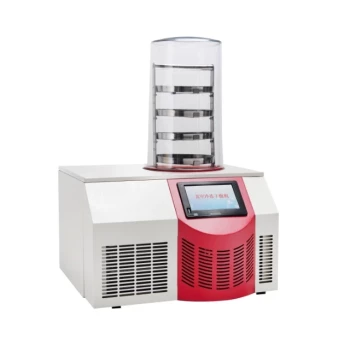
Knowledge What is the function of vacuum drying ovens for CNTs@S composites? Optimize Purity and Prevent Oxidation
Author avatar

Tech Team · Kintek Solution

Updated 4 days ago

What is the function of vacuum drying ovens for CNTs@S composites? Optimize Purity and Prevent Oxidation


The primary function of vacuum drying ovens in this context is to eliminate residual organic solvents while strictly preventing material oxidation. Specifically, these ovens operate at controlled temperatures (typically 60°C) to remove solvents like ethylenediamine used during the synthesis process. This ensures the final carbon nanotube-sulfur (CNTs@S) product retains the necessary purity for optimal electrochemical performance without compromising the structural integrity of the components.

Core Takeaway Vacuum drying performs a critical dual function: it ensures the complete removal of performance-degrading solvent residues through low-temperature evaporation, while simultaneously creating an oxygen-free environment that prevents the chemical degradation of nano-sulfur and carbon nanotubes.

The Critical Role of Solvent Removal

Eliminating Specific Organic Residues

The synthesis of CNTs@S composites often involves the use of organic solvents, particularly ethylenediamine.

If left in the final product, these residual solvents can severely hamper the material's electrochemical performance. Standard air drying is often insufficient to remove these stubborn residues completely.

Low-Temperature Evaporation

Vacuum drying lowers the boiling point of liquids. By applying a vacuum, the oven allows for the accelerated evaporation of ethylenediamine and other moisture.

This occurs at a relatively low temperature of 60°C. This is crucial because it allows for thorough drying without subjecting the composite to high thermal stress that could alter its properties.

Preserving Material Integrity via Atmosphere Control

Preventing Oxidation

Both nano-sulfur and carbon nanotubes are susceptible to chemical changes when exposed to heat in the presence of oxygen.

The vacuum environment removes air from the drying chamber. This effectively prevents the oxidation of the carbon nanotubes and the sulfur component during the heating process.

Maintaining Electrochemical Potential

By preventing oxidation, the vacuum drying process preserves the conductive network of the carbon nanotubes and the active nature of the sulfur.

This step is vital for ensuring the final composite functions correctly in battery applications, as oxidation would introduce impurities and increase internal resistance.

Understanding the Trade-offs

The Importance of Temperature Precision

While vacuum drying is effective, strict adherence to the 60°C temperature limit is essential for CNTs@S composites.

Exceeding this temperature, even under vacuum, could risk sublimating the sulfur or altering the composite structure. Conversely, lower temperatures may fail to fully evacuate the ethylenediamine residue.

Dependency on Vacuum Quality

The effectiveness of this process relies entirely on the quality of the vacuum seal.

A partial vacuum may reduce the boiling point slightly but will fail to prevent oxidation completely. For the process to work, the environment must be sufficiently void of oxygen to protect the nano-materials.

Making the Right Choice for Your Goal

To maximize the performance of your CNTs@S composites, apply these guidelines during post-treatment:

  • If your primary focus is Electrochemical Purity: Ensure the drying cycle is long enough to fully remove ethylenediamine, as any residue will degrade battery performance.
  • If your primary focus is Structural Integrity: Strictly monitor the temperature at 60°C to prevent thermal damage while relying on the vacuum to halt oxidation.

By controlling the atmosphere and temperature, you transform a fragile intermediate product into a stable, high-performance composite.

Summary Table:

Feature Function in CNTs@S Post-Treatment Benefit to Material
Vacuum Environment Eliminates oxygen and air from the chamber Prevents oxidation of nano-sulfur and nanotubes
Temperature Control Sustained drying at exactly 60°C Removes ethylenediamine without sublimating sulfur
Pressure Reduction Lowers the boiling point of solvents Facilitates rapid evaporation of residual chemicals
Atmosphere Control Creates a stable, oxygen-free drying zone Preserves electrochemical potential and conductivity

Elevate Your Nano-Material Synthesis with KINTEK Precision

Don't let residual solvents or oxidation compromise your battery research. KINTEK provides high-performance vacuum drying solutions and laboratory equipment tailored for sensitive chemical processes. Whether you are developing CNTs@S composites or advanced energy storage materials, our comprehensive range of products—including vacuum ovens, high-temperature reactors, and planetary ball mills—ensures the purity and structural integrity your research demands.

Why choose KINTEK?

  • Precision-engineered thermal and vacuum control for delicate nano-materials.
  • Full support for battery research with electrolytic cells, electrodes, and consumables.
  • Expert-grade equipment designed to maximize electrochemical performance.

Contact KINTEK Today to Optimize Your Lab Workflow

Related Products

People Also Ask

Related Products

Vacuum Heat Treat Sintering Brazing Furnace

Vacuum Heat Treat Sintering Brazing Furnace

A vacuum brazing furnace is a type of industrial furnace used for brazing, a metalworking process that joins two pieces of metal using a filler metal that melts at a lower temperature than the base metals. Vacuum brazing furnaces are typically used for high-quality applications where a strong, clean joint is required.

Vacuum Dental Porcelain Sintering Furnace

Vacuum Dental Porcelain Sintering Furnace

Get precise and reliable results with KinTek's Vacuum Porcelain Furnace. Suitable for all porcelain powders, it features hyperbolic ceramic furnace function, voice prompt, and automatic temperature calibration.

Vacuum Heat Treat and Molybdenum Wire Sintering Furnace for Vacuum Sintering

Vacuum Heat Treat and Molybdenum Wire Sintering Furnace for Vacuum Sintering

A vacuum molybdenum wire sintering furnace is a vertical or bedroom structure, which is suitable for withdrawal, brazing, sintering and degassing of metal materials under high vacuum and high temperature conditions. It is also suitable for dehydroxylation treatment of quartz materials.

2200 ℃ Tungsten Vacuum Heat Treat and Sintering Furnace

2200 ℃ Tungsten Vacuum Heat Treat and Sintering Furnace

Experience the ultimate refractory metal furnace with our Tungsten vacuum furnace. Capable of reaching 2200℃, perfect for sintering advanced ceramics and refractory metals. Order now for high-quality results.

Horizontal High Temperature Graphite Vacuum Graphitization Furnace

Horizontal High Temperature Graphite Vacuum Graphitization Furnace

Horizontal Graphitization Furnace: This type of furnace is designed with the heating elements placed horizontally, allowing for uniform heating of the sample. It's well-suited for graphitizing large or bulky samples that require precise temperature control and uniformity.

Vacuum Heat Treat and Sintering Furnace with 9MPa Air Pressure

Vacuum Heat Treat and Sintering Furnace with 9MPa Air Pressure

The air pressure sintering furnace is a high-tech equipment commonly used for the sintering of advanced ceramic materials. It combines vacuum sintering and pressure sintering techniques to achieve high-density and high-strength ceramics.

1800℃ Muffle Oven Furnace for Laboratory

1800℃ Muffle Oven Furnace for Laboratory

KT-18 muffle furnace with Japan Al2O3 polycrystalline fibe and Silicon Molybdenum heating element, up to 1900℃, PID temperature control and 7" smart touch screen. Compact design, low heat loss, and high energy efficiency. Safety interlock system and versatile functions.

Non Consumable Vacuum Arc Induction Melting Furnace

Non Consumable Vacuum Arc Induction Melting Furnace

Explore the benefits of Non-Consumable Vacuum Arc Furnace with high melting point electrodes. Small, easy to operate & eco-friendly. Ideal for laboratory research on refractory metals & carbides.

Vertical High Temperature Graphite Vacuum Graphitization Furnace

Vertical High Temperature Graphite Vacuum Graphitization Furnace

Vertical high temperature graphitization furnace for carbonization and graphitization of carbon materials up to 3100℃.Suitable for shaped graphitization of carbon fiber filaments and other materials sintered in a carbon environment.Applications in metallurgy, electronics, and aerospace for producing high-quality graphite products like electrodes and crucibles.

Ultra-High Temperature Graphite Vacuum Graphitization Furnace

Ultra-High Temperature Graphite Vacuum Graphitization Furnace

The ultra-high temperature graphitization furnace utilizes medium frequency induction heating in a vacuum or inert gas environment. The induction coil generates an alternating magnetic field, inducing eddy currents in the graphite crucible, which heats up and radiates heat to the workpiece, bringing it to the desired temperature. This furnace is primarily used for graphitization and sintering of carbon materials, carbon fiber materials, and other composite materials.

1400℃ Muffle Oven Furnace for Laboratory

1400℃ Muffle Oven Furnace for Laboratory

Get precise high-temperature control up to 1500℃ with KT-14M Muffle furnace. Equipped with a smart touch screen controller and advanced insulation materials.

1700℃ Muffle Oven Furnace for Laboratory

1700℃ Muffle Oven Furnace for Laboratory

Get superior heat control with our 1700℃ Muffle Furnace. Equipped with intelligent temperature microprocessor, TFT touch screen controller & advanced insulation materials for precise heating up to 1700C. Order now!

1200℃ Controlled Atmosphere Furnace Nitrogen Inert Atmosphere Furnace

1200℃ Controlled Atmosphere Furnace Nitrogen Inert Atmosphere Furnace

Discover our KT-12A Pro Controlled atmosphere furnace - high precision, heavy duty vacuum chamber, versatile smart touch screen controller, and excellent temperature uniformity up to 1200C. Ideal for both laboratory and industrial application.

Vacuum Hot Press Furnace Heated Vacuum Press Machine Tube Furnace

Vacuum Hot Press Furnace Heated Vacuum Press Machine Tube Furnace

Reduce forming pressure & shorten sintering time with Vacuum Tube Hot Press Furnace for high-density, fine-grain materials. Ideal for refractory metals.

1400℃ Controlled Atmosphere Furnace with Nitrogen and Inert Atmosphere

1400℃ Controlled Atmosphere Furnace with Nitrogen and Inert Atmosphere

Achieve precise heat treatment with KT-14A controlled atmosphere furnace. Vacuum sealed with a smart controller, it's ideal for lab and industrial use up to 1400℃.

Vacuum Heat Treat Furnace and Levitation Induction Melting Furnace

Vacuum Heat Treat Furnace and Levitation Induction Melting Furnace

Experience precise melting with our Vacuum Levitation Melting Furnace. Ideal for high melting point metals or alloys, with advanced technology for effective smelting. Order now for high-quality results.

Dental Porcelain Zirconia Sintering Ceramic Vacuum Press Furnace

Dental Porcelain Zirconia Sintering Ceramic Vacuum Press Furnace

Get precise dental results with Dental Vacuum Press Furnace. Automatic temperature calibration, low noise tray, and touch screen operation. Order now!

600T Vacuum Induction Hot Press Furnace for Heat Treat and Sintering

600T Vacuum Induction Hot Press Furnace for Heat Treat and Sintering

Discover the 600T Vacuum Induction Hot Press Furnace, designed for high-temperature sintering experiments in vacuum or protected atmospheres. Its precise temperature and pressure control, adjustable working pressure, and advanced safety features make it ideal for nonmetal materials, carbon composites, ceramics, and metal powders.

Vacuum Hot Press Furnace Machine Heated Vacuum Press

Vacuum Hot Press Furnace Machine Heated Vacuum Press

Discover the advantages of Vacuum Hot Press Furnace! Manufacture dense refractory metals & compounds, ceramics, and composites under high temp and pressure.

Touchscreen Automatic Vacuum Heat Press

Touchscreen Automatic Vacuum Heat Press

Precision vacuum heat press for labs: 800°C, 5-ton pressure, 0.1MPa vacuum. Ideal for composites, solar cells, aerospace.


Leave Your Message