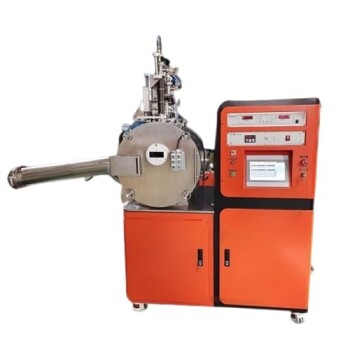
Vacuum induction melting (VIM) or precision casting equipment functions as the primary mechanism for melting and forming Ni–20Cr–5Al alloy rods with exacting chemical precision. By executing the melt within a controlled environment, this equipment guarantees the uniform distribution of elemental components while simultaneously preventing contamination, resulting in a raw material suitable for rigorous performance testing.
Core Takeaway The value of this equipment lies in its ability to isolate the alloy from environmental contamination during the molten state. It produces a chemically homogenous and structurally uniform material, ensuring that future test results reflect the alloy's true properties rather than manufacturing defects.
Ensuring Compositional Integrity
Precise Component Distribution
The primary function of this equipment is to melt Nickel (Ni), Chromium (Cr), and Aluminum (Al) into alloy rods with specific nominal compositions.
Crucially, the equipment ensures that these elements are distributed uniformly throughout the matrix. This prevents localized concentrations of any single element, which could compromise the material's mechanical behavior.
Microstructural Consistency
Beyond simple mixing, precision casting delivers a raw material with a uniform microstructure.
This consistency is a prerequisite for accurate scientific analysis. It provides a reliable baseline, ensuring that any variations observed during subsequent testing are due to experimental conditions, not inconsistencies in the rod's formation.
The Critical Role of the Vacuum Environment
Preventing Oxidation of Active Elements
Aluminum and Chromium are highly active elements that readily react with oxygen at high temperatures.
The vacuum induction furnace creates a high-vacuum environment (typically less than 100 Pa). This effectively shields these active components from oxidation, preserving the intended alloy chemistry.
Elimination of Impurities
The vacuum process does more than just shield the melt; it actively purifies it.
It reduces interstitial gases such as Oxygen (O2), Nitrogen (N2), and Hydrogen (H2) and facilitates the removal of non-metallic inclusions. Additionally, it helps eliminate harmful low-melting-point metal impurities like Lead (Pb) and Copper (Cu).
Understanding the Operational Constraints
The Necessity of Strict Vacuum Control
The benefits of VIM are entirely dependent on the integrity of the vacuum seal.
To achieve the desired purity, the environment must typically be maintained at pressures below 100 Pa. Any breach in this vacuum allows for immediate oxidation, negating the advantages of the precision equipment.
The Cost of Purity
While this method produces superior alloys, it is a complex and energy-intensive process compared to air melting.
It is specifically designed for high-stakes applications where the presence of even trace impurities or oxides would result in catastrophic failure or skewed data.
Making the Right Choice for Your Goal
To maximize the utility of Ni–20Cr–5Al model alloys, align your processing method with your specific research or application needs:
- If your primary focus is fundamental research: Use VIM to ensure high chemical purity, which is essential for studying the intrinsic effects of radiation damage or material degradation.
- If your primary focus is high-temperature performance: Rely on vacuum processing to minimize interstitial elements, which can significantly raise the alloy's maximum operating temperature (potentially from ~800°C to over 1000°C).
Precision in the melting phase is the single most critical factor in guaranteeing the reliability of high-performance alloy data.
Summary Table:
| Feature | Function in Ni–20Cr–5Al Preparation | Benefit to Material Performance |
|---|---|---|
| Vacuum Environment | Eliminates oxygen, nitrogen, and hydrogen | Prevents oxidation of active Al and Cr elements |
| Induction Melting | Ensures uniform distribution of Ni, Cr, and Al | Provides microstructural and compositional consistency |
| Impurity Removal | Facilitates removal of low-melting-point metals (Pb, Cu) | Enhances reliability for high-temperature testing |
| Controlled Casting | Precision forming of alloy rods | Eliminates manufacturing defects for accurate data |
Elevate Your Material Research with KINTEK Precision
Ensure the integrity of your high-performance alloys with KINTEK’s industry-leading laboratory solutions. From advanced vacuum induction melting furnaces and induction melting systems to specialized high-temperature furnaces (vacuum, CVD, atmosphere) and crushing and milling equipment, we provide the tools necessary for exacting chemical precision.
Whether you are conducting fundamental research on radiation damage or testing high-temperature durability, KINTEK empowers your lab with superior microstructural consistency and contamination-free processing. Contact us today to find the perfect equipment for your alloy preparation and see how our comprehensive range of consumables—including ceramics, crucibles, and high-pressure reactors—can support your most demanding applications.
References
- Xiao Huang, D. Guzonas. Characterization of Ni–20Cr–5Al model alloy in supercritical water. DOI: 10.1016/j.jnucmat.2013.11.011
This article is also based on technical information from Kintek Solution Knowledge Base .
Related Products
- Lab-Scale Vacuum Induction Melting Furnace
- Vacuum Induction Melting Spinning System Arc Melting Furnace
- Vacuum Arc Induction Melting Furnace
- Non Consumable Vacuum Arc Induction Melting Furnace
- Vacuum Heat Treat Furnace and Levitation Induction Melting Furnace
People Also Ask
- How do vacuum induction or arc melting furnaces facilitate the synthesis of U-Al-C MAX phases? Precision Heat & Purity
- What is the primary function of a vacuum induction melting furnace in Ni-Mo-Cr-Fe master alloy prep? Ensure High Purity
- What types of metals are typically processed in a vacuum induction melting furnace? High-Purity Alloys for Critical Applications
- Why use VIM for rare earth steel? Essential Precision for Melting Reactive Lanthanum and Cerium
- What is the function of a vacuum induction melting furnace? Essential Guide for High-Purity FeCrAl Alloy Production