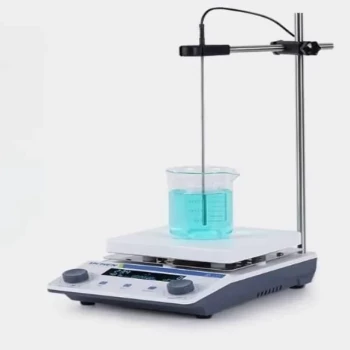
A magnetic stirrer serves as the critical driver of forced convection in electrochemical systems, ensuring the process is not limited by slow natural diffusion. By rotating a stir bar at high speeds, it guarantees that acrylic acid molecules are rapidly and continuously transported to the electrode surface for effective oxidation.
Core Takeaway In electrochemical degradation, the reaction rate is often bottlenecked by how quickly pollutants reach the anode. A magnetic stirrer overcomes this diffusion limit by creating a homogeneous mixture, ensuring reactants contact the electrode efficiently while dispersing active oxidants like chlorine to prevent unwanted side reactions.
The Mechanics of Enhanced Degradation
Driving Mass Transfer Efficiency
The primary function of the magnetic stirrer is to induce forced convection. Without this mechanical agitation, acrylic acid molecules would rely on passive diffusion to move through the electrolyte, a process that is far too slow for efficient degradation. The stirrer ensures that the bulk solution flows rapidly toward the electrode interface, significantly shortening the time required for organic pollutants to reach the oxidation sites.
Minimizing the Diffusion Layer
In a stagnant solution, a thick "diffusion layer" forms around the electrode, acting as a barrier to the reaction. Continuous mixing provided by the magnetic stirrer drastically reduces the thickness of this layer. This accelerates the transport of reaction products away from the electrode and allows fresh reactants to take their place immediately, improving the overall reaction kinetics.
Eliminating Concentration Polarization
Effective stirring prevents concentration polarization, a phenomenon where reactants are depleted at the electrode surface while remaining abundant in the rest of the solution. By keeping the electrolyte homogenized, the stirrer ensures that the concentration of acrylic acid at the electrode surface remains high. This creates a uniform environment that maximizes the contact between the pollutant and the active radicals produced at the anode.
Regulating Chemical Interactions
Preventing Localized Over-Concentration
During electrochemical processes, powerful oxidants such as active chlorine are generated. Without adequate stirring, these species can build up in localized "hot spots" near the electrode. The magnetic stirrer disperses these active species throughout the solution, preventing localized over-concentration which can lead to inefficient reactant usage.
Reducing Undesirable Side Reactions
By maintaining a uniform distribution of active chlorine and other radicals, the stirrer helps direct the chemical energy toward the target pollutant. This dispersion reduces undesirable side reactions that occur when oxidants react with themselves or other non-target species due to high local density. Consequently, this focus on the target pollutant accelerates the overall degradation rate of the acrylic acid.
Understanding the Trade-offs
The Risk of Inconsistent Hydrodynamics
While high-speed stirring is beneficial, the physical stability of the setup is paramount. If the stirring becomes inconsistent or the bar decouples, the system immediately reverts to a diffusion-limited state. This sudden shift allows concentration gradients to re-establish, leading to unreliable data and a sharp drop in degradation efficiency.
Impact on Sensor Accuracy
Homogeneity is not just for the reaction; it is vital for monitoring. If the solution is not mixed thoroughly, sensors (such as pH meters) may measure a local pocket of solution that does not represent the whole. Kinetic uniformity ensures that any data collected reflects the true state of the entire reactor volume.
Optimizing Your Electrochemical Setup
To maximize the degradation of acrylic acid, align your stirring strategy with your specific experimental goals:
- If your primary focus is reaction speed: Maintain high RPMs to minimize the diffusion layer and maximize the contact frequency between acrylic acid and the electrode.
- If your primary focus is selectivity: Ensure consistent, moderate mixing to disperse active chlorine rapidly, reducing the probability of parasitic side reactions.
Ultimately, the magnetic stirrer transforms the reactor from a passive vessel into a dynamic system, bridging the gap between reactant generation and pollutant destruction.
Summary Table:
| Feature | Impact on Electrochemical Degradation | Benefit for Acrylic Acid Removal |
|---|---|---|
| Mass Transfer | Replaces passive diffusion with forced convection | Rapidly moves pollutants to the electrode surface |
| Boundary Layer | Significantly reduces diffusion layer thickness | Accelerates reaction kinetics and product removal |
| Homogeneity | Eliminates concentration polarization | Maintains high reactant density at oxidation sites |
| Oxidant Dispersion | Prevents localized over-concentration | Reduces side reactions and improves oxidant efficiency |
Maximize Your Electrochemical Efficiency with KINTEK
Precise control over your reaction kinetics starts with the right equipment. KINTEK specializes in high-performance laboratory solutions, providing the advanced electrolytic cells, electrodes, and magnetic stirring systems essential for efficient acrylic acid degradation.
Whether you are optimizing wastewater treatment or advancing battery research, our comprehensive portfolio—including high-temperature reactors, ultrasonic homogenizers, and precision-engineered consumables—is designed to meet the rigorous demands of modern electrochemistry.
Ready to scale your research or optimize your lab processes? Contact our technical experts today to discover how KINTEK’s specialized equipment can enhance your reaction selectivity and degradation rates.
References
- Jinrui Liu, Xuan Zhang. Electrochemical degradation of acrylic acid using Ti/Ta<sub>2</sub>O<sub>5</sub>–IrO<sub>2</sub> electrode. DOI: 10.1039/d3ra01997g
This article is also based on technical information from Kintek Solution Knowledge Base .
Related Products
- Laboratory Small Constant Temperature Heated Magnetic Stirrer Heater and Stirrer
- Custom PTFE Teflon Parts Manufacturer for Magnetic Stirring Bar
- High Performance Laboratory Stirrers for Diverse Applications
- Three-dimensional electromagnetic sieving instrument
- Custom PTFE Teflon Parts Manufacturer for PTFE Stirring Bar Recovery Rod
People Also Ask
- What role does a magnetic stirrer with heating play in ZnO nanoparticle synthesis? Precision Control for Quality Results
- What role does a constant temperature heating magnetic stirrer play in MFC-HAp synthesis? Achieve Material Homogeneity
- What is the function of a laboratory magnetic stirrer in Ni–Cr–P electrodeposition? Optimize Ion Transport & Coating
- Why is a laboratory magnetic stirrer required for benzoic acid esters? Boost Reaction Speed & Yield with High RPM
- What role does a laboratory magnetic stirrer play in TiO2 and TiO2-Ag sol preparation? Master Chemical Kinetics