Knowledge Resources What is the most common source of heat used for brazing? Torch Brazing Explained for Optimal Joints
Author avatar

Tech Team · Kintek Solution

Updated 2 months ago

What is the most common source of heat used for brazing? Torch Brazing Explained for Optimal Joints


By far the most common source of heat for brazing is a gas-fueled torch. Its versatility, relatively low equipment cost, and portability make it the standard for manual operations, repair work, and low-to-medium volume production across countless industries.

The central challenge in brazing is not merely reaching a target temperature, but applying heat uniformly and controllably. While a torch is the most widespread tool, the ideal heating method is ultimately dictated by your production volume, joint complexity, and required precision.
What is the most common source of heat used for brazing? Torch Brazing Explained for Optimal Joints

Why the Heat Source is Critical

The success of a brazed joint depends entirely on the filler metal flowing evenly throughout the joint via capillary action. This can only happen if the entire joint area on the base metals is heated uniformly to the correct brazing temperature.

The Role of Uniform Heating

If one part of the joint is too cool, the filler metal will not flow into that area, creating voids and a weak bond. If another area is overheated, it can damage the base metals or burn away the flux, leading to oxidation and a failed joint.

Matching the Method to the Application

The choice of heat source directly impacts the quality of the joint, the speed of the operation, the level of operator skill required, and the overall cost. Selecting the wrong method leads to inefficiency and inconsistent results.

A Breakdown of Brazing Heat Sources

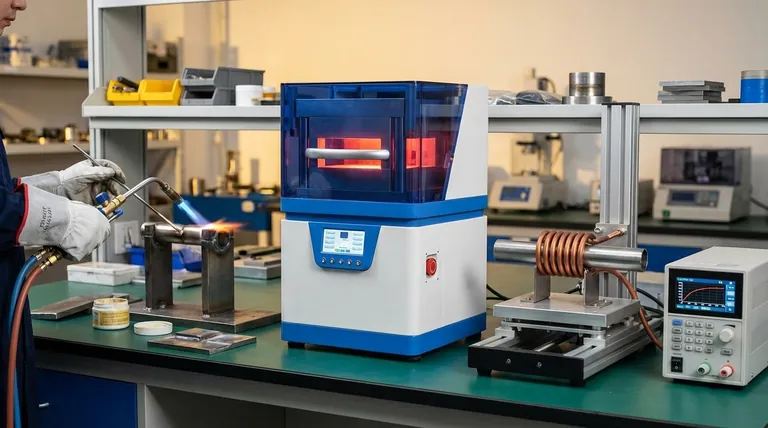
While torch brazing is most common, several other methods are used for specific industrial applications, each with distinct advantages.

Torch Brazing: The Versatile Standard

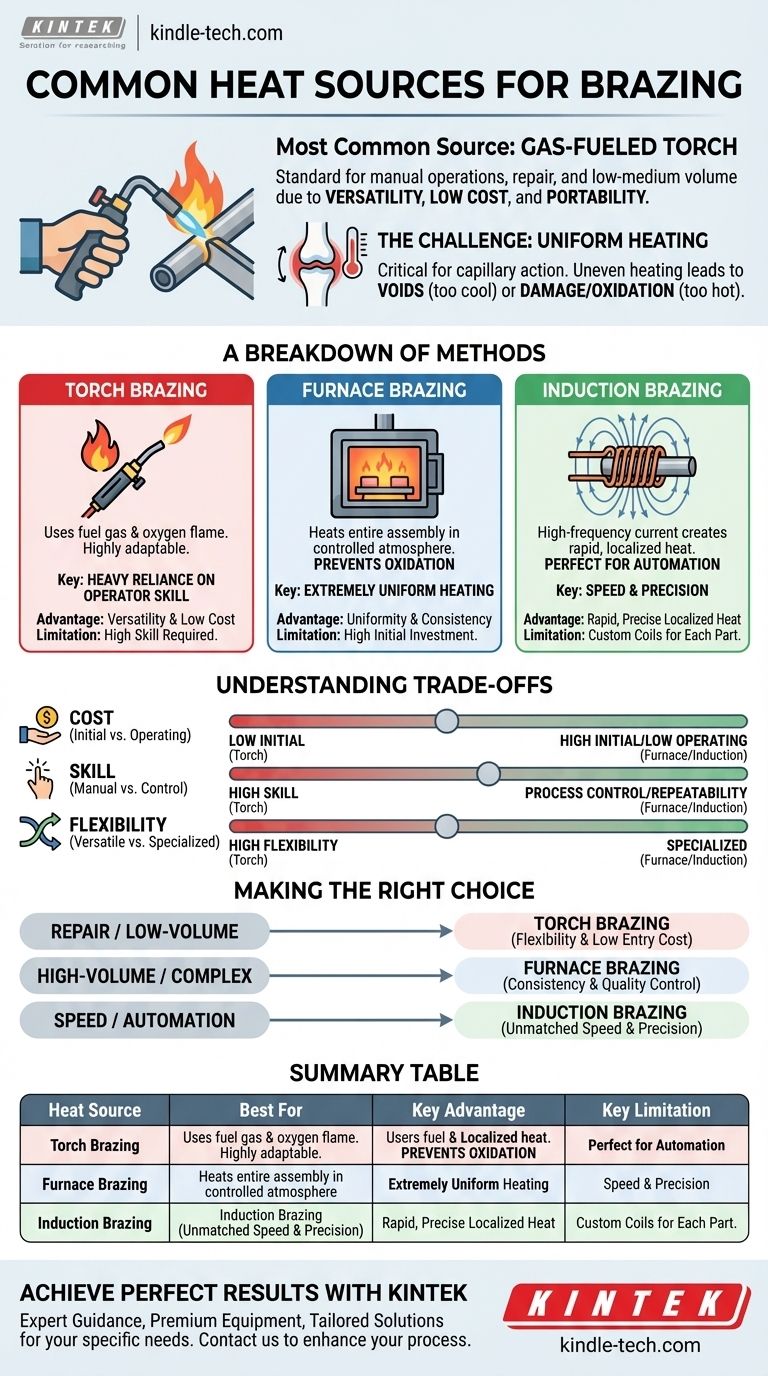
This method uses a flame from the combustion of a fuel gas (like acetylene, propane, or natural gas) with oxygen or air. It is highly adaptable and can be used on parts of almost any size or configuration.

The primary drawback of manual torch brazing is its heavy reliance on operator skill. The quality of the joint is directly determined by the operator's ability to apply heat evenly and recognize the visual cues of proper temperature.

Furnace Brazing: For High-Volume Precision

In furnace brazing, the entire assembly (with filler metal pre-placed) is heated in a furnace with a controlled atmosphere. This atmosphere is typically inert or reducing, which prevents oxidation and often eliminates the need for flux.

This method ensures extremely uniform heating, making it ideal for complex assemblies and high-volume production runs. Every part in a batch receives the exact same thermal cycle, resulting in exceptional consistency.

Induction Brazing: Speed and Automation

Induction heating uses a high-frequency alternating current passed through a copper coil. This creates an electromagnetic field that induces current within the metal part, generating precise, localized heat very rapidly.

Because it is so fast and controllable, induction brazing is perfectly suited for automation and integration into production lines. The main considerations are the initial equipment cost and the need to design custom coils for each specific joint geometry.

Understanding the Trade-offs

Choosing a heat source involves balancing four key factors: cost, volume, precision, and the required skill level.

Initial Investment vs. Operating Cost

Torch systems have a very low initial cost, making them accessible to virtually any shop. Furnace and induction systems require a significant capital investment but can offer a lower cost-per-part in high-volume scenarios.

Operator Skill vs. Process Control

Manual torch brazing demands a highly skilled operator to achieve consistent results. In contrast, furnace and induction brazing remove most of the human variable, embedding the "skill" into the machine's programming for unparalleled repeatability.

Flexibility vs. Specialization

A torch can be used on an infinite variety of parts with minimal setup. Induction coils are custom-designed for a specific part, and furnaces are best suited for batch processing parts of a similar size, making them less flexible for one-off jobs.

Making the Right Choice for Your Application

Your choice of heating method should be a direct reflection of your project's goals.

  • If your primary focus is repair, prototyping, or low-volume work: Torch brazing offers the best combination of flexibility and low entry cost.
  • If your primary focus is high-volume production with complex joints: Furnace brazing provides the highest level of consistency and quality control.
  • If your primary focus is speed and automation in a mass-production line: Induction brazing delivers unmatched speed and precise, repeatable heating.

Ultimately, selecting the correct heat source is the first step toward creating a strong, reliable, and cost-effective brazed joint.

Summary Table:

Heat Source Best For Key Advantage Key Limitation
Torch Brazing Repair, Low-Volume, Prototyping Versatility & Low Cost High Operator Skill Required
Furnace Brazing High-Volume, Complex Assemblies Uniform Heating & Consistency High Initial Investment
Induction Brazing Automated, High-Speed Production Rapid, Precise Localized Heat Custom Coils for Each Part

Achieve Perfect Brazing Results with KINTEK

Struggling to choose the right brazing method for your laboratory or production needs? The quality of your brazed joints depends heavily on precise, uniform heating. At KINTEK, we specialize in providing the ideal lab equipment and consumables to meet your specific brazing requirements.

Why choose KINTEK for your brazing solutions?

  • Expert Guidance: Our specialists help you select the perfect heating method—whether you need the flexibility of torch systems, the consistency of furnace brazing, or the speed of induction heating.
  • Premium Equipment: We supply reliable, high-performance brazing systems designed for durability and precision.
  • Tailored Solutions: From small-scale R&D to high-volume production, we provide equipment that matches your volume, complexity, and precision needs.

Ready to enhance your brazing process? Contact us today via our Contact Form to discuss your project and discover how KINTEK's solutions can deliver stronger, more reliable joints for your laboratory or production line.

Visual Guide
What is the most common source of heat used for brazing? Torch Brazing Explained for Optimal Joints Visual Guide

Related Products

People Also Ask

Related Products

Vacuum Heat Treat Sintering Brazing Furnace

Vacuum Heat Treat Sintering Brazing Furnace

A vacuum brazing furnace is a type of industrial furnace used for brazing, a metalworking process that joins two pieces of metal using a filler metal that melts at a lower temperature than the base metals. Vacuum brazing furnaces are typically used for high-quality applications where a strong, clean joint is required.

High Temperature Muffle Oven Furnace for Laboratory Debinding and Pre Sintering

High Temperature Muffle Oven Furnace for Laboratory Debinding and Pre Sintering

KT-MD High temperature debinding and pre-sintering furnace for ceramic materials with various molding processes. Ideal for electronic components such as MLCC and NFC.

Ultra-High Temperature Graphite Vacuum Graphitization Furnace

Ultra-High Temperature Graphite Vacuum Graphitization Furnace

The ultra-high temperature graphitization furnace utilizes medium frequency induction heating in a vacuum or inert gas environment. The induction coil generates an alternating magnetic field, inducing eddy currents in the graphite crucible, which heats up and radiates heat to the workpiece, bringing it to the desired temperature. This furnace is primarily used for graphitization and sintering of carbon materials, carbon fiber materials, and other composite materials.

Vertical High Temperature Graphite Vacuum Graphitization Furnace

Vertical High Temperature Graphite Vacuum Graphitization Furnace

Vertical high temperature graphitization furnace for carbonization and graphitization of carbon materials up to 3100℃.Suitable for shaped graphitization of carbon fiber filaments and other materials sintered in a carbon environment.Applications in metallurgy, electronics, and aerospace for producing high-quality graphite products like electrodes and crucibles.

Vacuum Heat Treat and Pressure Sintering Furnace for High Temperature Applications

Vacuum Heat Treat and Pressure Sintering Furnace for High Temperature Applications

Vacuum pressure sintering furnaces are designed for high temperature hot pressing applications in metal and ceramic sintering. Its advanced features ensure precise temperature control, reliable pressure maintenance, and a robust design for seamless operation.

600T Vacuum Induction Hot Press Furnace for Heat Treat and Sintering

600T Vacuum Induction Hot Press Furnace for Heat Treat and Sintering

Discover the 600T Vacuum Induction Hot Press Furnace, designed for high-temperature sintering experiments in vacuum or protected atmospheres. Its precise temperature and pressure control, adjustable working pressure, and advanced safety features make it ideal for nonmetal materials, carbon composites, ceramics, and metal powders.

Graphite Vacuum Continuous Graphitization Furnace

Graphite Vacuum Continuous Graphitization Furnace

High-temperature graphitization furnace is a professional equipment for graphitization treatment of carbon materials. It is a key equipment for the production of high-quality graphite products. It has high temperature, high efficiency and uniform heating. It is suitable for various high-temperature treatments and graphitization treatments. It is widely used in metallurgy, electronics, aerospace, etc. industry.

Large Vertical Graphite Vacuum Graphitization Furnace

Large Vertical Graphite Vacuum Graphitization Furnace

A large vertical high-temperature graphitization furnace is a type of industrial furnace used for the graphitization of carbon materials, such as carbon fiber and carbon black. It is a high-temperature furnace that can reach temperatures of up to 3100°C.

Horizontal High Temperature Graphite Vacuum Graphitization Furnace

Horizontal High Temperature Graphite Vacuum Graphitization Furnace

Horizontal Graphitization Furnace: This type of furnace is designed with the heating elements placed horizontally, allowing for uniform heating of the sample. It's well-suited for graphitizing large or bulky samples that require precise temperature control and uniformity.

Vacuum Hot Press Furnace Machine Heated Vacuum Press

Vacuum Hot Press Furnace Machine Heated Vacuum Press

Discover the advantages of Vacuum Hot Press Furnace! Manufacture dense refractory metals & compounds, ceramics, and composites under high temp and pressure.

Graphite Vacuum Furnace Bottom Discharge Graphitization Furnace for Carbon Materials

Graphite Vacuum Furnace Bottom Discharge Graphitization Furnace for Carbon Materials

Bottom-out graphitization furnace for carbon materials, ultra-high temperature furnace up to 3100°C, suitable for graphitization and sintering of carbon rods and carbon blocks. Vertical design, bottom discharging, convenient feeding and discharging, high temperature uniformity, low energy consumption, good stability, hydraulic lifting system, convenient loading and unloading.

2200 ℃ Graphite Vacuum Heat Treat Furnace

2200 ℃ Graphite Vacuum Heat Treat Furnace

Discover the power of the KT-VG Graphite Vacuum Furnace - with a maximum working temperature of 2200℃, it's perfect for vacuum sintering of various materials. Learn more now.

Dental Porcelain Zirconia Sintering Ceramic Furnace Chairside with Transformer

Dental Porcelain Zirconia Sintering Ceramic Furnace Chairside with Transformer

Experience top-notch sintering with Chairside Sintering Furnace with Transformer. Easy to operate, noise-free pallet, and automatic temperature calibration. Order now!

Laboratory Muffle Oven Furnace Bottom Lifting Muffle Furnace

Laboratory Muffle Oven Furnace Bottom Lifting Muffle Furnace

Efficiently produce batches with excellent temperature uniformity using our Bottom Lifting Furnace. Features two electric lifting stages and advanced temperature control up to 1600℃.

1700℃ Controlled Atmosphere Furnace Nitrogen Inert Atmosphere Furnace

1700℃ Controlled Atmosphere Furnace Nitrogen Inert Atmosphere Furnace

KT-17A Controlled atmosphere furnace: 1700℃ heating, vacuum sealing technology, PID temperature control, and versatile TFT smart touch screen controller for laboratory and industrial use.

Non Consumable Vacuum Arc Induction Melting Furnace

Non Consumable Vacuum Arc Induction Melting Furnace

Explore the benefits of Non-Consumable Vacuum Arc Furnace with high melting point electrodes. Small, easy to operate & eco-friendly. Ideal for laboratory research on refractory metals & carbides.

Lab-Scale Vacuum Induction Melting Furnace

Lab-Scale Vacuum Induction Melting Furnace

Get precise alloy composition with our Vacuum Induction Melting Furnace. Ideal for aerospace, nuclear energy, and electronic industries. Order now for effective smelting and casting of metals and alloys.

Vacuum Arc Induction Melting Furnace

Vacuum Arc Induction Melting Furnace

Discover the power of Vacuum Arc Furnace for melting active & refractory metals. High-speed, remarkable degassing effect, and free of contamination. Learn more now!

Vacuum Heat Treat Furnace with Ceramic Fiber Liner

Vacuum Heat Treat Furnace with Ceramic Fiber Liner

Vacuum furnace with polycrystalline ceramic fiber insulation liner for excellent heat insulation and uniform temperature field. Choose from 1200℃ or 1700℃ max. working temperature with high vacuum performance and precise temperature control.

Mesh belt controlled atmosphere furnace

Mesh belt controlled atmosphere furnace

Discover our KT-MB mesh belt sintering furnace - perfect for high-temperature sintering of electronic components & glass insulators. Available for open air or controlled atmosphere environments.


Leave Your Message