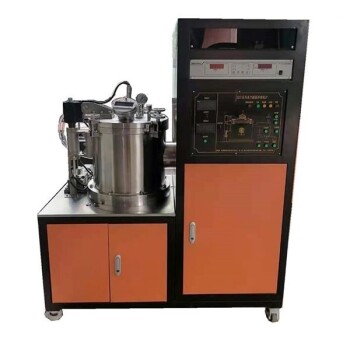
The necessity of achieving a high vacuum level of 10^-5 mbar is fundamentally about completely eliminating atmospheric air and residual moisture from the melting chamber. Without this stringent vacuum, the constituent elements of eutectic high-entropy alloys—specifically those with high chemical activity like Chromium—will instantly react with residual oxygen at elevated temperatures, leading to irreversible degradation of the material.
Core Takeaway Eutectic high-entropy alloys (EHEAs) are comprised of elements that become highly reactive during the melting process. Achieving a deep vacuum is the only reliable method to prevent the formation of oxide inclusions, which act as defects and destroy the alloy’s intended mechanical and physical properties.
The Critical Role of Oxidation Prevention
Reactivity at Elevated Temperatures
High-entropy alloys often contain elements such as Chromium, which exhibit intense chemical activity when heated. At melting temperatures, these elements lose their stability and will aggressively bond with any available oxygen.
Eliminating Oxide Inclusions
If the vacuum level is insufficient (e.g., lower than $10^{-5}$ mbar), oxygen remains in the chamber. This leads to the formation of oxide inclusions within the alloy matrix. These inclusions are contaminants that disrupt the material's structure, creating weak points that can cause premature failure.
Removal of Trapped Gases
Beyond ambient air, raw powder materials often contain gases trapped within particle gaps. A high vacuum environment extracts these trapped gases before melting begins, ensuring a dense, non-porous final product.
Environmental Control Strategy
The Moisture Factor
Achieving $10^{-5}$ mbar is not just about removing oxygen; it is essential for removing residual moisture. Water vapor is difficult to evacuate and acts as a significant source of oxygen and hydrogen contamination during the melt.
Synergistic Argon Purging
The high vacuum step is rarely used in isolation; it prepares the chamber for high-purity argon gas purging. By first establishing a deep vacuum, you ensure that the subsequent backfilling with Argon creates a truly inert environment, effectively "washing" the chamber of contaminants.
Common Pitfalls and Risks
The "Good Enough" Fallacy
Stopping at a lower vacuum level (e.g., $10^{-2}$ or $10^{-3}$ mbar) may seem efficient, but it leaves enough partial pressure of oxygen to cause surface oxidation on raw materials. This prevents proper metallic bonding between particles and compromises the alloy's ductility.
Phase Purity Degradation
The unique properties of EHEAs rely on the formation of specific intermetallic phases. Oxygen contamination interferes with this chemistry, potentially preventing the formation of essential phases or creating unwanted brittle ceramic phases instead.
Making the Right Choice for Your Goal
When setting up your melting protocol, consider your specific objectives:
- If your primary focus is Structural Integrity: Adhere strictly to the $10^{-5}$ mbar threshold to prevent oxide inclusions that serve as crack initiation sites.
- If your primary focus is Alloy Chemistry: Use high vacuum combined with Argon purging to prevent reactive element loss (like Chromium) due to oxidation.
Ultimately, the vacuum level is not a variable; it is a prerequisite for stabilizing the complex chemistry of high-entropy alloys.
Summary Table:
| Feature | Necessity in EHEAs Melting |
|---|---|
| Vacuum Level | $10^{-5}$ mbar (High Vacuum) |
| Primary Goal | Elimination of Oxygen & Moisture |
| Target Elements | Highly reactive metals (e.g., Chromium) |
| Risk Prevention | Oxide inclusions & brittle phase formation |
| Final Benefit | Superior density, ductility, and phase purity |
Elevate Your Material Research with KINTEK Precision
Achieving the stringent $10^{-5}$ mbar vacuum required for high-entropy alloys demands reliable, high-performance equipment. KINTEK specializes in advanced laboratory solutions designed for the most demanding thermal processes.
Whether you are working with Eutectic High-Entropy Alloys (EHEAs) or sensitive powder metallurgy, our portfolio offers the tools you need for success:
- High-Temperature Vacuum & Atmosphere Furnaces for precise environmental control.
- Induction Melting Systems for rapid, clean alloy development.
- High-Pressure Reactors & Autoclaves for advanced chemical synthesis.
- Crushing, Milling & Pelleting Systems to prepare high-purity raw materials.
Don't let oxidation compromise your innovation. Let our experts help you configure the perfect melting or sintering environment.
Contact KINTEK Today to Optimize Your Lab Setup
References
- Muhammad Mukarram, Khurram Yaqoob. Systematic Development of Eutectic High Entropy Alloys by Thermodynamic Modeling and Experimentation: An Example of the CoCrFeNi-Mo System. DOI: 10.3390/met11091484
This article is also based on technical information from Kintek Solution Knowledge Base .
Related Products
- Laboratory High Pressure Vacuum Tube Furnace
- Ultra-High Temperature Graphite Vacuum Graphitization Furnace
- 2200 ℃ Graphite Vacuum Heat Treat Furnace
- 2200 ℃ Tungsten Vacuum Heat Treat and Sintering Furnace
- Horizontal High Temperature Graphite Vacuum Graphitization Furnace
People Also Ask
- What role does a high-vacuum tube furnace play in synthesizing manganese nitride? Achieve Precise Phase & Stoichiometry.
- What is the role of a high-vacuum tube furnace in preparing Co3S4@NiS2/C composite materials? Expert Synthesis Insights
- What is the primary function of a high-vacuum tube furnace in CVD synthesis of Sb-doped Bi2Se3? Precision Growth Control
- Role of High-Pressure Tube Furnace in Ru/OMC Synthesis: Achieve Precise Reduction & Nanostructure Control
- What are the primary functions of a high-pressure tube furnace? Expert Guide to MWCNT/Metal Oxide Synthesis