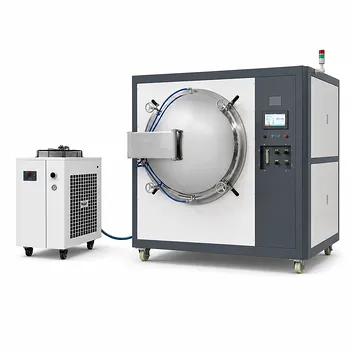
Applying 30 to 50 MPa of pressure is mechanically necessary to force the metal matrix—specifically materials like TB8 titanium alloy foils—to undergo plastic flow. This intense pressure overcomes the material's yield strength, pushing the metal into the microscopic spaces between reinforcing fibers (such as SiC) to ensure a void-free, fully dense composite.
Core Takeaway Heat softens the material, but pressure is the engine of consolidation. The specific range of 30–50 MPa is critical to mechanically deform the metal matrix so it completely fills microscopic voids, maximizing the surface contact required for atomic diffusion bonding.
The Mechanics of Plastic Deformation
To understand why this specific pressure range is non-negotiable, you must look at the physical behavior of the matrix material at the microscopic level.
Inducing Sufficient Plastic Flow
High temperature alone is often insufficient to densify a composite. While heat softens the TB8 titanium alloy, the material retains structural resistance.
Applying 30 to 50 MPa provides the mechanical force required to overcome this resistance, inducing plastic flow. This forces the solid metal to behave somewhat like a viscous fluid, allowing it to move and reshape itself around obstacles.
Filling Microscopic Interstices
The primary obstacle in these composites is the array of Silicon Carbide (SiC) fibers. Between these fibers lie tiny, complex gaps.
Without significant pressure, the metal matrix would simply bridge over these gaps, leaving air pockets. The applied pressure drives the deforming metal deep into these interstices, ensuring the matrix completely fills the microscopic gaps between the fibers.
Criticality for Diffusion Bonding
The ultimate goal of the vacuum hot pressing process is not just shape, but structural unity. Pressure is the catalyst for the chemical and atomic bonding process.
Eliminating Interlayer Voids
Any space between the matrix layers represents a structural flaw. Voids act as stress concentrators, which significantly weaken the final component.
By applying 30–50 MPa, you effectively squeeze out these voids. This ensures that the interface between the metal foils and the fibers becomes a continuous solid rather than a porous connection.
Maximizing Contact Area
Diffusion bonding requires atomic-level contact between surfaces. If the materials are merely touching, diffusion is slow and weak.
High pressure maximizes the contact area between the matrix and the fibers. This intimate contact allows atoms to migrate across the boundary efficiently, creating a robust metallurgical bond.
Achieving a 100% Welding Rate
The primary reference indicates that this specific pressure stage is the deciding factor in achieving a 100% welding rate. This means the layers of the matrix become indistinguishable from one another, resulting in a monolithic structure with superior mechanical properties.
Common Pitfalls to Avoid
While the target is 30–50 MPa, understanding the consequences of deviating from this range is vital for process control.
The Consequence of Insufficient Pressure
If the pressure drops below the 30 MPa threshold, the plastic flow will likely be incomplete. The metal will not fully penetrate the fiber bundles, leading to residual porosity. These voids compromise the density and drastically reduce the mechanical strength of the final part.
The Role of Vacuum Consistency
While pressure drives density, it must work in tandem with the vacuum environment.
As noted in the supplementary data regarding other materials (like WCp/Cu), the vacuum removes adsorbed gases and prevents oxidation. If the vacuum is compromised, even 50 MPa of pressure may seal trapped gases inside the composite, creating internal defects that pressure alone cannot fix.
Making the Right Choice for Your Goal
The parameters you choose must align with the specific defects you are trying to prevent.
- If your primary focus is Structural Density: Ensure pressure reaches the upper end of the range (near 50 MPa) to guarantee the complete elimination of interlayer voids.
- If your primary focus is Fiber Interface Quality: Maintain the 30-50 MPa range strictly to ensure the matrix flows around the fibers without damaging them, maximizing the surface area for diffusion.
Success in vacuum hot pressing relies on using pressure not just to compress, but to fundamentally alter the flow of solid metal to eliminate every microscopic gap.
Summary Table:
| Parameter Stage | Pressure Range (MPa) | Primary Mechanical Function | Desired Outcome |
|---|---|---|---|
| Plastic Deformation | 30 - 50 MPa | Forces metal matrix (e.g., TB8 alloy) to flow | Overcomes yield strength to induce plastic flow |
| Void Elimination | 30 - 50 MPa | Fills microscopic gaps between SiC fibers | 100% density and removal of air pockets |
| Diffusion Bonding | 30 - 50 MPa | Maximizes atomic-level surface contact | High-strength metallurgical bond/100% welding rate |
| Structural Unity | 30 - 50 MPa | Squeezes matrix layers into a monolith | Elimination of interlayer stress concentrators |
Elevate Your Material Science with KINTEK Precision
Don't let residual porosity compromise your research or production. KINTEK specializes in advanced vacuum hot pressing furnaces and high-pressure systems designed to deliver the precise mechanical force and thermal stability required for 100% welding rates.
From high-temperature furnaces and hydraulic pellet presses to isostatic presses and high-pressure reactors, our laboratory equipment ensures your metal matrix composites achieve maximum density and structural integrity.
Ready to optimize your consolidation process? Contact our experts today to find the perfect high-pressure solution for your laboratory needs.
Related Products
- Vacuum Hot Press Furnace Heated Vacuum Press Machine Tube Furnace
- 600T Vacuum Induction Hot Press Furnace for Heat Treat and Sintering
- Vacuum Hot Press Furnace Machine Heated Vacuum Press
- Vacuum Hot Press Furnace Machine for Lamination and Heating
- Vacuum Heat Treat and Pressure Sintering Furnace for High Temperature Applications
People Also Ask
- What advantages does a vacuum hot press furnace provide for LSLBO ceramic electrolytes? Achieve 94% Relative Density
- What role does a Vacuum Hot Press (VHP) furnace play in the densification of austenitic stainless steel 316 composites?
- What are the advantages of using a vacuum hot pressing furnace? Superior Densification for 2024Al/Gr/SiC Composites
- What are the advantages of a vacuum hot press furnace for LTPO solid electrolytes? Boost Density and Conductivity
- What core processing conditions does a vacuum hot press furnace provide? Achieve High-Density Cu-SiC/Diamond Composites