Knowledge vacuum induction melting furnace What is the other name of induction furnace? Coreless and Channel Furnace Types Explained
Author avatar

Tech Team · Kintek Solution

Updated 2 months ago

What is the other name of induction furnace? Coreless and Channel Furnace Types Explained


In short, an induction furnace does not have a single common alternative name. Instead, it is typically referred to by its specific type, such as a coreless induction furnace or a channel induction furnace. These terms describe the furnace's design and principle of operation rather than serving as a direct synonym.

The term "induction furnace" is already highly specific to its heating method. Any other names you encounter are less likely to be synonyms and more likely to be classifications describing its specific design, its energy source, or its role within a foundry.
What is the other name of induction furnace? Coreless and Channel Furnace Types Explained

Understanding the Name: Function Over Synonym

The name "induction furnace" directly describes how it works. This focus on its unique operating principle is why a simple, alternative name hasn't become common.

The Principle of "Induction"

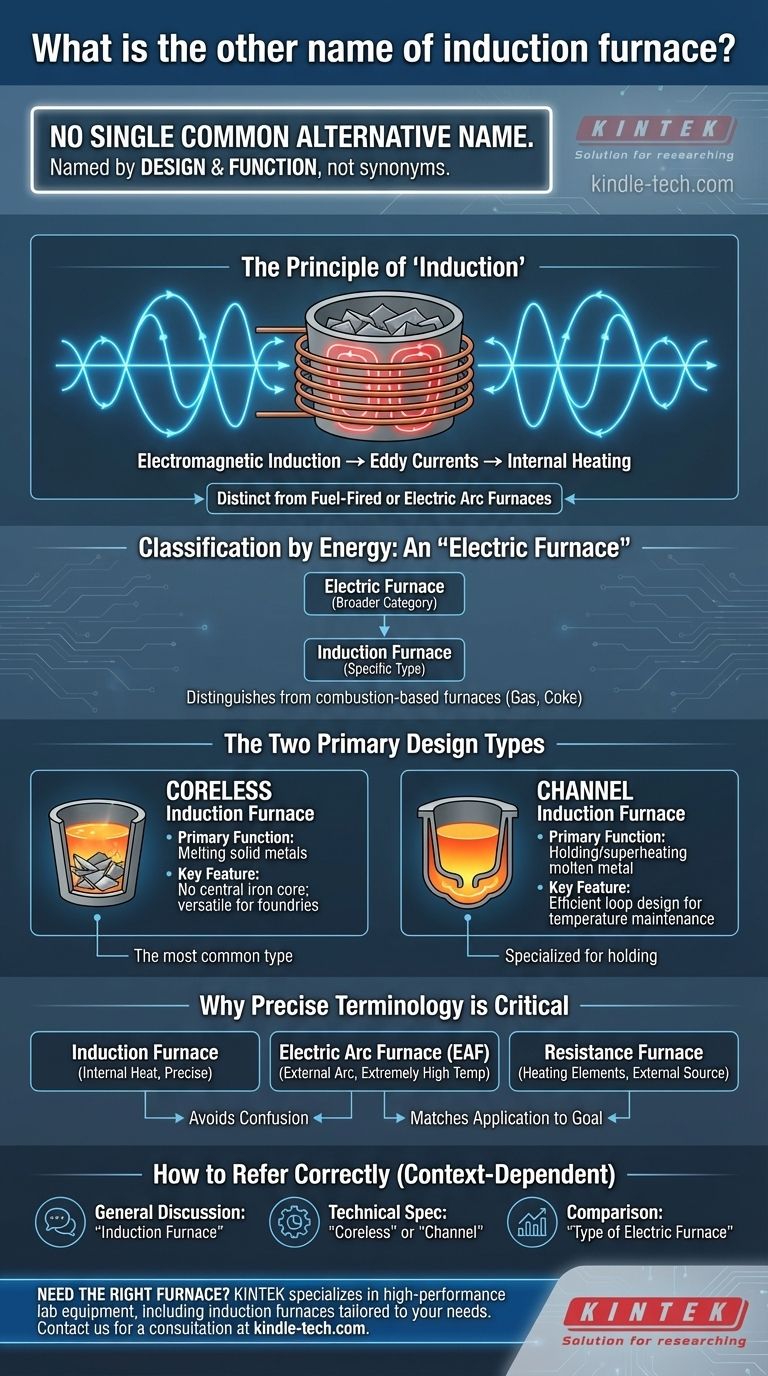
An induction furnace uses the principle of electromagnetic induction to generate heat directly within the metal. An alternating current flows through a copper coil, creating a powerful magnetic field. This field "induces" eddy currents within the metal charge, and the metal's natural electrical resistance causes it to heat up and melt, much like a pan heats on an induction cooktop.

This method is distinct from other furnaces that burn fuel or use an electric arc to generate heat externally.

Classification by Energy: An "Electric Furnace"

While not a synonym, an induction furnace is a primary type of electric furnace. This broader category distinguishes it from furnaces that use combustible fuels like gas or coke. When discussing industrial heating methods, it is accurate to refer to it as a type of electric furnace.

The Two Primary Design Types

The most common "other names" you will hear for an induction furnace are actually references to its two main construction types. The distinction is critical for engineering and operational purposes.

The Coreless Induction Furnace

This is the most common design, especially for melting solid metals in foundries. It consists of a non-conductive crucible surrounded by the water-cooled induction coil. Because it has no central iron core, it is called a coreless furnace. For many, this is the default image of an induction furnace.

The Channel Induction Furnace

A channel furnace has a distinct "channel" or loop of molten metal that passes through an induction coil assembly. This design is highly efficient for holding already-molten metal at a specific temperature or for superheating it, but it is less suited for melting cold scrap from a solid state.

Why Precise Terminology is Critical

Using the correct term is essential for clear communication in technical and industrial settings. Referring to a furnace by its specific type avoids costly misunderstandings.

Differentiating from Other Electric Furnaces

Calling an induction furnace simply an "electric furnace" can create confusion. This broad category also includes Electric Arc Furnaces (EAF), which melt metal using an extremely high-temperature arc, and resistance furnaces, which use heating elements. Each has vastly different applications, costs, and metallurgical effects.

Matching the Furnace to the Application

The choice between a coreless and a channel furnace depends entirely on the goal. Coreless furnaces are versatile for melting a wide range of metals from a solid state. Channel furnaces are more specialized, acting like a high-efficiency holding vessel. Specifying the type is crucial for process design and equipment procurement.

How to Refer to an Induction Furnace Correctly

Your choice of terminology should be guided by your context and your audience.

  • If your primary focus is a general discussion: Using "induction furnace" is the clearest and most universally understood term.
  • If your primary focus is technical specification: You must specify the design, such as "coreless induction furnace" for melting or "channel induction furnace" for holding.
  • If your primary focus is comparing heating methods: You can refer to it as a type of "electric furnace" to contrast it with fuel-fired alternatives.

Ultimately, clarity is achieved by describing the furnace by its unique and powerful method of heating: induction.

Summary Table:

Design Type Primary Function Key Feature
Coreless Induction Furnace Melting solid metals No central iron core; versatile for foundries
Channel Induction Furnace Holding/superheating molten metal Efficient loop design for temperature maintenance

Need the right furnace for your lab or foundry?
KINTEK specializes in high-performance lab equipment, including induction furnaces tailored to your specific melting or holding needs. Our experts can help you select the perfect coreless or channel furnace to optimize your process efficiency and results.
Contact our team today for a personalized consultation!

Visual Guide
What is the other name of induction furnace? Coreless and Channel Furnace Types Explained Visual Guide

Related Products

People Also Ask

Related Products

600T Vacuum Induction Hot Press Furnace for Heat Treat and Sintering

600T Vacuum Induction Hot Press Furnace for Heat Treat and Sintering

Discover the 600T Vacuum Induction Hot Press Furnace, designed for high-temperature sintering experiments in vacuum or protected atmospheres. Its precise temperature and pressure control, adjustable working pressure, and advanced safety features make it ideal for nonmetal materials, carbon composites, ceramics, and metal powders.

Lab-Scale Vacuum Induction Melting Furnace

Lab-Scale Vacuum Induction Melting Furnace

Get precise alloy composition with our Vacuum Induction Melting Furnace. Ideal for aerospace, nuclear energy, and electronic industries. Order now for effective smelting and casting of metals and alloys.

Non Consumable Vacuum Arc Induction Melting Furnace

Non Consumable Vacuum Arc Induction Melting Furnace

Explore the benefits of Non-Consumable Vacuum Arc Furnace with high melting point electrodes. Small, easy to operate & eco-friendly. Ideal for laboratory research on refractory metals & carbides.

Vacuum Arc Induction Melting Furnace

Vacuum Arc Induction Melting Furnace

Discover the power of Vacuum Arc Furnace for melting active & refractory metals. High-speed, remarkable degassing effect, and free of contamination. Learn more now!

Controlled Nitrogen Inert Hydrogen Atmosphere Furnace

Controlled Nitrogen Inert Hydrogen Atmosphere Furnace

KT-AH Hydrogen atmosphere furnace - induction gas furnace for sintering/annealing with built-in safety features, dual housing design, and energy-saving efficiency. Ideal for lab and industrial use.

High Temperature Muffle Oven Furnace for Laboratory Debinding and Pre Sintering

High Temperature Muffle Oven Furnace for Laboratory Debinding and Pre Sintering

KT-MD High temperature debinding and pre-sintering furnace for ceramic materials with various molding processes. Ideal for electronic components such as MLCC and NFC.

Graphite Vacuum Furnace High Thermal Conductivity Film Graphitization Furnace

Graphite Vacuum Furnace High Thermal Conductivity Film Graphitization Furnace

The high thermal conductivity film graphitization furnace has uniform temperature, low energy consumption and can operate continuously.

1700℃ Controlled Atmosphere Furnace Nitrogen Inert Atmosphere Furnace

1700℃ Controlled Atmosphere Furnace Nitrogen Inert Atmosphere Furnace

KT-17A Controlled atmosphere furnace: 1700℃ heating, vacuum sealing technology, PID temperature control, and versatile TFT smart touch screen controller for laboratory and industrial use.

1200℃ Controlled Atmosphere Furnace Nitrogen Inert Atmosphere Furnace

1200℃ Controlled Atmosphere Furnace Nitrogen Inert Atmosphere Furnace

Discover our KT-12A Pro Controlled atmosphere furnace - high precision, heavy duty vacuum chamber, versatile smart touch screen controller, and excellent temperature uniformity up to 1200C. Ideal for both laboratory and industrial application.

1400℃ Controlled Atmosphere Furnace with Nitrogen and Inert Atmosphere

1400℃ Controlled Atmosphere Furnace with Nitrogen and Inert Atmosphere

Achieve precise heat treatment with KT-14A controlled atmosphere furnace. Vacuum sealed with a smart controller, it's ideal for lab and industrial use up to 1400℃.

1200℃ Split Tube Furnace with Quartz Tube Laboratory Tubular Furnace

1200℃ Split Tube Furnace with Quartz Tube Laboratory Tubular Furnace

KT-TF12 split tube furnace: high-purity insulation, embedded heating wire coils, and max. 1200C. Widely used for new materials and chemical vapour deposition.

Vertical High Temperature Graphite Vacuum Graphitization Furnace

Vertical High Temperature Graphite Vacuum Graphitization Furnace

Vertical high temperature graphitization furnace for carbonization and graphitization of carbon materials up to 3100℃.Suitable for shaped graphitization of carbon fiber filaments and other materials sintered in a carbon environment.Applications in metallurgy, electronics, and aerospace for producing high-quality graphite products like electrodes and crucibles.

Laboratory Muffle Oven Furnace Bottom Lifting Muffle Furnace

Laboratory Muffle Oven Furnace Bottom Lifting Muffle Furnace

Efficiently produce batches with excellent temperature uniformity using our Bottom Lifting Furnace. Features two electric lifting stages and advanced temperature control up to 1600℃.

Vacuum Heat Treat and Pressure Sintering Furnace for High Temperature Applications

Vacuum Heat Treat and Pressure Sintering Furnace for High Temperature Applications

Vacuum pressure sintering furnaces are designed for high temperature hot pressing applications in metal and ceramic sintering. Its advanced features ensure precise temperature control, reliable pressure maintenance, and a robust design for seamless operation.

Ultra-High Temperature Graphite Vacuum Graphitization Furnace

Ultra-High Temperature Graphite Vacuum Graphitization Furnace

The ultra-high temperature graphitization furnace utilizes medium frequency induction heating in a vacuum or inert gas environment. The induction coil generates an alternating magnetic field, inducing eddy currents in the graphite crucible, which heats up and radiates heat to the workpiece, bringing it to the desired temperature. This furnace is primarily used for graphitization and sintering of carbon materials, carbon fiber materials, and other composite materials.

Vacuum Sealed Continuous Working Rotary Tube Furnace Rotating Tube Furnace

Vacuum Sealed Continuous Working Rotary Tube Furnace Rotating Tube Furnace

Experience efficient material processing with our vacuum-sealed rotary tube furnace. Perfect for experiments or industrial production, equipped with optional features for controlled feeding and optimized results. Order now.

Large Vertical Graphite Vacuum Graphitization Furnace

Large Vertical Graphite Vacuum Graphitization Furnace

A large vertical high-temperature graphitization furnace is a type of industrial furnace used for the graphitization of carbon materials, such as carbon fiber and carbon black. It is a high-temperature furnace that can reach temperatures of up to 3100°C.

Mesh belt controlled atmosphere furnace

Mesh belt controlled atmosphere furnace

Discover our KT-MB mesh belt sintering furnace - perfect for high-temperature sintering of electronic components & glass insulators. Available for open air or controlled atmosphere environments.

1400℃ Muffle Oven Furnace for Laboratory

1400℃ Muffle Oven Furnace for Laboratory

Get precise high-temperature control up to 1500℃ with KT-14M Muffle furnace. Equipped with a smart touch screen controller and advanced insulation materials.

1700℃ Muffle Oven Furnace for Laboratory

1700℃ Muffle Oven Furnace for Laboratory

Get superior heat control with our 1700℃ Muffle Furnace. Equipped with intelligent temperature microprocessor, TFT touch screen controller & advanced insulation materials for precise heating up to 1700C. Order now!


Leave Your Message



















