Knowledge What is the precursor for CNT preparation? Choosing the Right Carbon Source for Quality & Yield
Author avatar

Tech Team · Kintek Solution

Updated 6 days ago

What is the precursor for CNT preparation? Choosing the Right Carbon Source for Quality & Yield


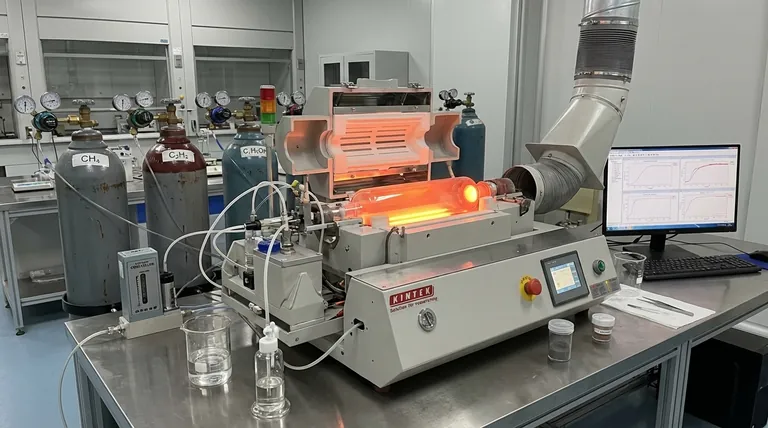
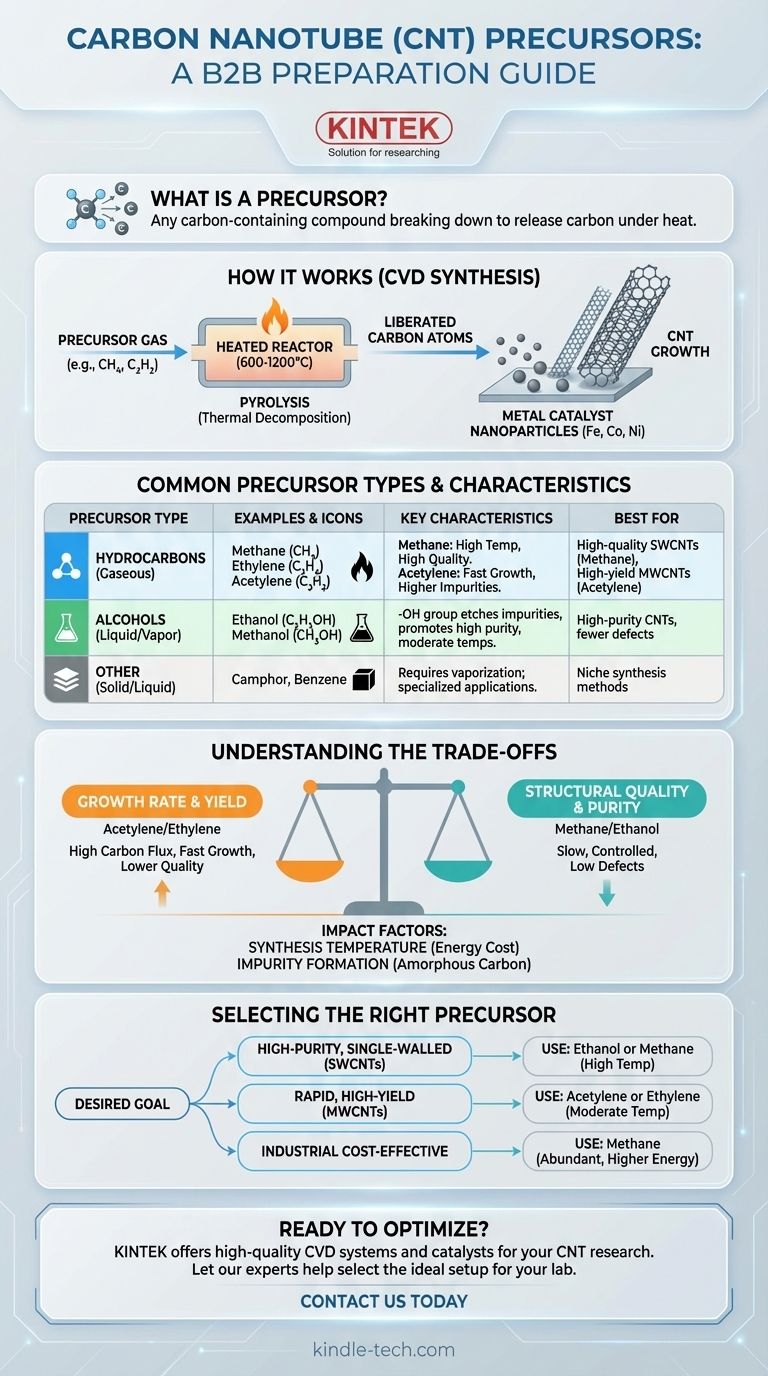
In essence, the precursor for Carbon Nanotube (CNT) preparation is any carbon-containing compound that can be broken down to release carbon atoms under specific reaction conditions. The most common precursors are simple hydrocarbons like methane, ethylene, and acetylene, or alcohols like ethanol. These substances are typically introduced in a gaseous state into a high-temperature reactor, where they decompose and form the building blocks for CNTs.

The choice of a carbon precursor is not merely about supplying a source of carbon. It is a critical process parameter that directly influences the quality, structure, yield, and synthesis temperature of the final Carbon Nanotubes.
What is the precursor for CNT preparation? Choosing the Right Carbon Source for Quality & Yield

How Precursors Form Carbon Nanotubes

The most prevalent method for synthesizing CNTs is Chemical Vapor Deposition (CVD). The precursor's role in this process is straightforward but crucial.

The Principle of Thermal Decomposition

In a CVD reactor, the precursor gas is heated to a very high temperature, typically between 600°C and 1200°C. This intense heat provides the energy to break the chemical bonds within the precursor molecules.

This process, known as pyrolysis or thermal decomposition, "cracks" the precursor and liberates individual carbon atoms or small carbon-containing radicals.

The Role of the Catalyst

These newly freed carbon atoms are highly reactive. They diffuse towards and dissolve into tiny nanoparticles of a metal catalyst, most commonly iron, cobalt, or nickel.

Once the catalyst particle becomes supersaturated with carbon, the carbon atoms begin to precipitate out. They self-assemble into the stable, hexagonal lattice structure that forms the wall of a Carbon Nanotube, which then grows outwards from the catalyst particle.

Common Carbon Precursors and Their Characteristics

Different precursors have distinct chemical stabilities and compositions, which makes them suitable for different synthesis goals.

Hydrocarbons (Gaseous)

Methane (CH4) is a highly stable molecule. It requires very high temperatures (typically >900°C) to decompose, but this slow and controlled carbon release often results in high-quality, well-structured CNTs with fewer defects.

Ethylene (C2H4) and Acetylene (C2H2) are less stable than methane. They decompose at lower temperatures, leading to a faster CNT growth rate and higher yield. However, this rapid decomposition can sometimes produce more amorphous carbon impurities that coat the nanotubes.

Alcohols (Liquid/Vapor)

Ethanol (C2H5OH) and Methanol (CH3OH) are excellent precursors. The presence of the hydroxyl (-OH) group is particularly beneficial.

At high temperatures, this group can form water vapor or other oxygen-containing species. These act as a mild etching agent, selectively removing the less-stable amorphous carbon and helping to prolong the life of the catalyst. This often results in very high-purity CNTs.

Other Precursor Types

While less common in standard laboratory setups, solid sources like camphor or other liquid hydrocarbons like benzene and xylene can also be used. These materials are either vaporized or sublimated into a gas before being introduced into the reactor.

Understanding the Trade-offs

Choosing a precursor involves balancing competing factors. There is no single "best" precursor, only the most appropriate one for a specific application.

Quality vs. Growth Rate

There is often an inverse relationship between growth rate and structural quality.

Reactive precursors like acetylene provide a very high carbon flux, enabling rapid growth. The downside is a higher likelihood of defects and byproduct formation. In contrast, stable precursors like methane offer slower, more controlled growth, which is conducive to forming highly crystalline, low-defect CNTs.

Synthesis Temperature

The chemical stability of the precursor directly dictates the required process temperature. This has significant implications for energy costs and the types of substrates that can be used.

For example, a process requiring methane at 1000°C is far more energy-intensive than one using acetylene at 700°C.

Impurity Formation

The primary impurity in CNT synthesis is amorphous carbon, a disordered, non-graphitic form of carbon. Precursors that decompose too quickly can deposit a thick layer of this soot-like material, which is difficult to remove and degrades the final product's properties.

Selecting the Right Precursor for Your Goal

Your choice should be guided by the desired properties of the final CNT material and your process constraints.

  • If your primary focus is high-purity, single-walled CNTs (SWCNTs): Consider using ethanol or methane at high temperatures, as these conditions favor cleaner growth with fewer defects.
  • If your primary focus is rapid, high-yield production of multi-walled CNTs (MWCNTs): A more reactive hydrocarbon like acetylene or ethylene at moderate temperatures is often the most efficient choice for maximizing output.
  • If your primary focus is balancing cost and quality for industrial scale-up: Methane is often preferred due to its low cost and abundance, despite requiring higher energy input for decomposition.

Ultimately, mastering CNT synthesis begins with understanding that the carbon precursor is not just an ingredient, but a critical control variable for tuning the final product.

Summary Table:

Precursor Type Common Examples Key Characteristics Best For
Hydrocarbons (Gaseous) Methane (CH₄), Ethylene (C₂H₄), Acetylene (C₂H₂) Methane: High temp, high quality. Acetylene: Fast growth, higher impurities. High-quality SWCNTs (Methane) or high-yield MWCNTs (Acetylene).
Alcohols (Liquid/Vapor) Ethanol (C₂H₅OH), Methanol (CH₃OH) -OH group etches impurities, promotes high-purity CNTs, moderate temperatures. High-purity CNTs with fewer defects.
Other (Solid/Liquid) Camphor, Benzene, Xylene Requires vaporization; used in specialized applications. Niche synthesis methods.

Ready to Optimize Your CNT Synthesis Process?

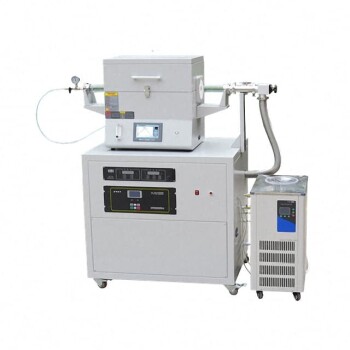
The right precursor is key to achieving your specific Carbon Nanotube goals—whether it's high purity, rapid yield, or cost-effective scale-up. KINTEK specializes in providing the high-quality lab equipment and consumables, including CVD systems and catalysts, needed to master your CNT preparation.

Let our experts help you select the ideal setup for your research or production needs. Contact us today to discuss how we can support your laboratory's success!

Visual Guide
What is the precursor for CNT preparation? Choosing the Right Carbon Source for Quality & Yield Visual Guide

Related Products

People Also Ask

Related Products

Customer Made Versatile CVD Tube Furnace Chemical Vapor Deposition Chamber System Equipment

Customer Made Versatile CVD Tube Furnace Chemical Vapor Deposition Chamber System Equipment

Get your exclusive CVD furnace with KT-CTF16 Customer Made Versatile Furnace. Customizable sliding, rotating, and tilting functions for precise reactions. Order now!

Split Chamber CVD Tube Furnace with Vacuum Station Chemical Vapor Deposition System Equipment Machine

Split Chamber CVD Tube Furnace with Vacuum Station Chemical Vapor Deposition System Equipment Machine

Efficient split chamber CVD furnace with vacuum station for intuitive sample checking and quick cooling. Up to 1200℃ max temperature with accurate MFC mass flowmeter control.

High Pressure Laboratory Vacuum Tube Furnace Quartz Tubular Furnace

High Pressure Laboratory Vacuum Tube Furnace Quartz Tubular Furnace

KT-PTF High Pressure Tube Furnace: Compact split tube furnace with strong positive pressure resistance. Working temp up to 1100°C and pressure up to 15Mpa. Also works under controller atmosphere or high vacuum.

Vertical Laboratory Quartz Tube Furnace Tubular Furnace

Vertical Laboratory Quartz Tube Furnace Tubular Furnace

Elevate your experiments with our Vertical Tube Furnace. Versatile design allows for operation under various environments and heat treatment applications. Order now for precise results!

Vacuum Heat Treat Furnace with Ceramic Fiber Liner

Vacuum Heat Treat Furnace with Ceramic Fiber Liner

Vacuum furnace with polycrystalline ceramic fiber insulation liner for excellent heat insulation and uniform temperature field. Choose from 1200℃ or 1700℃ max. working temperature with high vacuum performance and precise temperature control.

Graphite Vacuum Continuous Graphitization Furnace

Graphite Vacuum Continuous Graphitization Furnace

High-temperature graphitization furnace is a professional equipment for graphitization treatment of carbon materials. It is a key equipment for the production of high-quality graphite products. It has high temperature, high efficiency and uniform heating. It is suitable for various high-temperature treatments and graphitization treatments. It is widely used in metallurgy, electronics, aerospace, etc. industry.

Laboratory Quartz Tube Furnace Tubular RTP Heating Furnace

Laboratory Quartz Tube Furnace Tubular RTP Heating Furnace

Get lightning-fast heating with our RTP Rapid Heating Tube Furnace. Designed for precise, high-speed heating and cooling with convenient sliding rail and TFT touch screen controller. Order now for ideal thermal processing!

1200℃ Controlled Atmosphere Furnace Nitrogen Inert Atmosphere Furnace

1200℃ Controlled Atmosphere Furnace Nitrogen Inert Atmosphere Furnace

Discover our KT-12A Pro Controlled atmosphere furnace - high precision, heavy duty vacuum chamber, versatile smart touch screen controller, and excellent temperature uniformity up to 1200C. Ideal for both laboratory and industrial application.

Ultra-High Temperature Graphite Vacuum Graphitization Furnace

Ultra-High Temperature Graphite Vacuum Graphitization Furnace

The ultra-high temperature graphitization furnace utilizes medium frequency induction heating in a vacuum or inert gas environment. The induction coil generates an alternating magnetic field, inducing eddy currents in the graphite crucible, which heats up and radiates heat to the workpiece, bringing it to the desired temperature. This furnace is primarily used for graphitization and sintering of carbon materials, carbon fiber materials, and other composite materials.

Vacuum Heat Treat Sintering Brazing Furnace

Vacuum Heat Treat Sintering Brazing Furnace

A vacuum brazing furnace is a type of industrial furnace used for brazing, a metalworking process that joins two pieces of metal using a filler metal that melts at a lower temperature than the base metals. Vacuum brazing furnaces are typically used for high-quality applications where a strong, clean joint is required.

Vertical High Temperature Graphite Vacuum Graphitization Furnace

Vertical High Temperature Graphite Vacuum Graphitization Furnace

Vertical high temperature graphitization furnace for carbonization and graphitization of carbon materials up to 3100℃.Suitable for shaped graphitization of carbon fiber filaments and other materials sintered in a carbon environment.Applications in metallurgy, electronics, and aerospace for producing high-quality graphite products like electrodes and crucibles.

1700℃ Controlled Atmosphere Furnace Nitrogen Inert Atmosphere Furnace

1700℃ Controlled Atmosphere Furnace Nitrogen Inert Atmosphere Furnace

KT-17A Controlled atmosphere furnace: 1700℃ heating, vacuum sealing technology, PID temperature control, and versatile TFT smart touch screen controller for laboratory and industrial use.

1400℃ Laboratory Quartz Tube Furnace with Alumina Tube Tubular Furnace

1400℃ Laboratory Quartz Tube Furnace with Alumina Tube Tubular Furnace

Looking for a tube furnace for high-temperature applications? Our 1400℃ Tube Furnace with Alumina Tube is perfect for research and industrial use.

Vacuum Heat Treat and Sintering Furnace with 9MPa Air Pressure

Vacuum Heat Treat and Sintering Furnace with 9MPa Air Pressure

The air pressure sintering furnace is a high-tech equipment commonly used for the sintering of advanced ceramic materials. It combines vacuum sintering and pressure sintering techniques to achieve high-density and high-strength ceramics.

1400℃ Controlled Atmosphere Furnace with Nitrogen and Inert Atmosphere

1400℃ Controlled Atmosphere Furnace with Nitrogen and Inert Atmosphere

Achieve precise heat treatment with KT-14A controlled atmosphere furnace. Vacuum sealed with a smart controller, it's ideal for lab and industrial use up to 1400℃.

Vacuum Heat Treat and Molybdenum Wire Sintering Furnace for Vacuum Sintering

Vacuum Heat Treat and Molybdenum Wire Sintering Furnace for Vacuum Sintering

A vacuum molybdenum wire sintering furnace is a vertical or bedroom structure, which is suitable for withdrawal, brazing, sintering and degassing of metal materials under high vacuum and high temperature conditions. It is also suitable for dehydroxylation treatment of quartz materials.

Vacuum Hot Press Furnace Heated Vacuum Press Machine Tube Furnace

Vacuum Hot Press Furnace Heated Vacuum Press Machine Tube Furnace

Reduce forming pressure & shorten sintering time with Vacuum Tube Hot Press Furnace for high-density, fine-grain materials. Ideal for refractory metals.

1800℃ Muffle Oven Furnace for Laboratory

1800℃ Muffle Oven Furnace for Laboratory

KT-18 muffle furnace with Japan Al2O3 polycrystalline fibe and Silicon Molybdenum heating element, up to 1900℃, PID temperature control and 7" smart touch screen. Compact design, low heat loss, and high energy efficiency. Safety interlock system and versatile functions.

Rotary Tube Furnace Split Multi Heating Zone Rotating Tube Furnace

Rotary Tube Furnace Split Multi Heating Zone Rotating Tube Furnace

Multi zone rotary furnace for high-precision temperature control with 2-8 independent heating zones. Ideal for lithium ion battery electrode materials and high-temperature reactions. Can work under vacuum and controlled atmosphere.

600T Vacuum Induction Hot Press Furnace for Heat Treat and Sintering

600T Vacuum Induction Hot Press Furnace for Heat Treat and Sintering

Discover the 600T Vacuum Induction Hot Press Furnace, designed for high-temperature sintering experiments in vacuum or protected atmospheres. Its precise temperature and pressure control, adjustable working pressure, and advanced safety features make it ideal for nonmetal materials, carbon composites, ceramics, and metal powders.


Leave Your Message