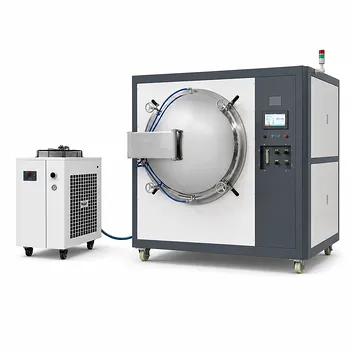
The primary function of a vacuum hot pressing sintering furnace in the fabrication of Ti-22Al-25Nb alloys is to consolidate pre-alloyed powders into a dense solid by simultaneously applying high temperatures and uniaxial mechanical pressure within a controlled high-vacuum environment. This process facilitates the necessary plastic flow and densification of the material while strictly preventing the oxidation of chemically active elements like titanium, aluminum, and niobium.
By integrating heat, pressure, and a contaminant-free atmosphere, this furnace technology effectively overcomes the high reactivity of titanium alloys. It ensures the production of components with near-theoretical density, high purity, and uniform, fine-grained microstructures that are critical for mechanical performance.
The Three Pillars of Functionality
1. Environmental Control via High Vacuum
The most critical challenge in fabricating Ti-22Al-25Nb is the high chemical reactivity of its constituent elements. Titanium, aluminum, and niobium react aggressively with oxygen at sintering temperatures.
Preventing Oxidation and Embrittlement
The furnace creates a high-vacuum environment, typically around 10^-3 Pa. This extremely low oxygen partial pressure prevents the formation of brittle oxide layers and interstitial contamination that would degrade the alloy's mechanical properties.
Degassing Powder Surfaces
Before densification begins, the vacuum environment effectively strips adsorbed gases from the surface of the raw powder particles. This ensures cleaner particle-to-particle bonding during the sintering phase.
Mechanisms of Densification
2. Simultaneous Application of Heat and Pressure
Unlike conventional sintering, which relies solely on thermal energy, this furnace applies uniaxial pressure (mechanical force) alongside high temperatures.
Lowering Activation Energy
The application of pressure significantly lowers the sintering activation energy. This promotes particle contact and diffusion at temperatures lower than those required for pressureless sintering.
Facilitating Plastic Flow
The combination of heat and pressure forces the powder particles to undergo plastic deformation and diffusion creep. This physical movement of material effectively closes internal pores, allowing the alloy to achieve high relative densities (often exceeding 95% to 99%).
Microstructural Control
3. Rapid Densification and Grain Refinement
The furnace is designed to increase heating rates and density simultaneously.
Achieving Uniform Microstructures
Rapid densification inhibits the excessive growth of grains within the aluminum matrix. By minimizing the time the material spends at peak temperatures, the furnace produces a fine-grained, uniform microstructure.
Minimizing Interface Reactions
The shortened holding times and lower required temperatures minimize the formation of brittle interface reaction products. This results in superior mechanical properties compared to alloys processed via slower, pressureless methods.
Understanding the Trade-offs
While vacuum hot pressing is superior for quality, it introduces specific constraints that must be managed.
Mold Limitations
The process relies on high-strength graphite molds to transmit pressure (often up to 35 MPa) to the powder. These molds must withstand extreme temperatures (up to 1550°C) without deforming, but they can induce carbon contamination if not properly coated or managed.
Equipment Complexity
Achieving and maintaining a 10^-3 Pa vacuum while applying tons of hydraulic force requires complex, expensive infrastructure. Any leak or pump failure during the cycle can lead to immediate oxidation and total batch loss.
Making the Right Choice for Your Goal
When configuring your fabrication process for Ti-22Al-25Nb, consider your specific performance targets:
- If your primary focus is Material Purity: Prioritize the vacuum system's capability to maintain 10^-3 Pa or better to strictly eliminate oxygen embrittlement.
- If your primary focus is Mechanical Strength: Optimize the pressure and temperature ramp rates to maximize plastic flow and achieve >99% density.
- If your primary focus is Fatigue Resistance: Focus on rapid densification parameters to ensure fine grain size, which directly correlates to fatigue performance.
The vacuum hot pressing sintering furnace is the definitive tool for converting reactive powder into high-performance structural alloy by mechanically forcing densification in a chemically inert vacuum.
Summary Table:
| Feature | Function in Ti-22Al-25Nb Fabrication | Key Benefit |
|---|---|---|
| High Vacuum (10^-3 Pa) | Eliminates oxygen and nitrogen | Prevents oxidation and embrittlement |
| Uniaxial Pressure | Mechanically forces particle contact | Achieves near-theoretical density (>99%) |
| Simultaneous Heating | Promotes plastic flow and diffusion | Lowers sintering activation energy |
| Rapid Processing | Reduces time at peak temperatures | Ensures fine-grained, uniform microstructure |
Elevate Your Material Research with KINTEK
Precision is paramount when working with reactive alloys like Ti-22Al-25Nb. KINTEK specializes in advanced laboratory equipment, providing high-performance vacuum hot pressing furnaces and hydraulic presses designed to meet the rigorous demands of aerospace and medical material science.
Beyond sintering, our comprehensive portfolio includes high-temperature high-pressure reactors, crushing and milling systems for powder preparation, and essential consumables like ceramics and crucibles.
Ready to achieve superior densification and purity in your lab? Contact our technical experts today to find the perfect solution for your research!
Related Products
- 600T Vacuum Induction Hot Press Furnace for Heat Treat and Sintering
- Vacuum Heat Treat and Sintering Furnace with 9MPa Air Pressure
- Vacuum Heat Treat and Pressure Sintering Furnace for High Temperature Applications
- 2200 ℃ Tungsten Vacuum Heat Treat and Sintering Furnace
- Vacuum Hot Press Furnace Heated Vacuum Press Machine Tube Furnace
People Also Ask
- What role does an induction vacuum hot pressing furnace play in sintering? Achieve 98% Density in Carbide Blocks
- What advantages does a vacuum hot press furnace provide for LSLBO ceramic electrolytes? Achieve 94% Relative Density
- What role does a Vacuum Hot Press (VHP) furnace play in the densification of austenitic stainless steel 316 composites?
- What role does mechanical pressure play during the vacuum diffusion bonding of tungsten and copper? Keys to Solid Bonding
- What are the advantages of a vacuum hot press furnace for W-50%Cu? Achieve 99.6% Density at Lower Temperatures