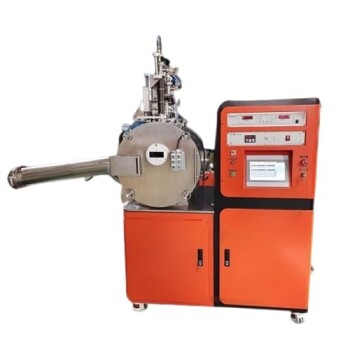
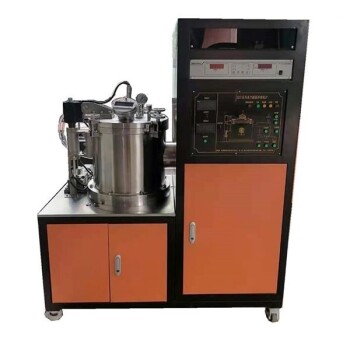
The primary function of a Vacuum Induction Melting (VIM) furnace is to melt materials within a vacuum or protective inert gas environment to eliminate atmospheric contamination. This isolation prevents the melt from reacting with oxygen and nitrogen, ensuring the high purity levels required for MoNiCr alloy raw materials.
By combining atmospheric isolation with active inert gas purging, VIM technology serves as a fundamental purification stage. It does not merely melt the alloy; it actively deoxidizes the material to meet the rigorous standards necessary for critical sectors like nuclear energy.
The Mechanics of Purity Control
Preventing Atmospheric Contamination
The most immediate function of a VIM furnace is the exclusion of ambient air. By operating in a vacuum, the system eliminates the presence of atmospheric gases such as oxygen and nitrogen.
This prevents the formation of harmful oxides and nitrides during the liquid phase. For high-performance alloys, excluding these gases is the first line of defense in maintaining material integrity.
Active Impurity Removal
Beyond passive protection, the VIM furnace facilitates active purification. The primary reference highlights that inert gas purging is utilized during the melting process.
This purging process aids in deoxidation and the removal of volatile impurities. It ensures the final raw material is chemically clean before it moves to subsequent processing stages.
Ensuring Alloy Integrity
Protecting Reactive Elements
MoNiCr alloys contain reactive elements, specifically chromium (Cr), which are prone to rapid oxidation. The low oxygen partial pressure in the VIM furnace is critical for preserving these elements.
Without this controlled environment, significant amounts of chromium could be lost to oxidation. VIM ensures that the precise chemical composition of the alloy is maintained from the very beginning.
Establishing Material Homogeneity
The vacuum environment often utilizes electromagnetic induction, which inherently stirs the molten metal. This natural agitation ensures that molybdenum, nickel, and chromium are distributed uniformly throughout the melt.
This results in a homogeneous base material. A uniform composition is essential for avoiding weak points or inconsistencies in the final solidified alloy.
Understanding the Constraints
The Distinction Between Chemistry and Structure
While VIM is exceptional for achieving chemical purity and composition control, it is often just the first step in a larger process. It produces high-quality "raw materials" or electrodes, but the solidification structure may still require refinement.
The Need for Secondary Processing
For the most demanding applications, VIM ingots are frequently used as the input material for secondary refining processes, such as Vacuum Arc Remelting (VAR). VIM sets the chemical baseline, while subsequent steps optimize the physical structure.
Making the Right Choice for Your Goal
Depending on the specific requirements of your MoNiCr alloy application, understand where VIM fits into your production line:
- If your primary focus is chemical precision: Rely on VIM to prevent the loss of reactive elements like chromium and to ensure the exact stoichiometry of the alloy.
- If your primary focus is material cleanliness: Utilize the VIM process's inert gas purging capabilities to actively reduce oxygen content and remove volatile inclusions.
A VIM furnace is the non-negotiable foundation for high-performance alloys, transforming raw ingredients into a pure, stable base ready for critical application.
Summary Table:
| Feature | Function in MoNiCr Preparation | Benefit to Material Quality |
|---|---|---|
| Vacuum Environment | Eliminates atmospheric O2 and N2 | Prevents harmful oxide and nitride formation |
| Inert Gas Purging | Active deoxidation and impurity removal | Achieves chemical cleanliness and high purity |
| Induction Stirring | Electromagnetic agitation of the melt | Ensures homogeneity and uniform element distribution |
| Oxidation Control | Protects reactive elements like Chromium | Maintains exact stoichiometric composition |
| Precursor Prep | Creates electrodes for secondary refining | Provides a stable baseline for VAR or ESR processes |
Elevate Your Material Purity with KINTEK Solutions
Precision in alloy preparation begins with the right thermal environment. KINTEK specializes in advanced laboratory equipment and consumables, providing industry-leading vacuum induction melting (VIM) systems, induction melting furnaces, and high-temperature furnaces designed to meet the rigorous standards of nuclear and aerospace engineering.
Whether you are developing MoNiCr alloys or refining reactive metals, our expertise ensures you achieve maximum chemical integrity and material homogeneity. Beyond melting, KINTEK offers a comprehensive range of crushing and milling systems, high-temperature high-pressure reactors, and essential ceramic crucibles to support your entire research and production workflow.
Ready to optimize your alloy production? Contact our technical experts today to find the perfect furnace solution for your laboratory's needs.
References
- Michal Duchek, Zbyšek Nový. Optimization of MoNiCr Alloy Production Through Additive Manufacturing. DOI: 10.3390/ma18010042
This article is also based on technical information from Kintek Solution Knowledge Base .
Related Products
- Lab-Scale Vacuum Induction Melting Furnace
- Vacuum Induction Melting Spinning System Arc Melting Furnace
- Vacuum Heat Treat Furnace and Levitation Induction Melting Furnace
- Vacuum Arc Induction Melting Furnace
- Non Consumable Vacuum Arc Induction Melting Furnace
People Also Ask
- How do vacuum induction or arc melting furnaces facilitate the synthesis of U-Al-C MAX phases? Precision Heat & Purity
- What types of metals are typically processed in a vacuum induction melting furnace? High-Purity Alloys for Critical Applications
- What is the primary function of a vacuum induction melting furnace in Ni-Mo-Cr-Fe master alloy prep? Ensure High Purity
- Why use VIM for rare earth steel? Essential Precision for Melting Reactive Lanthanum and Cerium
- What is the function of a vacuum induction melting furnace? Essential Guide for High-Purity FeCrAl Alloy Production