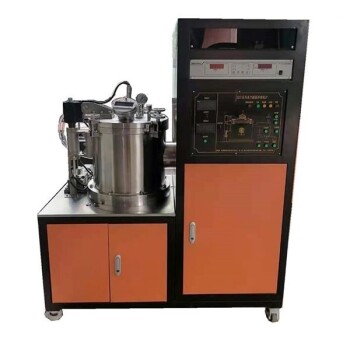
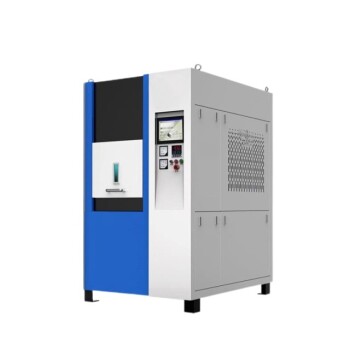
The primary function of an induction melting furnace in producing Fe-Cr-Ni heat-resistant alloys is to rapidly melt raw materials while simultaneously ensuring chemical homogeneity through electromagnetic stirring. This process leverages electromagnetic fields to generate intense heat and facilitate the uniform distribution of critical alloying elements such as Iron (Fe), Chromium (Cr), Nickel (Ni), Niobium (Nb), and Molybdenum (Mo).
Core Insight: The induction furnace serves a dual purpose: it is both a high-speed heating element and a precision mixer. Its inherent electromagnetic stirring action is the defining feature that prevents segregation in complex alloys, ensuring the final material meets the strict chemical consistency required for high-temperature performance.
The Mechanics of Alloy Production
Rapid Melting via Induction
The furnace operates by generating high-frequency electromagnetic fields that induce eddy currents directly within the metal charge.
This internal resistance generates immense heat, rapidly melting the raw materials without the need for a direct heat source like a flame or arc.
Because the energy is transmitted through an electromagnetic field, there is no physical contact between the heating element and the metal, preserving the purity of the melt.
Homogenization through Electromagnetic Stirring
For Fe-Cr-Ni alloys, simply melting the metal is insufficient; the heavy alloying elements must be perfectly mixed.
The magnetic field that generates heat also exerts a physical force on the molten metal, causing it to churn and circulate continuously.
This electromagnetic stirring effect is critical for distributing elements like Niobium and Molybdenum evenly throughout the Iron-Chromium-Nickel matrix, preventing weak spots in the final alloy.
Ensuring Quality and Stability
Precise Temperature Control
Producing high-quality alloy ingots requires maintaining specific temperature ranges to control the microstructure of the metal.
Modern induction furnaces are equipped with advanced cooling systems and power controls that provide exceptional temperature stability.
This precision prevents overheating, which can degrade the alloy, while ensuring the metal remains fluid enough for proper casting.
A Clean Melting Environment
The induction process is inherently cleaner than combustion-based melting methods.
By eliminating fuel gases, the furnace reduces the risk of introducing impurities into the molten bath.
This establishes a high-purity foundation, which is essential for subsequent processing steps like forging or rolling.
Understanding the Operational Trade-offs
Limited Refining Capability
While induction furnaces are excellent for melting and mixing, they are generally less effective at chemical refining (removing impurities like Sulfur or Phosphorus) compared to Electric Arc Furnaces.
Consequently, the quality of the output is highly dependent on the quality of the input materials (scrap and master alloys).
Input Material Requirements
Because the furnace focuses on mixing rather than refining, the raw materials loaded into the furnace must be pre-selected for cleanliness.
Operators cannot rely on the induction process to "clean up" low-grade dirty scrap; the charge must meet the chemical specifications desired in the final product.
Making the Right Choice for Your Goal
To maximize the quality of Fe-Cr-Ni heat-resistant alloys, align your process with the furnace's strengths:
- If your primary focus is Chemical Consistency: rely on the electromagnetic stirring effect to homogenize heavy elements like Mo and Nb, rather than using mechanical agitators.
- If your primary focus is Material Purity: invest in high-grade, pre-cleaned raw materials, as the furnace will preserve existing purity but cannot significantly improve low-quality scrap.
Ultimately, the induction furnace is a precision tool designed to lock in the quality of your raw materials through rapid melting and superior mixing.
Summary Table:
| Feature | Induction Melting Benefit | Impact on Fe-Cr-Ni Alloys |
|---|---|---|
| Heating Method | Internal eddy currents | Rapid, non-contact melting preserving material purity |
| Mixing Action | Electromagnetic stirring | Uniform distribution of heavy elements (Nb, Mo) |
| Temp Control | Precision power regulation | Prevents degradation and ensures optimal casting fluid |
| Environment | No combustion/fuel gases | Reduced risk of impurities and oxidation |
| Refining | Limited chemical refining | Focuses on high-quality input for superior final output |
Elevate Your Alloy Production with KINTEK Precision
Ensure the highest chemical consistency and material purity for your high-performance alloys. KINTEK specializes in advanced induction melting systems and laboratory equipment designed to meet the rigorous demands of material science. From high-temperature furnaces and vacuum systems to essential consumables like crucibles and ceramics, we provide the tools you need for superior R&D and production outcomes.
Ready to optimize your melting process? Contact KINTEK today to discover how our high-temperature solutions can enhance your lab's efficiency and product quality.
References
- Св. С. Квон, Е. П. Щербакова. Studying microstructure of heat-resistant alloy based on the Fe-Cr-Ni-alloying element system for manufacture of components for metallurgical equipment. DOI: 10.17580/cisisr.2023.01.14
This article is also based on technical information from Kintek Solution Knowledge Base .
Related Products
- Lab-Scale Vacuum Induction Melting Furnace
- Vacuum Heat Treat Furnace and Levitation Induction Melting Furnace
- Non Consumable Vacuum Arc Induction Melting Furnace
- Vacuum Arc Induction Melting Furnace
- 600T Vacuum Induction Hot Press Furnace for Heat Treat and Sintering
People Also Ask
- How do vacuum induction or arc melting furnaces facilitate the synthesis of U-Al-C MAX phases? Precision Heat & Purity
- Why use VIM for rare earth steel? Essential Precision for Melting Reactive Lanthanum and Cerium
- What types of metals are typically processed in a vacuum induction melting furnace? High-Purity Alloys for Critical Applications
- What is the primary function of a vacuum induction melting furnace in Ni-Mo-Cr-Fe master alloy prep? Ensure High Purity
- What are the key components inside the vacuum chamber of a vacuum induction melting furnace? A Guide to the Core Melting Assembly