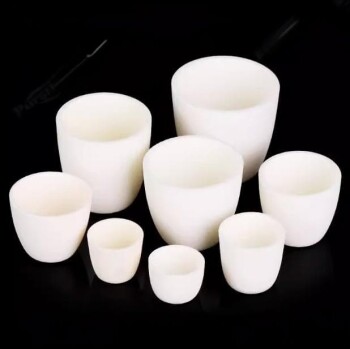
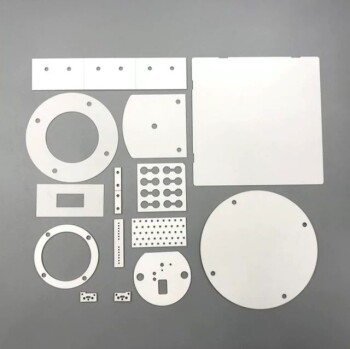
High-purity alumina crucibles serve as critical inert liners inside static experimental cells during high-temperature Lead-Bismuth Eutectic (LBE) corrosion experiments. Their primary function is to physically isolate the highly corrosive liquid metal from the external stainless steel pressure vessels, effectively containing the melt without influencing its chemical composition.
By preventing direct contact between the liquid LBE and the autoclave walls, these crucibles eliminate secondary chemical reactions, ensuring that experimental data accurately reflects the corrosion of the test specimens rather than environmental contamination.
The Critical Role of Chemical Isolation
The validity of an LBE corrosion experiment depends entirely on controlling the environment. Alumina crucibles facilitate this by decoupling the mechanical containment from the chemical containment.
Exceptional Chemical Inertness
High-purity alumina (typically >99.7%) exhibits remarkable stability in liquid lead and bismuth alloys. It remains chemically inert at standard experimental temperatures of 600°C, and can maintain this stability up to 750°C.
Preventing Secondary Reactions
Without an alumina liner, the liquid LBE would react directly with the metallic walls of the pressure vessel. This interaction creates "secondary reactions" that alter the chemistry of the liquid metal pool, rendering the experiment invalid.
Protecting the Pressure Vessel
The stainless steel autoclave provides the necessary pressure-bearing capabilities and sealed environment. The alumina liner acts as a physical barrier, preventing the highly dissolvable LBE from corroding and damaging the expensive autoclave interior.
Ensuring Data Integrity
The ultimate goal of using high-purity alumina is to ensure that the data collected is chemically accurate and reproducible.
Eliminating Impurity Leaching
Because high-purity alumina has extremely low solubility in liquid lead, it does not dissolve into the melt. This prevents the container material from leaching impurities into the LBE, which could otherwise skew results when studying trace elements or oxide film formation.
Isolating the Test Specimen
The crucible ensures that any corrosion behavior observed—such as oxidation or element leaching—is exclusively between the liquid LBE and the structural material being tested (e.g., T91 or HT9). This isolation allows for the precise evaluation of self-healing properties without interference from the container walls.
Understanding the Trade-offs
While alumina is the gold standard for chemical inertness in these experiments, it is important to understand its mechanical limitations relative to the system as a whole.
Liner vs. Pressure Vessel
Alumina serves strictly as a containment liner, not a pressure vessel. It possesses high refractoriness but lacks the tensile strength to hold high pressures on its own. It must be nested within a metallic autoclave to function safely under experimental pressures.
Thermal Shock Sensitivity
Unlike the metallic vessels they protect, ceramic crucibles can be susceptible to thermal shock. While they offer thermal stability, rapid temperature changes must be managed carefully to maintain the integrity of the liner throughout the experiment.
Making the Right Choice for Your Goal
When designing LBE corrosion experiments, the selection of crucible material dictates the reliability of your data.
- If your primary focus is Data Accuracy: Use alumina with purity exceeding 99.7% to ensure zero impurity leaching or catalytic effects from the container.
- If your primary focus is Equipment Longevity: Ensure the alumina liner fits precisely within the steel autoclave to prevent LBE seepage that could corrode the pressure vessel walls.
By utilizing high-purity alumina as an isolation barrier, you transform a volatile chemical environment into a controlled baseline for precise material science.
Summary Table:
| Feature | Alumina Crucible (Liner) | Stainless Steel Autoclave (Vessel) |
|---|---|---|
| Primary Function | Chemical isolation & melt containment | Pressure bearing & environmental sealing |
| Chemical Stability | Inert up to 750°C in liquid LBE | Susceptible to LBE corrosion/dissolution |
| Material Purity | >99.7% Al2O3 | Industrial grade alloys (e.g., 316L) |
| Mechanical Role | Non-structural liner | Structural pressure containment |
| Impact on Data | Prevents secondary reactions | Potential source of impurity leaching |
Elevate Your Corrosion Research with KINTEK Precision
Don't let container contamination compromise your LBE corrosion data. KINTEK specializes in high-performance laboratory solutions, providing the high-purity alumina crucibles and ceramics necessary for total chemical isolation.
Our comprehensive portfolio supports every stage of your research, featuring:
- High-Temperature High-Pressure Reactors & Autoclaves designed for extreme durability.
- Crushing, Milling, and Pellet Presses for precise specimen preparation.
- Advanced Thermal Solutions, including muffle, tube, and vacuum furnaces.
Whether you are studying T91 steel degradation or advanced oxide films, KINTEK delivers the reliable consumables and equipment required for reproducible results. Contact our technical experts today to discuss how our high-purity liners and pressure vessels can enhance your laboratory's capabilities!
References
- Seung Gi Lee, Il Soon Hwang. High-Temperature Corrosion Behaviors of Structural Materials for Lead-Alloy-Cooled Fast Reactor Application. DOI: 10.3390/app11052349
This article is also based on technical information from Kintek Solution Knowledge Base .
Related Products
- Arc-Shaped Alumina Ceramic Crucible High Temperature Resistant for Engineering Advanced Fine Ceramics
- Engineering Advanced Fine Alumina Al2O3 Ceramic Crucible for Laboratory Muffle Furnace
- Engineering Advanced Fine Ceramics Alumina Al2O3 Crucible With Lid Cylindrical Laboratory Crucible
- Engineering Advanced Fine Ceramics Alumina Crucibles (Al2O3) for Thermal Analysis TGA DTA
- Alumina Al2O3 Ceramic Crucible Semicircle Boat with Lid for Engineering Advanced Fine Ceramics
People Also Ask
- Why Use Alumina Crucibles & Powder Burial for NaSICON? Ensure Phase Purity and Prevent Elemental Volatilization
- What is the primary purpose of using alumina crucibles for LLTO ceramics? Optimize Your High-Temperature Sintering
- Why are alumina crucibles and mother powder essential for LATP sintering? Optimize Your Solid Electrolyte Performance
- Why are high-purity alumina crucibles used for liquid lead corrosion experiments? Ensure Data Accuracy at 550°C
- Primary considerations for choosing alumina crucibles and quartz tubes in indium intercalation: Ensure Material Purity