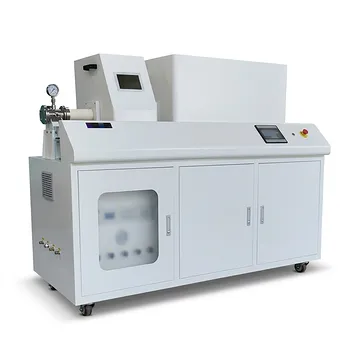
The primary function of isothermal Chemical Vapor Infiltration (CVI) equipment in this context is to deposit a precisely controlled, uniform pyrolytic carbon interface layer onto carbon fiber preforms. By managing parameters such as the deposition temperature of source gases (like propane) and total furnace pressure, this equipment creates a critical boundary that defines the composite's final performance.
Isothermal CVI is the defining step for structural integrity in multiphase ceramic composites. It creates an interface that protects fibers during manufacturing and acts as a mechanical "fuse," optimizing bonding strength to significantly enhance the material's fracture toughness.
The Critical Role of the Interface Layer
Protecting Fiber Integrity
The immediate purpose of the CVI process is protection. The pyrolytic carbon layer serves as a shield for the delicate carbon fibers.
This coating prevents chemical or mechanical damage to the fibers during subsequent high-temperature processing steps. Without this barrier, the aggressive environment required to form the ceramic matrix could degrade the fibers, rendering the composite weak.
Enhancing Fracture Toughness
Beyond protection, the equipment functions to tune the mechanical relationship between the fiber and the matrix.
A ceramic matrix is naturally brittle; if it bonds too tightly to the fiber, a crack in the matrix will snap the fiber instantly. The interface layer adjusts this bonding strength, allowing fibers to pull out or deflect cracks rather than breaking, which provides the composite with high fracture toughness.
Mechanism of Action
Precision Gas Infiltration
The equipment utilizes a high-temperature reaction chamber to manage the flow of hydrocarbon gases.
Unlike liquid processes, CVI allows gases to diffuse deep into the porous structure of the fiber preform. This ensures that the interface layer is deposited not just on the surface, but throughout the internal architecture of the material.
Uniform Deposition Control
The "isothermal" aspect of the equipment refers to maintaining a constant, uniform temperature profile.
By strictly controlling the temperature and pressure, the equipment ensures the decomposition of propane results in a consistent layer thickness. This uniformity is vital for reducing internal defects and ensuring consistent performance across the entire composite part.
Understanding the Trade-offs
Process Speed vs. Uniformity
While CVI offers superior quality compared to liquid impregnation, it is inherently a diffusion-limited process.
Achieving a truly uniform interface layer inside a dense preform takes time. If the deposition rate is forced too high (to save time), the outer pores may seal off before the inner fibers are coated, leading to "canning" and internal structural weaknesses.
Complexity of Parameter Control
The effectiveness of the equipment relies entirely on the precise balance of temperature, pressure, and gas flow.
Slight deviations in the isothermal environment can lead to varying microstructures in the pyrolytic carbon. This sensitivity requires rigorous monitoring, as an inconsistent interface layer can lead to unpredictable failure modes in the final aerospace or nuclear component.
Making the Right Choice for Your Goal
To maximize the utility of isothermal CVI equipment, you must align the process parameters with your specific performance requirements.
- If your primary focus is Fiber Protection: prioritize a deposition protocol that ensures complete coverage of the fiber surface to prevent degradation during matrix formation.
- If your primary focus is Fracture Toughness: optimize the thickness and microstructure of the pyrolytic carbon layer to ensure the bond is weak enough to deflect cracks, but strong enough to transfer load.
The ultimate value of this equipment lies not just in coating fibers, but in engineering the microscopic interface that allows brittle ceramics to behave like tough, resilient metals.
Summary Table:
| Feature | Function in Isothermal CVI | Impact on Composite Performance |
|---|---|---|
| Interface Deposition | Coats fibers with pyrolytic carbon | Protects fiber integrity during high-temp processing |
| Bonding Control | Tunes fiber-matrix adhesion | Enhances fracture toughness via crack deflection |
| Gas Diffusion | Deep infiltration of porous preforms | Ensures uniform internal coating and structural density |
| Isothermal Control | Maintains constant temperature/pressure | Minimizes defects and ensures consistent microstructure |
Elevate Your Material Engineering with KINTEK Precision
Advanced materials require advanced processing. KINTEK specializes in cutting-edge laboratory solutions, including high-performance CVD/CVI systems and high-temperature furnaces designed to meet the rigorous demands of ceramic matrix composite research.
Whether you are refining fracture toughness in aerospace components or optimizing battery research, our comprehensive range of high-temperature reactors, crushing systems, and specialized consumables ensures your lab achieves repeatable, industry-leading results. Don't let process inconsistencies limit your innovation.
Ready to optimize your composite manufacturing? Contact KINTEK today to consult with our technical experts and find the perfect equipment for your research goals!
References
- Yinchao JU, Wei Xi. Ablation Behavior of Ultra-high Temperature Composite Ceramic Matrix Composites. DOI: 10.15541/jim20210182
This article is also based on technical information from Kintek Solution Knowledge Base .
Related Products
- Customer Made Versatile CVD Tube Furnace Chemical Vapor Deposition Chamber System Equipment
- Chemical Vapor Deposition CVD Equipment System Chamber Slide PECVD Tube Furnace with Liquid Gasifier PECVD Machine
- HFCVD Machine System Equipment for Drawing Die Nano-Diamond Coating
- Multi Heating Zones CVD Tube Furnace Machine Chemical Vapor Deposition Chamber System Equipment
- Split Chamber CVD Tube Furnace with Vacuum Station Chemical Vapor Deposition System Equipment Machine
People Also Ask
- What is a CVD tube furnace? A Complete Guide to Thin-Film Deposition
- What is the function of a high-temperature CVD tube furnace in 3D graphene foam prep? Master 3D Nanomaterial Growth
- What are the technical advantages of using a CVD tube furnace? Optimize Silicon-Carbon Battery Anodes
- How does a CVD tube furnace inhibit the sintering of silver supports? Boost Membrane Durability and Performance
- What is the function of a tube furnace in CVD SiC synthesis? Achieving Ultra-Pure Silicon Carbide Powders