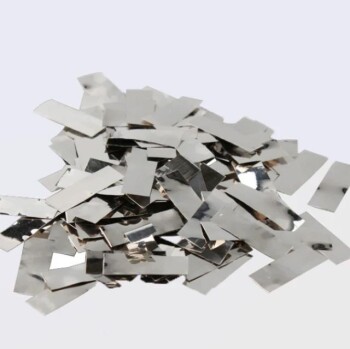
The primary purpose of using high-purity graphite granules in Microbial Electrolysis Cell (MEC) electrodes is to create a conductive, high-surface-area interface that maximizes bio-electrochemical activity. These granules act as electrode fillers that drastically increase the available space for microorganism attachment while ensuring rapid electron transfer between the biofilm and the circuit.
The core advantage of graphite granules lies in their ability to solve the biological bottleneck of MECs: they provide a vast, conductive scaffold that supports high-density biofilm growth without compromising the speed of electron transfer or chemical stability.
Maximizing Biological Capacity
Increasing Specific Surface Area
The fundamental challenge in MEC design is providing enough room for bacteria to work. High-purity graphite granules offer a large specific surface area compared to flat surfaces.
This increased geometry allows for a significantly higher volume of electrochemically active microorganisms to inhabit the electrode.
Enabling High-Density Biofilms
Because of the granular structure, the electrode environment becomes conducive to the formation of high-density biofilms.
Rather than a thin monolayer of microbes, the granules support a robust biological community. This density is critical for scaling up the bio-electrochemical reactions required for efficient operation.
Enhancing Electrochemical Performance
Rapid Electron Transfer
Biology alone is not enough; the system requires a conductive bridge. Graphite offers excellent electrical conductivity, which lowers the barrier for electron movement.
This property facilitates rapid electron transfer from the microorganisms (which generate the electrons during organic oxidation) to the electrode surface, ensuring the circuit remains active and efficient.
Chemical Stability
The internal environment of an MEC can be chemically aggressive. High-purity graphite possesses exceptional chemical stability.
This ensures the electrode material does not degrade, corrode, or leach impurities that could harm the microbial colony over long operational periods.
Understanding the Trade-offs: The Need for Current Collectors
The Conductivity Limit of Granules
While graphite granules are excellent for microbial attachment, a bed of loose granules can introduce ohmic internal resistance if used in isolation.
Electrons must jump from granule to granule, which can result in energy loss across larger electrode volumes.
The Role of the Current Collector
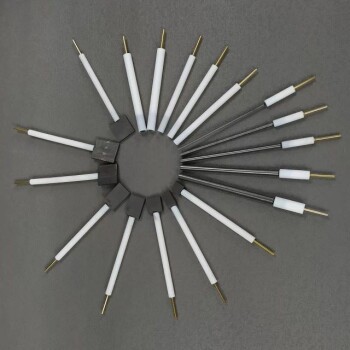
To mitigate this resistance, industrial-grade graphite rods are often inserted into the center of the granule bed.
As noted in broader contexts, these rods act as efficient current collectors, ensuring the externally applied voltage is uniformly distributed throughout the granule electrode. This combination maintains a stable environment for reaction without the voltage drops associated with packed beds.
Making the Right Choice for Your Goal
To optimize your MEC design, consider how the electrode structure aligns with your specific operational targets:
- If your primary focus is maximizing reaction rates: Prioritize smaller granule sizes to increase the specific surface area, allowing for the densest possible bacterial colonization.
- If your primary focus is electrical efficiency: Ensure the granule bed is paired with a central graphite rod current collector to minimize internal resistance and ensure uniform voltage distribution.
By combining the surface area of granules with the conductivity of a solid collector, you create an electrode that is both biologically hospitable and electrically efficient.
Summary Table:
| Feature | Benefit for MEC Performance |
|---|---|
| Large Specific Surface Area | Increases space for high-density biofilm growth and colonization |
| High Electrical Conductivity | Facilitates rapid electron transfer between microbes and the circuit |
| Chemical Stability | Ensures long-term durability and prevents corrosion in aggressive media |
| Granular Structure | Maximizes bio-electrochemical reaction rates via increased interface |
Optimize Your MEC Research with KINTEK
Take your bio-electrochemical systems to the next level with KINTEK’s premium high-purity graphite solutions. From high-surface-area granules that foster robust biofilms to industrial-grade graphite rods for efficient current collection, we provide the specialized materials needed for high-performance electrode construction.
As experts in laboratory equipment and consumables, KINTEK offers a comprehensive range of electrolytic cells, electrodes, and battery research tools designed to meet the rigorous demands of modern science. Whether you are scaling up microbial electrolysis or developing next-gen energy storage, our chemical-stable and high-conductivity materials ensure your results are both reproducible and efficient.
Ready to enhance your lab’s efficiency? Contact us today to discover how our tailored solutions can support your specific research goals.
References
- Xianshu Liu, Luyan Zhang. The Detoxification and Degradation of Benzothiazole from the Wastewater in Microbial Electrolysis Cells. DOI: 10.3390/ijerph13121259
This article is also based on technical information from Kintek Solution Knowledge Base .
Related Products
- High Purity Pure Graphite Crucible for Electron Beam Evaporation
- High Purity Pure Graphite Crucible for Evaporation
- High Purity Alumina Granulated Powder for Engineering Advanced Fine Ceramics
- Graphite Disc Rod and Sheet Electrode Electrochemical Graphite Electrode
- High Purity Gold Platinum Copper Iron Metal Sheets
People Also Ask
- What is the container that holds the metal source material called in e-beam evaporation? Ensure Purity and Quality in Your Thin-Film Deposition
- What role do high-purity graphite crucibles play in molten salt corrosion research? Ensure Reactor-Grade Precision
- Why is a high-purity graphite crucible ideal for nitrogen-doped graphene at 1500 °C? Maximize Purity and Stability
- What dual roles do high-purity graphite crucibles play? Expert Insights into Fluoride Salt Testing
- What role does a high-purity graphite crucible play in CaO-MgO-Al2O3-SiO2 system equilibrium experiments? Maximize Accuracy