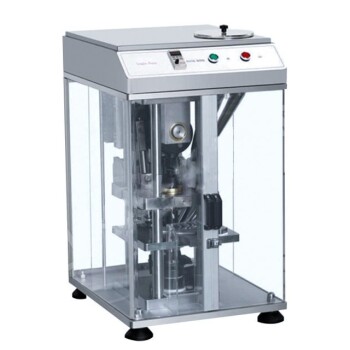
The application of 250-360 MPa pressure serves the fundamental purpose of inducing plastic deformation in sulfide electrolyte powders to create a unified, dense material layer. By subjecting the powder to this specific high-pressure range, you eliminate void spaces (pores) between particles and maximize the physical contact area, which is a prerequisite for high ionic conductivity.
Core Takeaway Cold-pressing at these pressures transitions the sulfide electrolyte from a collection of loose particles into a dense, cohesive pellet. This physical transformation is the primary mechanism for minimizing resistance and creating a structural barrier against failure modes like lithium dendrite penetration.
The Mechanics of Densification
Inducing Plastic Deformation
Sulfide electrolytes possess mechanical properties that allow them to deform under stress without fracturing.
Applying 250-360 MPa causes plastic deformation in the powder particles, forcing them to reshape and flow into one another.
Eliminating Porosity
A loose powder bed is filled with microscopic voids that block ion movement.
High-pressure cold pressing collapses these internal pores, significantly increasing the relative density of the electrolyte layer.
Electrochemical Performance Impacts
Reducing Grain Boundary Resistance
The interface where two solid particles meet is known as a grain boundary, which typically resists the flow of ions.
By maximizing the contact area through deformation, you drastically reduce grain boundary resistance, creating a smoother path for lithium ions to travel.
Maximizing Ionic Conductivity
Conductivity in solid-state batteries is directly tied to how well the particles touch.
The saturation of ionic conductivity is achieved only when the material approaches high density, ensuring the battery operates efficiently during charge and discharge cycles.
Improving Interfacial Contact
While the primary goal is densifying the electrolyte, this pressure range is also used to press composite cathodes onto the electrolyte layer.
This secondary pressing ensures intimate physical contact between the electrode and the electrolyte, reducing solid-solid interfacial contact resistance.
Structural Integrity and Safety
Preventing Lithium Dendrite Penetration
One of the greatest risks in solid-state batteries is the growth of lithium dendrites (metal spikes) that short-circuit the cell.
A highly dense electrolyte layer, achieved through high-pressure pressing, acts as a physical barrier that resists the penetration of these dendrites.
Understanding the Trade-offs
The Necessity of High Pressure
Lower pressures (e.g., the 6 MPa used for forming "green bodies") are insufficient for final performance.
Low-pressure pressing leaves significant porosity, resulting in a fragile structure with high internal resistance that will degrade battery performance.
Material Limitations
While high pressure is beneficial, it must be uniform.
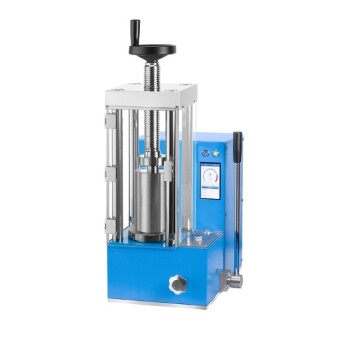
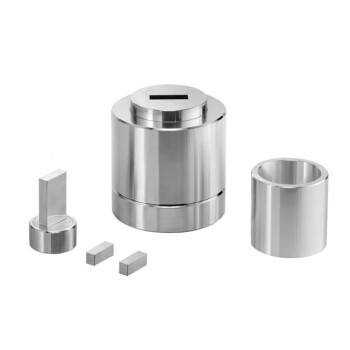
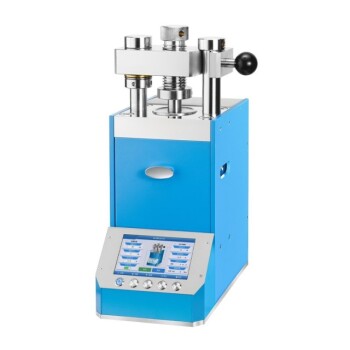
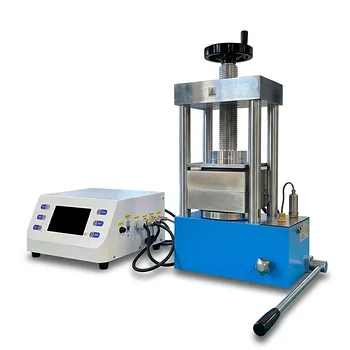
The laboratory hydraulic press is essential here to apply force evenly; uneven pressure could lead to density gradients or structural defects that compromise the layer's integrity.
Making the Right Choice for Your Goal
To achieve optimal results with sulfide electrolytes, tailor your approach based on the specific assembly stage:
- If your primary focus is increasing ionic conductivity: Ensure your hydraulic press can sustain pressures above 250 MPa to induce the necessary plastic deformation for particle cohesion.
- If your primary focus is preventing short circuits: Prioritize maximizing density through high pressure (up to 360 MPa) to eliminate pores that could serve as pathways for lithium dendrites.
High-pressure cold pressing is not merely a shaping step; it is the critical determinant of the electrolyte's electrochemical efficiency and safety.
Summary Table:
| Feature | Impact of 250-360 MPa Pressure |
|---|---|
| Material State | Induces plastic deformation for a dense, unified layer |
| Porosity | Eliminates microscopic voids and internal pores |
| Conductivity | Drastically reduces grain boundary resistance |
| Safety | Prevents lithium dendrite penetration and short circuits |
| Interface | Minimizes solid-solid interfacial contact resistance |
Elevate Your Battery Research with KINTEK Precision
To achieve the critical 250-360 MPa thresholds required for high-performance sulfide electrolytes, you need reliable and precise laboratory equipment. KINTEK specializes in high-quality hydraulic presses—including pellet, hot, and isostatic models—designed specifically for materials research and all-solid-state battery assembly.
Our comprehensive portfolio supports every stage of your workflow, from crushing and milling systems to high-temperature furnaces and advanced battery research tools. By choosing KINTEK, you ensure uniform pressure application and consistent material density, directly enhancing your cell's ionic conductivity and safety.
Ready to optimize your lab's densification process? Contact us today to find the perfect hydraulic press for your research!
Related Products
- Laboratory Hydraulic Press Split Electric Lab Pellet Press
- Electric Lab Cold Isostatic Press CIP Machine for Cold Isostatic Pressing
- Laboratory Hydraulic Pellet Press for XRF KBR FTIR Lab Applications
- Automatic Laboratory Hydraulic Press for XRF & KBR Pellet Press
- Laboratory Manual Hydraulic Pellet Press for Lab Use
People Also Ask
- What role does a laboratory hydraulic press play in platinum recovery research? Enhancing Sample Precision
- What are the specific applications of a lab hydraulic press in biochar evaluation? Optimize density and data accuracy.
- What are the roles of a laboratory hydraulic press and stainless steel molds in the preparation of graphite samples?
- What is the role of a laboratory hydraulic press in electrode prep? Maximize Energy Density & Sealing Precision
- Why must a laboratory hydraulic press equipped with cylindrical molds be used when preparing BZY green bodies? High Density