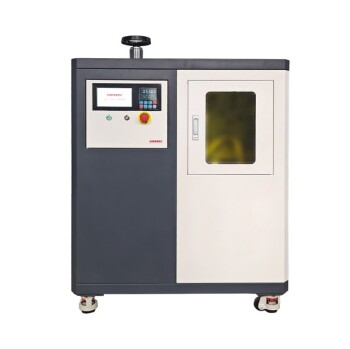
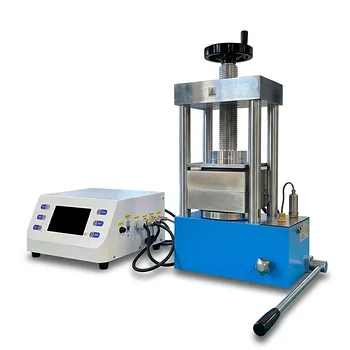
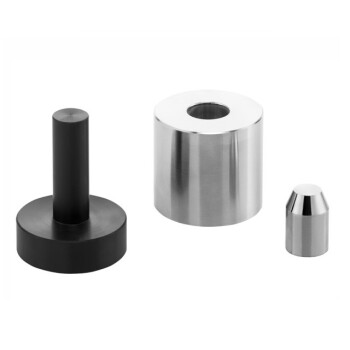
The primary purpose of using a hydraulic press during the secondary pressing stage is to force the composite cathode powder onto the pre-pressed electrolyte layer to establish a unified structure. By applying high pressure, typically around 360 MPa, the press ensures intimate physical contact between these distinct layers, which is strictly necessary for the battery to function.
In solid-state batteries, rigid materials do not naturally flow into one another like liquid electrolytes do. The hydraulic press overcomes this physical limitation by mechanically eliminating microscopic voids, thereby drastically reducing interfacial contact resistance to enable efficient charge and discharge performance.
The Mechanics of Secondary Pressing
Unifying the Cell Structure
In the final assembly of a full solid-state battery, you are often working with a pre-pressed electrolyte layer and a loose or semi-compacted composite cathode powder.
The hydraulic press applies immense force to compress this cathode powder directly onto the electrolyte. This transforms separate components into a cohesive, integrated cell stack.
Overcoming Solid-Solid Resistance
The greatest challenge in solid-state battery design is the high resistance found at the solid-solid interface.
Without liquid to wet the surface, ions struggle to jump from the electrode to the electrolyte. The hydraulic press creates the necessary "intimate contact" that bridges this gap, allowing ions to traverse the boundary freely.
Why High Pressure is Critical
Eliminating Microscopic Voids
At a microscopic level, the surfaces of solid electrolytes and electrodes are rough and uneven.
If these layers are simply stacked without sufficient pressure, microscopic voids and pores remain trapped between them. These voids act as dead zones that block ion transport.
Reducing Grain Boundary Resistance
High-pressure application, such as the 370 MPa cited in cold-press molding, does more than just push layers together.
It increases the contact area between individual particles (such as halide solid-state electrolyte powder). This significantly reduces grain boundary resistance, ensuring that the ionic conductivity is saturated and highly efficient throughout the material.
Understanding the Trade-offs
The Necessity of Specific Force
Achieving the required performance is not merely about applying "some" pressure; it requires precise, high-magnitude force (e.g., 360–370 MPa).
Standard pressing equipment often lacks the capacity to reach these specific thresholds. Failing to reach the target pressure results in a battery with poor structural integrity and high internal resistance.
Density vs. Integrity
The goal is to achieve high density to maximize electrochemical performance.
However, the pressure must be applied uniformly. The hydraulic press is essential because it provides continuous stacking pressure, minimizing the risk of uneven contact that could lead to localized failure points or inefficient ion transport channels.
Making the Right Choice for Your Goal
To ensure your solid-state battery assembly yields viable results, align your pressing strategy with your specific objectives:
- If your primary focus is minimizing internal resistance: Prioritize a press capable of sustaining at least 360 MPa to ensure the elimination of microscopic voids at the electrode-electrolyte interface.
- If your primary focus is structural longevity: Ensure your equipment can provide continuous, uniform stacking pressure to maintain high material density and prevent delamination.
The success of a solid-state battery relies less on the chemistry alone and more on the mechanical precision used to fuse those chemicals into a dense, void-free unit.
Summary Table:
| Feature | Secondary Pressing Specification | Impact on Battery Performance |
|---|---|---|
| Target Pressure | ~360 - 370 MPa | Maximizes ionic conductivity and density |
| Interface Goal | Intimate Solid-Solid Contact | Minimizes grain boundary and interfacial resistance |
| Structural Result | Cohesive Integrated Cell Stack | Eliminates microscopic voids and prevents delamination |
| Process Method | Continuous Uniform Stacking | Ensures consistent ion transport across the boundary |
Elevate Your Battery Research with KINTEK Precision
Unlock the full potential of your solid-state battery assembly with KINTEK’s advanced laboratory solutions. To achieve the critical 360 MPa pressure required for eliminating microscopic voids and reducing interfacial resistance, you need equipment engineered for precision and durability.
KINTEK specializes in high-performance hydraulic presses (pellet, hot, and isostatic) and battery research tools designed specifically for the rigorous demands of next-generation energy storage. Whether you are optimizing composite cathodes or perfecting solid-state electrolyte layers, our comprehensive range of equipment—including high-temperature furnaces and specialized consumables—ensures your research yields reproducible, high-density results.
Ready to eliminate internal resistance and enhance your cell integrity? Contact KINTEK today to find the perfect pressing solution for your lab!
Related Products
- Warm Isostatic Press for Solid State Battery Research
- Laboratory Hydraulic Press Lab Pellet Press for Button Battery
- Automatic Laboratory Hydraulic Press for XRF & KBR Pellet Press
- Laboratory Manual Hydraulic Pellet Press for Lab Use
- Laboratory Hydraulic Press Split Electric Lab Pellet Press
People Also Ask
- What is the temperature of a warm isostatic press? Achieve Optimal Densification for Your Materials
- What is the function of a Warm Isostatic Press (WIP) in all-solid-state pouch cells? Optimize Battery Density
- Why are Warm Isostatic Presses (WIP) necessary for solid-state batteries? Achieve Atomic-Level Contact
- What advantages does a warm isostatic press offer over a traditional uniaxial press for Li6PS5Cl electrolyte sheets?
- How do warm isostatic presses improve dry electrode performance? Enhance ASSB Conductivity with Heat & Pressure