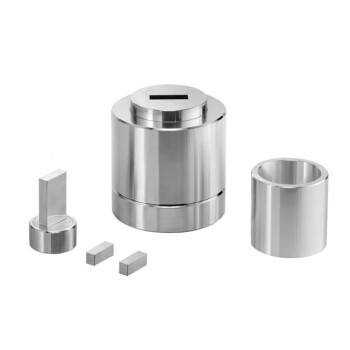
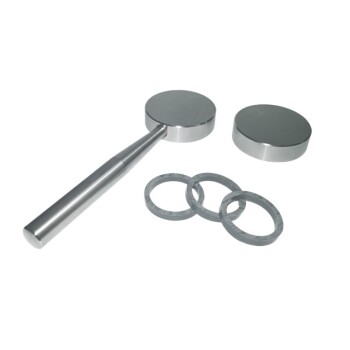
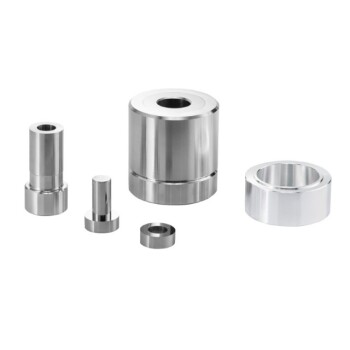
The use of a laboratory hydraulic press is essential for optimizing solid-state reaction kinetics during the synthesis of $FeVTaO_6$. By compressing loose powders into dense pellets, researchers maximize the contact area between reactant particles and drastically shorten the paths required for atomic diffusion. This physical compaction is the primary driver for achieving a complete phase transformation and producing a ceramic with high structural integrity and minimal porosity.
Pelletizing transforms loose powder into a dense "green body," shifting the synthesis from a surface-limited process to an efficient bulk reaction by facilitating rapid ion diffusion across particle boundaries.
Accelerating Chemical Reaction Kinetics
Maximizing Interfacial Contact Area
Solid-state synthesis, such as the formation of $FeVTaO_6$, occurs at the points where individual powder particles touch. A hydraulic press applies high tonnage to eliminate air gaps, ensuring that the solid-solid contact interface is maximized across the entire volume of the material.
Shortening Atomic Diffusion Paths
Chemical reactions in solids rely on the movement of ions across particle boundaries, a process that is naturally slow. Compressing the powders reduces the physical distance atoms must travel, which significantly increases the reaction rate and allows the transformation to occur more efficiently during heating.
Lowering Effective Reaction Temperatures
Because pelletizing enhances the intimacy of the mixture, the target phase can often be achieved at lower calcination temperatures. This efficiency reduces the thermal energy required and helps prevent the formation of unwanted secondary phases or residual intermediate products.
Ensuring Phase Purity and Material Integrity
Suppressing Component Volatilization
At the high temperatures required for $FeVTaO_6$ synthesis, certain chemical components may become volatile and escape the system. A compacted pellet has a lower surface-area-to-volume ratio than loose powder, which effectively suppresses the volatilization of sensitive elements and maintains the intended stoichiometry.
Preventing Material Stratification
During the heating process in a furnace, loose powders can shift or stratify based on particle size and density, leading to an inhomogeneous product. Pelletizing locks the raw materials into a stable geometric form, ensuring the chemical composition remains uniform throughout the high-temperature soak.
Enhancing Grain Growth and Crystallinity
The tight packing achieved by the hydraulic press facilitates better mass transport and grain growth during the sintering phase. This results in a final product with a well-crystallized structure and improved physical properties, such as higher mechanical stiffness.
Understanding the Trade-offs and Pitfalls
The Risk of Pressure-Induced Laminations
Applying excessive pressure can lead to "capping" or lamination, where the pellet develops internal cracks or splits into layers upon release from the die. This occurs when trapped air or elastic recovery exceeds the structural integrity of the compacted powder.
Die Contamination and Wear
The high-strength steel or tungsten carbide used in press dies can introduce metallic impurities into the $FeVTaO_6$ sample through abrasion. It is critical to clean dies thoroughly and, in some cases, use a lubricant or thin foil barrier to maintain the highest levels of phase purity.
How to Optimize Your Pelletizing Process
Recommendations for Synthesis Goals
- If your primary focus is Phase Purity: Use a moderate, consistent pressure to ensure intimate contact while avoiding the introduction of die wear contaminants.
- If your primary focus is High Density/Low Porosity: Increase the dwell time (the duration the pressure is held) to allow for better particle rearrangement and the elimination of micro-voids.
- If your primary focus is Homogeneity: Ensure the powders are thoroughly ground and mixed before pelletizing to prevent "pockets" of unreacted material within the dense body.
The strategic use of a laboratory hydraulic press transforms a simple powder mixture into a reactive system capable of producing high-quality, high-purity $FeVTaO_6$ ceramics.
Summary Table:
| Key Benefit | Mechanism of Action | Impact on Synthesis Results |
|---|---|---|
| Enhanced Kinetics | Maximizes solid-solid interfacial contact | Accelerates chemical reaction rates |
| Faster Diffusion | Shortens atomic travel distances | Lowers necessary calcination temperatures |
| Phase Purity | Reduces surface-area-to-volume ratio | Suppresses volatilization of sensitive elements |
| Homogeneity | Prevents powder shifting/stratification | Ensures uniform chemical composition |
| Crystallinity | Facilitates better mass transport | Promotes grain growth and mechanical stiffness |
Elevate Your Material Synthesis with KINTEK Precision
Achieving the perfect phase purity in complex oxides like $FeVTaO_6$ requires more than just heat—it requires precision compaction. KINTEK specializes in high-performance laboratory equipment designed to optimize every stage of your solid-state synthesis.
From our robust hydraulic presses (pellet, hot, and isostatic) that ensure maximum interfacial contact, to our advanced crushing and milling systems for superior pre-mixing, we provide the tools necessary for high-integrity research. Pair your pelletizing process with our comprehensive range of high-temperature furnaces (muffle, vacuum, and atmosphere) and high-purity ceramic crucibles to achieve unparalleled results.
Ready to optimize your lab’s efficiency and reaction yields? Contact our technical experts today to find the ideal pressing and heating solution for your specific research goals.
References
- E. Filipek, Maciej Zubko. New FeVTaO6 compound—synthesis, structure and selected properties. DOI: 10.1007/s10853-023-09168-x
This article is also based on technical information from Kintek Solution Knowledge Base .
Related Products
- Automatic Laboratory Hydraulic Pellet Press Machine for Lab Use
- Automatic Laboratory Hydraulic Press for XRF & KBR Pellet Press
- Laboratory Hydraulic Pellet Press for XRF KBR FTIR Lab Applications
- Laboratory Manual Hydraulic Pellet Press for Lab Use
- Laboratory Hydraulic Press Lab Pellet Press Machine for Glove Box
People Also Ask
- What is the role of a laboratory hydraulic pellet press and stainless steel molds in the fabrication of RuO2/NbC anodes?
- What role does a laboratory pellet press play in the enhancement of biomass energy products? Optimize Fuel Efficiency
- What is the purpose of using a laboratory pellet press when evaluating the electronic conductivity of carbon powders? Guide
- How does a laboratory hydraulic pellet press contribute to SiCw/2024 aluminum composite preforms? Optimize Densification
- What is the significance of applying 200 MPa of pressure with a laboratory hydraulic pellet press for composite ceramics?