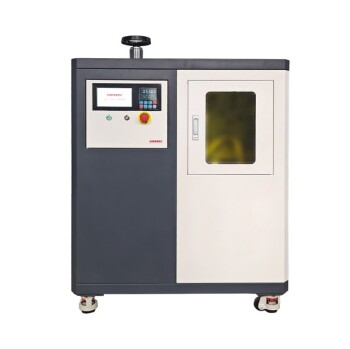
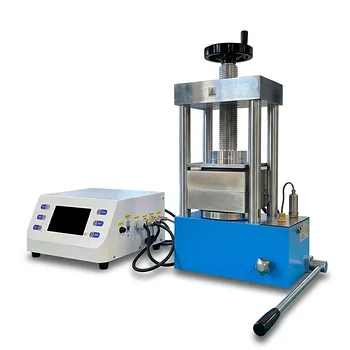
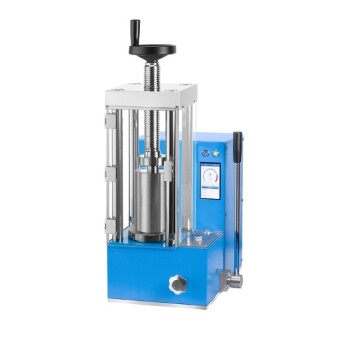
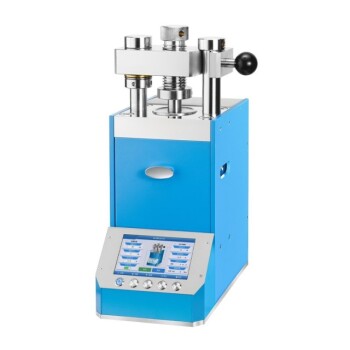
The primary objective of using a large-tonnage laboratory hydraulic press during the final molding stage is to apply extreme mechanical force to densify the electrode structure. By exerting pressures as high as 770 MPa on solid electrolyte-infiltrated cathodes, this cold-pressing process drastically minimizes internal porosity. This ensures the active materials and solid electrolytes are forced into tight, cohesive physical contact, which is essential for establishing efficient ion transport pathways.
The core function of high-tonnage cold pressing is to overcome the physical resistance of solid particles to create a unified, high-density composite. It replaces the wetting action of liquid electrolytes with mechanical interlocking, significantly reducing interfacial impedance without the use of heat.
The Physics of Densification
Minimizing Internal Porosity
In solid-state batteries, any air gap or void is a "dead zone" that blocks ion movement.
A large-tonnage press applies sufficient force to collapse these voids. By eliminating porosity, you ensure that the volume of the electrode is utilized almost entirely by active material and electrolyte, rather than wasted space.
Maximizing Compaction Density
The effectiveness of a solid-state battery relies heavily on how tightly packed the components are.
High-pressure cold pressing significantly increases the compaction density of the composite cathode. This directly translates to higher volumetric energy density, allowing for more energy storage in a smaller physical footprint.
Establishing Structural Integrity
Unlike liquid systems, solid-state components do not naturally adhere to one another.
The extreme pressure creates a self-supporting structure. This provides the necessary mechanical strength for the cathode to withstand subsequent assembly steps or operation cycles without delaminating.
Optimizing Ion Transport
Forcing Intimate Contact
Solid electrolytes cannot flow into crevices like liquid electrolytes.
The press forces the active materials and the solid electrolyte into tight physical contact. This proximity is non-negotiable; without it, lithium ions cannot physically jump from the cathode material into the electrolyte lattice.
Reducing Interfacial Impedance
High resistance at the particle boundaries is a primary failure mode in solid-state batteries.
By utilizing mechanical force to interlock particles, the process minimizes the distance ions must travel between materials. This mechanical interlocking significantly reduces interfacial impedance, facilitating faster charging and discharging rates.
Enabling Solvent-Free Processing
Traditional slurry coatings rely on solvents and binders that can trigger side reactions.
Using a hydraulic press allows for a dry, layer-by-layer manufacturing approach. This avoids chemical incompatibilities associated with solvents, relying instead on pure pressure to maintain the interface stability.
Understanding the Trade-offs
The Risk of Particle Fracture
While high pressure is necessary for contact, excessive force can be destructive.
If the pressure exceeds the mechanical limits of the cathode particles (such as single-crystal NMC), it may cause particle cracking or pulverization. This damage can isolate active material, rendering it chemically inactive despite the high density.
Uniformity Challenges
Applying massive tonnage requires precise control to ensure the pressure is distributed evenly across the pellet.
Uneven pressure distribution can lead to density gradients within the cathode. Areas of lower density will become bottlenecks for ion flux, leading to localized degradation and reduced overall cell performance.
Making the Right Choice for Your Goal
If your primary focus is maximizing volumetric energy density: Prioritize higher pressure settings (up to 770 MPa) to eliminate virtually all porosity, ensuring the most compact electrode possible.
If your primary focus is reducing interfacial resistance: Focus on the uniformity of the pressure application to ensure consistent mechanical interlocking between the active material and the electrolyte across the entire interface.
If your primary focus is material integrity: Balance the pressure levels carefully to achieve sufficient contact without crushing or pulverizing sensitive active material particles.
Success in solid-state molding lies in finding the precise pressure window that maximizes density without compromising the structural integrity of the individual particles.
Summary Table:
| Key Objective | Mechanism | Performance Impact |
|---|---|---|
| Densification | Collapses voids & internal porosity | Higher volumetric energy density |
| Interfacial Contact | Forces mechanical interlocking | Lower impedance & faster ion transport |
| Structural Integrity | Creates self-supporting solid pellets | Prevents delamination during cycling |
| Solvent-Free Process | Layer-by-layer dry pressing | Eliminates chemical side reactions |
| Pressure Control | Optimized tonnage up to 770 MPa | Prevents particle fracture & cracking |
Elevate Your Battery Research with KINTEK Precision
Unlock the full potential of your solid-state battery research with KINTEK’s high-performance laboratory hydraulic presses. Our manual and electric pellet presses provide the extreme, uniform pressure (up to 770 MPa and beyond) required for achieving superior compaction density and seamless mechanical interlocking in composite cathodes.
From high-temperature high-pressure reactors to specialized crushing and milling systems, KINTEK specializes in laboratory equipment and consumables tailored for energy storage innovation. Let us help you eliminate interfacial impedance and optimize your electrode structural integrity.
Ready to scale your energy density? Contact KINTEK today for a customized solution!
Related Products
- kbr pellet press 2t
- Laboratory Hydraulic Press Lab Pellet Press for Button Battery
- Automatic Laboratory Hydraulic Press for XRF & KBR Pellet Press
- Laboratory Hydraulic Press Split Electric Lab Pellet Press
- Warm Isostatic Press for Solid State Battery Research
People Also Ask
- How do you prepare samples for IR spectroscopy? A Step-by-Step Guide for Solids, Liquids, and Gases
- What measurement methods are commonly used for powder samples in infrared spectroscopy? Optimize Your FTIR Analysis
- Why KBr is used in IR spectrophotometry? A Key to Transparent Sample Analysis
- How are a KBr pellet press and mortar utilized in FTIR analysis of activated carbon? Expert Sample Prep Guide
- How do you prepare KBr pellets for FTIR analysis? Master the Technique for High-Quality IR Spectra