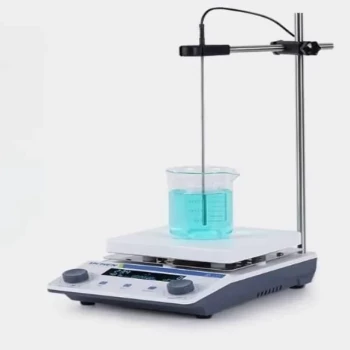
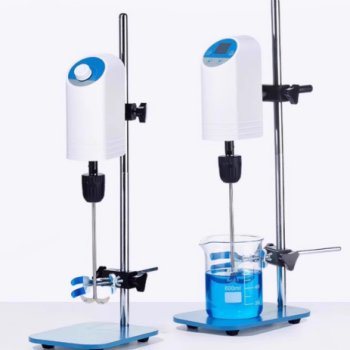
The primary purpose of using a magnetic stirrer or shaker is to maintain continuous, low-speed agitation during the critical initial hardening phase. This mechanical movement, typically around 100 rpm, prevents the newly formed beads from clumping together and ensures they are evenly exposed to the cross-linking chemicals necessary for solidification.
Core Takeaway: Agitation is the key to consistency. It physically separates the beads to prevent fusion while chemically facilitating a uniform cross-linking reaction from the surface to the core, resulting in stable, usable spheres.
The Mechanics of Bead Stabilization
Preventing Bead Aggregation
When immobilized beads are first dropped into the solution, they are often soft and prone to sticking. Without movement, gravity would cause them to settle and fuse into a single mass.
Continuous agitation keeps the beads suspended and moving relative to one another. This physical separation ensures that each bead hardens as a distinct, individual sphere rather than part of an unusable clump.
Ensuring Chemical Uniformity
For a bead to harden correctly, its entire surface area must interact with the cross-linking agent, such as a saturated boric acid solution containing calcium chloride.
Agitation cycles the solution, ensuring fresh chemicals are constantly in contact with the bead surface. This eliminates stagnant zones around the bead that could otherwise slow down the reaction or leave soft spots.
Promoting Core Stability
The goal of cross-linking is not just a hard shell, but a stable structure throughout the bead.
By maintaining full surface contact, agitation drives the cross-linking reaction from the outer surface deep into the core. This thorough penetration creates physically stable spheres that are robust enough for downstream applications.
Critical Operational Considerations
The Importance of Speed Control
While movement is essential, the intensity of that movement matters. The reference specifically suggests a low speed, such as 100 rpm.
Avoiding Shear Stress
Excessive agitation speed can be detrimental. High-velocity stirring creates shear forces that can deform or shatter fragile beads before they have fully hardened.
Balancing Suspension and Safety
The ideal operational window provides just enough force to keep beads buoyant and separate. It must be gentle enough to preserve the integrity of the soft, forming spheres during the initial stages of the reaction.
Optimizing Your Bead Production Process
To ensure high-quality immobilized beads, tailor your approach based on your specific production priorities:
- If your primary focus is Physical Consistency: maintain a strict, low-speed RPM (e.g., 100 rpm) to prevent beads from fusing without causing deformation.
- If your primary focus is Structural Integrity: ensure the agitation continues until the cross-linking agent has fully penetrated from the surface to the core.
Correct agitation turns a delicate chemical process into a reliable, repeatable manufacturing standard.
Summary Table:
| Parameter | Purpose | Benefit |
|---|---|---|
| Agitation Speed | Low-speed (approx. 100 rpm) | Prevents shear stress and bead deformation |
| Mechanical Separation | Continuous suspension | Prevents beads from clumping and fusing into masses |
| Chemical Exposure | Solution cycling | Ensures uniform cross-linking from surface to core |
| Structural Integrity | Full surface contact | Creates robust, physically stable spheres for downstream use |
Elevate Your Lab Research with KINTEK Precision
Achieving the perfect consistency in immobilized bead production requires precision tools. KINTEK specializes in high-quality laboratory equipment designed to meet the rigorous demands of material science and biotech research. From our reliable magnetic stirrers and shakers to specialized homogenizers and high-pressure reactors, we provide the technology you need for repeatable, high-quality results.
Whether you are focusing on battery research, milling systems, or advanced thermal processing, KINTEK is your partner in laboratory excellence. Contact us today to discover how our comprehensive range of equipment and consumables can optimize your workflow and drive your next breakthrough!
References
- Yanrong Dong, Mingwei Li. Dynamic Experimental Study on Treatment of Acid Mine Drainage by Bacteria Supported in Natural Minerals. DOI: 10.3390/en13020439
This article is also based on technical information from Kintek Solution Knowledge Base .
Related Products
- Laboratory Small Constant Temperature Heated Magnetic Stirrer Heater and Stirrer
- Custom PTFE Teflon Parts Manufacturer for Magnetic Stirring Bar
- High Performance Laboratory Stirrers for Diverse Applications
- Three-dimensional electromagnetic sieving instrument
- Custom PTFE Teflon Parts Manufacturer for PTFE Stirring Bar Recovery Rod
People Also Ask
- What role does a magnetic stirrer with heating play in ZnO nanoparticle synthesis? Precision Control for Quality Results
- What role does a constant temperature heating magnetic stirrer play in MFC-HAp synthesis? Achieve Material Homogeneity
- What is the function of a laboratory magnetic stirrer in Ni–Cr–P electrodeposition? Optimize Ion Transport & Coating
- Why is a laboratory magnetic stirrer required for benzoic acid esters? Boost Reaction Speed & Yield with High RPM
- What role does a laboratory magnetic stirrer play in TiO2 and TiO2-Ag sol preparation? Master Chemical Kinetics