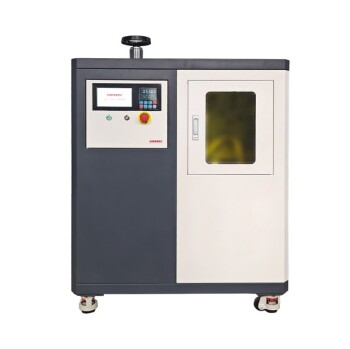
The primary purpose of using a precision hot press in Membrane Electrode Assembly (MEA) integration is to bond the catalyst-coated gas diffusion layer (GDL) with the proton exchange membrane through synchronized heat and pressure. This technique ensures superior physical contact between layers, which is fundamental to the structural integrity and electrochemical efficiency of the final device.
The precision hot press transforms separate components into a high-performance electrochemical unit. By inducing thermoplastic softening and mechanical interlocking, it minimizes interfacial resistance and establishes the critical pathways required for efficient proton conduction.
The Mechanics of the Integration Process
Synchronized Temperature and Pressure
The core function of the machine is the application of synchronized, precise temperature and pressure.
Unlike standard lamination, a precision hot press controls these variables tightly (e.g., 2.4 MPa at 155 °C) to ensure uniformity across the entire active area.
Thermoplastic Softening
The application of heat serves a specific chemical purpose: it induces thermoplastic softening of the ionomer.
This softening allows the catalyst layer to bond seamlessly with the Nafion proton exchange membrane.
Mechanical Interlocking
Once the ionomer softens, the pressure forces the components together to create tight mechanical interlocking.
This ensures that the catalyst layer acts as a cohesive unit with the membrane, rather than merely resting on top of it.
Optimizing Electrochemical Performance
Reducing Interfacial Resistance
The most critical output of this process is the reduction of interfacial resistance.
By eliminating microscopic gaps between the catalyst layer and the membrane, the press ensures efficient electron transfer efficiency during operation.
Establishing Proton Transport Channels
Proper bonding creates efficient proton transport channels between the catalyst particles and the membrane.
Without this "intimate" contact, protons cannot move effectively, severely limiting the performance of the PEM electrolyzer.
Maximizing Catalyst Utilization
The hot-pressing process is vital for realizing the actual potential of advanced catalysts (such as Pt/Ti(1-x)MxO2-C).
Even the highest-quality catalyst will fail to perform in single-cell testing if the physical connection to the membrane is weak or inconsistent.
Understanding the Trade-offs
The Balance of Pressure
While pressure is necessary for bonding, there is a fine line between optimal contact and component damage.
Insufficient pressure results in high contact resistance, while excessive pressure can crush the gas diffusion layer, reducing the porosity needed for mass transport.
Temperature Sensitivity
The temperature must be high enough to soften the ionomer but low enough to prevent thermal degradation of the membrane.
Precision control is required to hit the specific window (often around 120°C to 155°C) where bonding occurs without compromising the material properties of the Nafion.
Making the Right Choice for Your Goal
To maximize the efficacy of your MEA fabrication, consider your specific testing objectives.
- If your primary focus is Electrical Efficiency: Prioritize higher precision in pressure application to minimize contact resistance and maximize electron transfer.
- If your primary focus is Durability: Focus on optimizing the temperature profile to ensure robust mechanical interlocking without thermally stressing the membrane.
The precision hot press is not just a bonding tool; it is the gatekeeper of your device's electrochemical efficiency.
Summary Table:
| Feature | Function in MEA Integration | Impact on Performance |
|---|---|---|
| Synchronized Heat | Induces thermoplastic softening of the ionomer | Ensures seamless bonding with the membrane |
| Controlled Pressure | Facilitates mechanical interlocking of layers | Minimizes interfacial and contact resistance |
| Precision Control | Maintains uniform active area contact | Prevents GDL crushing and membrane degradation |
| Interface Optimization | Eliminates microscopic air gaps | Maximizes catalyst utilization and electron transfer |
Elevate Your Electrochemical Research with KINTEK
Precision is the foundation of high-performance Membrane Electrode Assemblies (MEA). At KINTEK, we specialize in the advanced laboratory equipment necessary to bridge the gap between material synthesis and device efficiency. Our range of high-precision hydraulic presses (including pellet, hot, and isostatic models) is engineered to provide the exact temperature and pressure control required to minimize interfacial resistance and maximize your catalyst's potential.
Whether you are developing next-generation PEM electrolyzers or optimizing fuel cell durability, our comprehensive portfolio—from electrolytic cells and electrodes to high-temperature furnaces and crushing systems—is designed to support every stage of your laboratory workflow.
Ready to achieve superior bonding and electrochemical integrity? Contact our technical experts today to find the perfect precision hot press solution for your research goals.
References
- Iveta Boshnakova, Evelina Slavcheva. Bimetallic Ir-Sn Non-Carbon Supported Anode Catalysts for PEM Water Electrolysis. DOI: 10.3390/inorganics13070210
This article is also based on technical information from Kintek Solution Knowledge Base .
Related Products
- Automatic Heated Hydraulic Press Machine with Heated Plates for Laboratory Hot Press 25T 30T 50T
- Manual High Temperature Heated Hydraulic Press Machine with Heated Plates for Lab
- Touchscreen Automatic Vacuum Heat Press
- 30T 40T Split Automatic Heated Hydraulic Press Machine with Heated Plates for Laboratory Hot Press
- Vacuum Hot Press Furnace Machine Heated Vacuum Press
People Also Ask
- Why is the heating function of a laboratory hydraulic press essential for MEA assembly in DEFC? Optimize Cell Bonding
- What technical conditions does a heated hydraulic press provide for PEO batteries? Optimize Solid-State Interfaces
- How is a heated hydraulic press used for Li-LLZO batteries? Optimize Interfacial Bonding with Thermal-Pressure
- What role does a heated hydraulic press play in Cold Sintering (CSP)? Enhancing LATP-Halide Densification
- What are heated hydraulic presses used for? Molding Composites, Vulcanizing Rubber, and More