Knowledge What is the relationship between pressure and filtration? Unlock the Key to Efficient Filter Performance
Author avatar

Tech Team · Kintek Solution

Updated 6 days ago

What is the relationship between pressure and filtration? Unlock the Key to Efficient Filter Performance


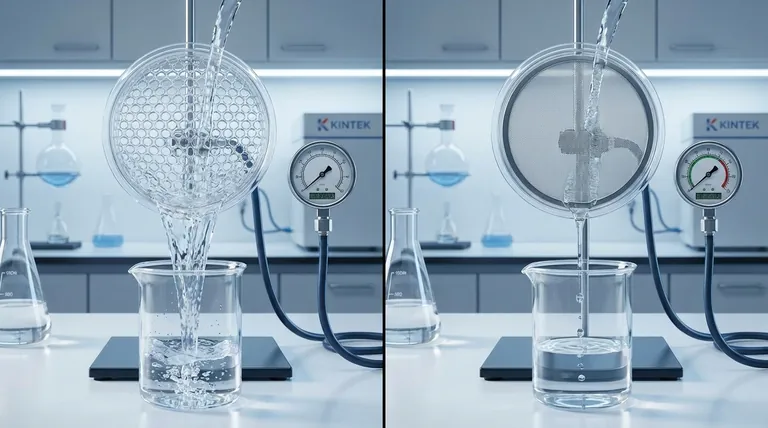
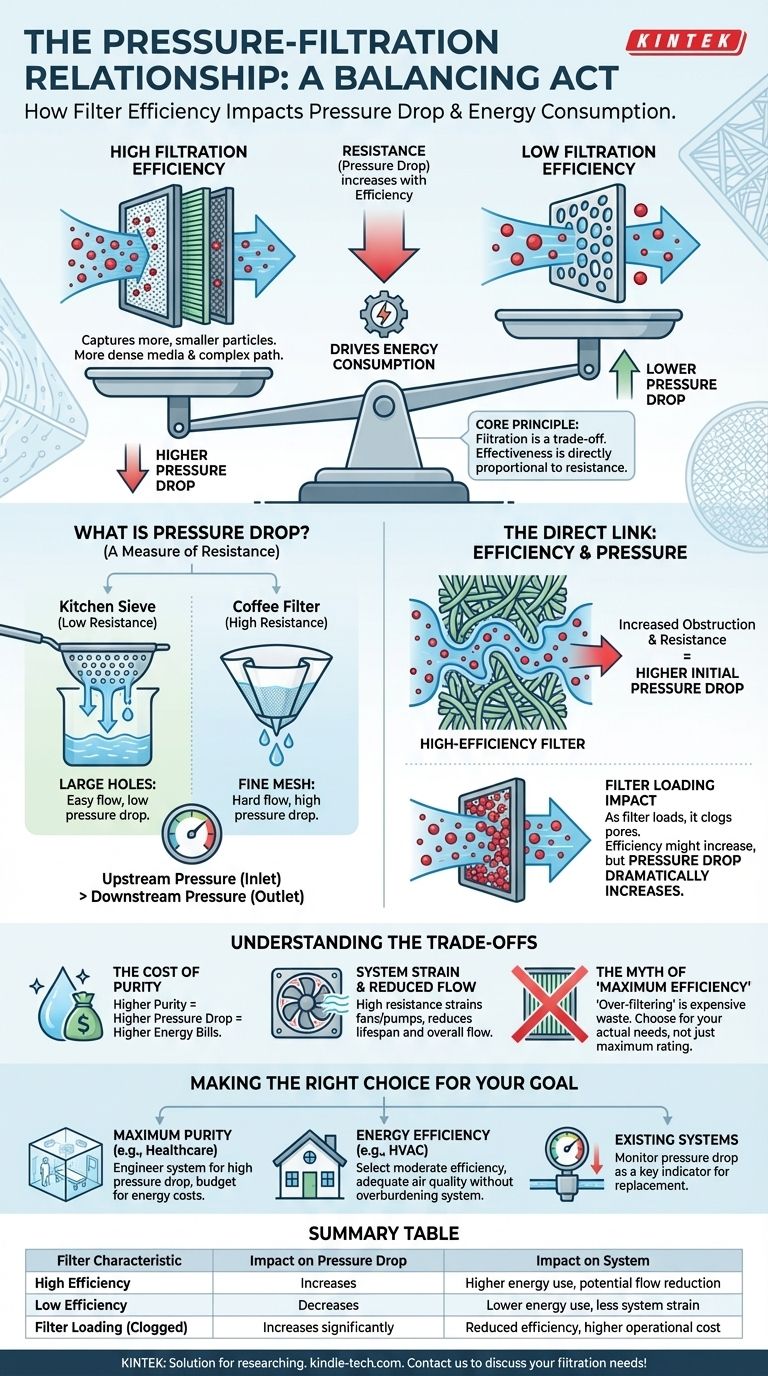
In filtration, pressure and efficiency are fundamentally linked. A higher filtration efficiency invariably results in a higher pressure drop. This means the more effective a filter is at capturing small particles, the more resistance it creates to the flow of the fluid (like air or water) passing through it, forcing your system to work harder.

The core principle to understand is that filtration is a balancing act. The effectiveness of a filter at capturing contaminants (its efficiency) is directly proportional to the resistance it creates (pressure drop), which in turn drives energy consumption and system performance.
What is the relationship between pressure and filtration? Unlock the Key to Efficient Filter Performance

What is Pressure Drop?

A Measure of Resistance

Pressure drop is the difference in pressure measured between the upstream (inlet) side and the downstream (outlet) side of a filter. It is the most direct way to quantify how much resistance a filter adds to a system.

An Intuitive Analogy

Think of pouring water through a kitchen sieve. A sieve with large holes allows water to flow through with little resistance—this is a low pressure drop. A sieve made of very fine mesh, like a coffee filter, requires more force to push the same amount of water through in the same amount of time. This resistance is a high pressure drop.

Why It Matters

A high pressure drop signifies that the system's fan or pump must exert more energy to move the fluid through the filter. This directly translates to higher energy consumption and can reduce the overall flow rate if the system isn't powerful enough to overcome the resistance.

The Direct Link Between Efficiency and Pressure

How High-Efficiency Filters Work

High-efficiency filters are designed to capture extremely small particles. To do this, their internal filter media is either much denser or creates a more complex, tortuous path for the fluid to navigate.

The Source of Resistance

This dense and complex structure, which is essential for capturing microscopic contaminants, naturally creates more physical obstruction. More obstruction means more resistance, leading directly to a higher initial pressure drop compared to a less efficient filter.

The Impact of Filter Loading

As any filter operates, it captures and holds contaminants. These trapped particles begin to clog the filter's pores, which ironically can increase its capture efficiency but also dramatically increases the pressure drop. This is why filters must be changed regularly.

Understanding the Trade-offs

The Cost of Purity

The central trade-off is between the quality of your filtered fluid and the operational cost. Achieving higher purity with a more efficient filter will always demand more energy to overcome the associated pressure drop, leading to higher utility bills.

System Strain and Reduced Flow

Forcing air or liquid through a high-resistance filter can put significant strain on fans, motors, and pumps, potentially reducing their operational lifespan. In systems not designed for it, a high-efficiency filter can starve the system, leading to a noticeable reduction in overall flow.

The Myth of "Always Choose Maximum Efficiency"

Selecting a filter with an efficiency rating that is much higher than what the application truly requires is a frequent and expensive error. This "over-filtering" leads to unnecessary energy expenditure and can negatively impact system performance without providing any tangible benefit.

Making the Right Choice for Your Goal

Ultimately, the correct filter is the one that meets your specific requirements without introducing excessive and costly resistance.

  • If your primary focus is maximum purity (e.g., cleanrooms, healthcare): You must engineer the system to handle a high pressure drop and budget for the corresponding energy costs.
  • If your primary focus is energy efficiency (e.g., residential HVAC): Select a filter with a moderate efficiency rating that provides adequate air quality without overburdening your system's fan.
  • If you are managing an existing system: Monitor the pressure drop across your filters as a key indicator for when they are loaded and require replacement to maintain both efficiency and performance.

Choosing the right filter is about finding the optimal balance between performance and purity for your specific application.

Summary Table:

Filter Characteristic Impact on Pressure Drop Impact on System
High Efficiency Increases Higher energy use, potential flow reduction
Low Efficiency Decreases Lower energy use, less system strain
Filter Loading (Clogged) Increases significantly Reduced efficiency, higher operational cost

Struggling to balance filtration efficiency with system pressure and energy costs? KINTEK specializes in lab equipment and consumables, offering expert solutions to help you select the perfect filter for your specific application—ensuring optimal performance, purity, and cost-efficiency for your laboratory. Contact us today to discuss your filtration needs and let our specialists guide you to a smarter, more effective solution!

Visual Guide
What is the relationship between pressure and filtration? Unlock the Key to Efficient Filter Performance Visual Guide

Related Products

People Also Ask

Related Products

Laboratory Sterilizer Lab Autoclave Pulse Vacuum Lifting Sterilizer

Laboratory Sterilizer Lab Autoclave Pulse Vacuum Lifting Sterilizer

The pulse vacuum lifting sterilizer is a state-of-the-art equipment for efficient and precise sterilization. It uses pulsating vacuum technology, customizable cycles, and a user-friendly design for easy operation and safety.

Laboratory Sterilizer Lab Autoclave Vertical Pressure Steam Sterilizer for Liquid Crystal Display Automatic Type

Laboratory Sterilizer Lab Autoclave Vertical Pressure Steam Sterilizer for Liquid Crystal Display Automatic Type

Liquid crystal display automatic vertical sterilizer is a safe, reliable and automatic control sterilization equipment, which is composed of heating system, microcomputer control system and overheating and overvoltage protection system.

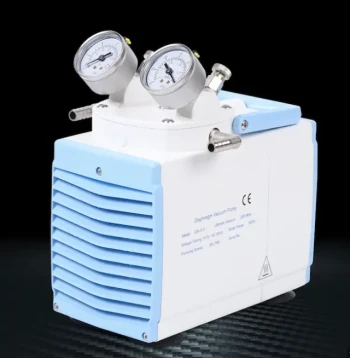
Oil Free Diaphragm Vacuum Pump for Laboratory and Industrial Use

Oil Free Diaphragm Vacuum Pump for Laboratory and Industrial Use

Oil-free diaphragm vacuum pump for labs: clean, reliable, chemical-resistant. Ideal for filtration, SPE, and rotary evaporation. Maintenance-free operation.

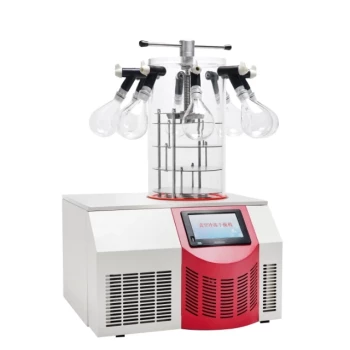
Benchtop Laboratory Vacuum Freeze Dryer

Benchtop Laboratory Vacuum Freeze Dryer

Benchtop laboratory freeze dryer for efficient lyophilization of biological, pharmaceutical, and food samples. Features intuitive touchscreen, high-performance refrigeration, and durable design. Preserve sample integrity—consult now!

HFCVD Machine System Equipment for Drawing Die Nano-Diamond Coating

HFCVD Machine System Equipment for Drawing Die Nano-Diamond Coating

The nano-diamond composite coating drawing die uses cemented carbide (WC-Co) as the substrate, and uses the chemical vapor phase method ( CVD method for short ) to coat the conventional diamond and nano-diamond composite coating on the surface of the inner hole of the mold.

Vacuum Hot Press Furnace Machine for Lamination and Heating

Vacuum Hot Press Furnace Machine for Lamination and Heating

Experience clean and precise lamination with Vacuum Lamination Press. Perfect for wafer bonding, thin-film transformations, and LCP lamination. Order now!

915MHz MPCVD Diamond Machine Microwave Plasma Chemical Vapor Deposition System Reactor

915MHz MPCVD Diamond Machine Microwave Plasma Chemical Vapor Deposition System Reactor

915MHz MPCVD Diamond Machine and its multi-crystal effective growth, the maximum area can reach 8 inches, the maximum effective growth area of single crystal can reach 5 inches. This equipment is mainly used for the production of large-size polycrystalline diamond films, the growth of long single crystal diamonds, the low-temperature growth of high-quality graphene, and other materials that require energy provided by microwave plasma for growth.

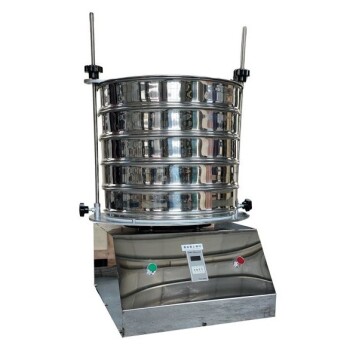
Laboratory Test Sieves and Sieving Machines

Laboratory Test Sieves and Sieving Machines

Precision lab test sieves & sieving machines for accurate particle analysis. Stainless steel, ISO-compliant, 20μm-125mm range. Request specs now!

Graphite Vacuum Furnace IGBT Experimental Graphitization Furnace

Graphite Vacuum Furnace IGBT Experimental Graphitization Furnace

IGBT experimental graphitization furnace, a tailored solution for universities and research institutions, with high heating efficiency, user-friendliness, and precise temperature control.

Vacuum Dental Porcelain Sintering Furnace

Vacuum Dental Porcelain Sintering Furnace

Get precise and reliable results with KinTek's Vacuum Porcelain Furnace. Suitable for all porcelain powders, it features hyperbolic ceramic furnace function, voice prompt, and automatic temperature calibration.

Large Vertical Graphite Vacuum Graphitization Furnace

Large Vertical Graphite Vacuum Graphitization Furnace

A large vertical high-temperature graphitization furnace is a type of industrial furnace used for the graphitization of carbon materials, such as carbon fiber and carbon black. It is a high-temperature furnace that can reach temperatures of up to 3100°C.

Vertical High Temperature Graphite Vacuum Graphitization Furnace

Vertical High Temperature Graphite Vacuum Graphitization Furnace

Vertical high temperature graphitization furnace for carbonization and graphitization of carbon materials up to 3100℃.Suitable for shaped graphitization of carbon fiber filaments and other materials sintered in a carbon environment.Applications in metallurgy, electronics, and aerospace for producing high-quality graphite products like electrodes and crucibles.

Ultra-High Temperature Graphite Vacuum Graphitization Furnace

Ultra-High Temperature Graphite Vacuum Graphitization Furnace

The ultra-high temperature graphitization furnace utilizes medium frequency induction heating in a vacuum or inert gas environment. The induction coil generates an alternating magnetic field, inducing eddy currents in the graphite crucible, which heats up and radiates heat to the workpiece, bringing it to the desired temperature. This furnace is primarily used for graphitization and sintering of carbon materials, carbon fiber materials, and other composite materials.

Small Vacuum Heat Treat and Tungsten Wire Sintering Furnace

Small Vacuum Heat Treat and Tungsten Wire Sintering Furnace

The small vacuum tungsten wire sintering furnace is a compact experimental vacuum furnace specially designed for universities and scientific research institutes. The furnace features a CNC welded shell and vacuum piping to ensure leak-free operation. Quick-connect electrical connections facilitate relocation and debugging, and the standard electrical control cabinet is safe and convenient to operate.

Benchtop Laboratory Freeze Dryer for Lab Use

Benchtop Laboratory Freeze Dryer for Lab Use

Premium benchtop laboratory freeze dryer for lyophilization, preserving samples with ≤ -60°C cooling. Ideal for pharmaceuticals & research.

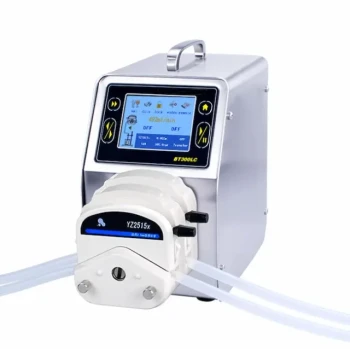
Variable Speed Peristaltic Pump

Variable Speed Peristaltic Pump

KT-VSP Series Smart Variable Speed Peristaltic Pumps offer precise flow control for labs, medical, and industrial applications. Reliable, contamination-free liquid transfer.

Anti-Cracking Press Mold for Lab Use

Anti-Cracking Press Mold for Lab Use

The anti-cracking press mold is a specialized equipment designed for molding various shapes and sizes of film using high pressure and electric heating.

Vacuum Heat Treat Furnace with Ceramic Fiber Liner

Vacuum Heat Treat Furnace with Ceramic Fiber Liner

Vacuum furnace with polycrystalline ceramic fiber insulation liner for excellent heat insulation and uniform temperature field. Choose from 1200℃ or 1700℃ max. working temperature with high vacuum performance and precise temperature control.

Vacuum Heat Treat and Molybdenum Wire Sintering Furnace for Vacuum Sintering

Vacuum Heat Treat and Molybdenum Wire Sintering Furnace for Vacuum Sintering

A vacuum molybdenum wire sintering furnace is a vertical or bedroom structure, which is suitable for withdrawal, brazing, sintering and degassing of metal materials under high vacuum and high temperature conditions. It is also suitable for dehydroxylation treatment of quartz materials.

Graphite Vacuum Furnace High Thermal Conductivity Film Graphitization Furnace

Graphite Vacuum Furnace High Thermal Conductivity Film Graphitization Furnace

The high thermal conductivity film graphitization furnace has uniform temperature, low energy consumption and can operate continuously.


Leave Your Message