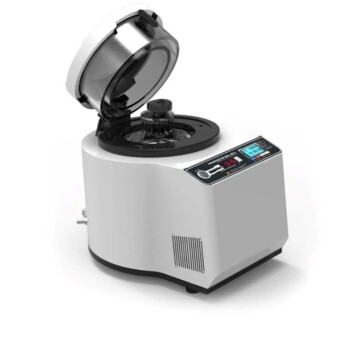
The combination of a high-energy ball mill and zirconia grinding balls is the standard method for preparing high-purity NASICON electrolyte precursors.
The high-energy ball mill provides the necessary mechanical force to refine raw materials like Sodium Carbonate (Na2CO3) and Zirconium Dioxide (ZrO2) into a uniformly dispersed mixture. Zirconia grinding balls are the specific medium of choice because their extreme hardness allows them to pulverize these particles to the micrometer level without introducing performance-killing contaminants.
Core Takeaway The success of NASICON preparation relies on "clean energy": the ball mill generates the intense kinetic energy required for particle refinement, while zirconia media ensures this energy is transferred without shedding metallic impurities that would degrade the electrolyte's ionic conductivity.
The Mechanics of Preparation
Utilizing Mechanical Force
A high-energy ball mill is not merely a mixer; it is a reactor that applies intense mechanical force. Its primary function is to break down the crystal structures of the raw materials.
Uniform Dispersion
For NASICON electrolytes, the starting materials—specifically Na2CO3 and ZrO2—must be intimately mixed. The mill ensures these distinct compounds are dispersed homogeneously, creating a consistent precursor blend.
Particle Size Reduction
The process targets the "micrometer level." Achieving this fine particle size is critical because it increases the surface area of the powder, making the subsequent chemical reactions more efficient.
Why Zirconia is the Critical Media
Superior Hardness and Wear Resistance
Standard grinding media often fail when processing hard oxide ceramics. Zirconia balls possess exceptional hardness, allowing them to effectively crush and pulverize hard raw materials where softer media would simply deform or wear down.
Preventing Contamination
This is the most critical function of zirconia in solid electrolyte preparation. Metal grinding balls (like stainless steel) shed microscopic amounts of iron or chromium during the grinding process.
Chemical Inertness
Zirconia is chemically inert regarding the NASICON precursors. It allows for long-term grinding—necessary for high refinement—without chemically reacting with the powder or introducing impurities that would cause side reactions later.
Impact on Final NASICON Quality
Enhancing Reactivity
By refining the powder to the micrometer level, the process ensures high reactivity. The increased surface area allows the precursor materials to react more fully during the synthesis phase, leading to a better final crystal structure.
Preserving Ionic Conductivity
Impurities are the enemy of solid electrolytes. Metallic contaminants can block the pathways for sodium ions or create short circuits. By using zirconia to maintain high purity, the final NASICON powder retains the optimal electrical properties required for battery performance.
Understanding the Trade-offs
The Risk of Over-Milling
While zirconia is wear-resistant, it is not indestructible. Extremely long milling durations can eventually lead to minor zirconia contamination. While less harmful than iron, this acts as an inert filler that can dilute the active electrolyte material.
Energy Input vs. Heat Generation
High-energy milling generates significant heat. While the references highlight the need for mechanical force, it is important to balance energy input to avoid unintended thermal reactions or phase changes in the raw powder before the sintering stage.
Making the Right Choice for Your Goal
When setting up your milling parameters for NASICON, consider your specific constraints:
- If your primary focus is Maximum Conductivity: Prioritize the use of high-grade zirconia media to ensure absolute zero metallic contamination, as even trace metals will impede ion flow.
- If your primary focus is Reactivity: Ensure the milling duration is sufficient to reach the micrometer scale, as coarse particles will result in incomplete synthesis during calcination.
The ultimate goal is to achieve the smallest possible particle size with the highest possible purity, creating a reactive powder ready for efficient sintering.
Summary Table:
| Component | Primary Role in NASICON Preparation | Key Benefit |
|---|---|---|
| High-Energy Ball Mill | Mechanical force & reactor for crystal breakdown | Achieve uniform micrometer-level dispersion |
| Zirconia Grinding Balls | High-hardness pulverizing medium | Prevents metallic contamination & maintains purity |
| Raw Materials (Na2CO3, ZrO2) | Starting chemical precursors | Forms the base for ionic conductivity |
| Micrometer Refinement | Increases surface area of powder | Enhances chemical reactivity during sintering |
Elevate Your Battery Research with KINTEK Precision
High-performance NASICON electrolytes demand the highest purity and finest particle refinement. KINTEK specializes in advanced laboratory equipment designed to meet these rigorous standards. From our high-energy crushing and milling systems to premium zirconia grinding media and high-temperature vacuum or atmosphere furnaces, we provide the end-to-end solutions necessary for superior solid electrolyte synthesis.
Our value to you:
- Contamination-Free Processing: High-grade media to preserve ionic conductivity.
- Precision Refinement: Ball mills capable of reaching the critical micrometer scale.
- Comprehensive Support: Expertise in battery research tools, hydraulic presses, and high-temperature reactors.
Don't let impurities compromise your energy storage innovations. Contact KINTEK today to optimize your lab's workflow!
Related Products
- High Energy Planetary Ball Mill for Laboratory Horizontal Tank Type Milling Machine
- High-Energy Omnidirectional Planetary Ball Mill Milling Machine for Laboratory
- High Energy Planetary Ball Mill Milling Machine for Laboratory
- High Energy Planetary Ball Mill Milling Machine for Laboratory
- High-Energy Omnidirectional Planetary Ball Mill Machine for Laboratory
People Also Ask
- What is the role of a planetary ball mill in sulfide-based solid-state batteries? Engineer High-Performance Cathodes
- What are the parameters of a planetary ball mill? Master Speed, Time, and Media for Perfect Grinding
- What is the function of a planetary ball mill for nanostructured eutectic steel? Essential Prep for High-Strength Alloys
- What role does a planetary ball mill play in the preparation of NASICON-type solid electrolytes like LATP and LAGP?
- What is the function of a planetary ball mill in solid-state electrolyte prep? Milling vs. SDS Methods Explained