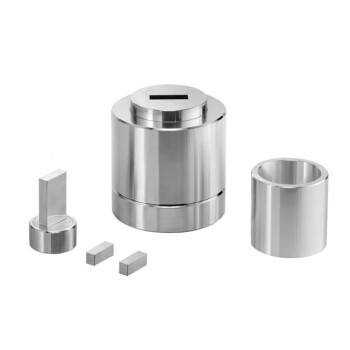
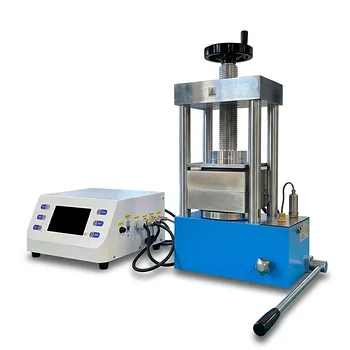
The hydraulic pellet press serves as the critical densification mechanism in the preparation of vanadium-titanium magnetite. Its primary function is to apply intense mechanical pressure to compress loose ore powder and calcification additives into solid, uniform pellets.
The press does more than simply shape the material; by eliminating voids and maximizing particle contact, it creates the necessary physical conditions for efficient solid-phase reactions and structural durability during aggressive chemical processing.
The Mechanics of Densification
Compressing the Raw Mixture
The process begins with a mixture of vanadium-titanium magnetite ore powder and calcification additives. The hydraulic press applies mechanical force to this loose mixture to reduce its volume significantly.
Eliminating Internal Voids
The pressure acts to remove air and minimize porosity within the material. This transforms a loose aggregate into a dense, cohesive solid that is easier to handle and process.
Enhancing Chemical Reactivity
Maximizing Contact Area
The most significant chemical benefit of the hydraulic press is the increase in contact area between the ore powder particles. By forcing particles into tight proximity, the press removes the physical gaps that inhibit chemical interaction.
Facilitating Solid-Phase Reactions
This tight packing is a prerequisite for the subsequent calcification roasting process. The increased contact area ensures that solid-phase reactions occur efficiently and uniformly throughout the pellet.
Ensuring Durability in Processing
Stability During Acid Leaching
After roasting, these pellets undergo long-duration acid leaching. The hydraulic press ensures the pellets possess the physical structural stability required to withstand this harsh environment without disintegrating.
Preventing Structural Failure
If the pellets were not sufficiently compressed, the acid would likely erode the structure too quickly. The densification provided by the press creates a robust matrix that maintains its integrity throughout the leaching cycle.
Critical Considerations and Trade-offs
The Importance of Uniformity
While high pressure is necessary, uniformity of that pressure is equally critical. As seen in similar laboratory applications, inconsistent pressure can lead to internal defects or density gradients.
Balancing Porosity and Density
The goal is to eliminate unwanted voids while establishing a structure that allows for controlled chemical activity. A press that offers precise pressure control is essential to avoid creating pellets that are brittle or unevenly compacted.
Making the Right Choice for Your Goal
To maximize the effectiveness of your vanadium-titanium magnetite preparation, align your pressing parameters with your downstream processing needs:
- If your primary focus is Reaction Efficiency (Roasting): Prioritize high compression forces to maximize particle contact area, ensuring the most complete solid-phase reactions.
- If your primary focus is Physical Durability (Leaching): Focus on the uniformity of the pressure application to prevent micro-cracks that could lead to disintegration during long acid exposure.
The hydraulic pellet press is not just a forming tool, but a crucial enabler of both chemical reactivity and physical resilience in metallurgical processing.
Summary Table:
| Process Phase | Function of Hydraulic Press | Impact on Quality |
|---|---|---|
| Densification | Eliminates internal voids and air pockets | Creates a dense, cohesive solid structure |
| Chemical Prep | Maximizes particle-to-particle contact area | Facilitates uniform solid-phase reactions during roasting |
| Durability | Increases physical structural stability | Prevents disintegration during long-duration acid leaching |
| Optimization | Precise pressure control and uniformity | Eliminates internal defects and density gradients |
Elevate Your Metallurgical Research with KINTEK Precision
At KINTEK, we understand that the quality of your vanadium-titanium magnetite pellets depends on precise densification. Our high-performance hydraulic pellet presses are engineered to provide the uniform pressure required for superior roasting efficiency and structural durability.
Beyond pelletizing, KINTEK offers a comprehensive range of laboratory solutions including:
- High-Temperature Furnaces: Muffle, tube, and vacuum furnaces for roasting and calcification.
- Crushing & Milling Systems: Achieve the perfect ore powder consistency.
- Consumables: High-quality ceramics, crucibles, and PTFE products for acid leaching and chemical analysis.
Ready to achieve consistent, high-density results? Contact our laboratory equipment experts today to find the perfect hydraulic press and thermal processing solution for your specific application.
References
- Zhongchen Han, Junyu Qu. Study on Vanadium Leaching from Vanadium and Ferro-Titanium Concentrate Using Calcified Roasting Pellets and Sulfuric Acid at Constant pH. DOI: 10.3390/min15060580
This article is also based on technical information from Kintek Solution Knowledge Base .
Related Products
- Laboratory Hydraulic Pellet Press for XRF KBR FTIR Lab Applications
- Automatic Laboratory Hydraulic Pellet Press Machine for Lab Use
- Automatic Laboratory Hydraulic Press for XRF & KBR Pellet Press
- Laboratory Manual Hydraulic Pellet Press for Lab Use
- Laboratory Manual Hydraulic Pellet Press for Lab Use
People Also Ask
- What is the role of a laboratory hydraulic pellet press and stainless steel molds in the fabrication of RuO2/NbC anodes?
- How does a laboratory hydraulic pellet press contribute to SiCw/2024 aluminum composite preforms? Optimize Densification
- What is the necessity of using a laboratory hydraulic pellet press in the preparation of biomass fuel pellets? Guide
- What is the significance of applying 200 MPa of pressure with a laboratory hydraulic pellet press for composite ceramics?
- What function does a laboratory pellet press or rolling mill serve? Enhance Electrode Density and Performance