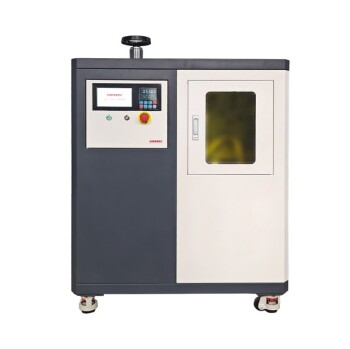
The laboratory hydraulic press and high-strength compression molds are the primary tools for transforming loose LLZO nanopowders into a cohesive "green body" with initial mechanical integrity. This process uses uniaxial pressure to force particles into close contact, establishing the geometric form and initial density required for successful high-temperature sintering.
A laboratory hydraulic press acts as the critical bridge between synthesized powders and functional ceramic electrolytes. By applying controlled uniaxial pressure, it eliminates air gaps and maximizes particle-to-particle contact, creating a stable foundation for ion transport and final densification.
The Role of Pre-Molding and Structural Formation
Establishing the "Green Body"
The primary function of the hydraulic press is to compress LLZO nanopowders into a green body, which is the un-sintered, shaped form of the electrolyte. High-strength molds ensure the powder takes a specific geometric shape, such as a cylindrical pellet, while maintaining the structural stability needed for handling.
Optimizing Particle Contact
By applying tens of kilonewtons (kN) of force, the press forces individual garnet-type particles together to eliminate large inter-particle voids. This close contact is essential because it creates the physical pathways that allow ions to move across the material once it is fully processed.
Preparing for Secondary Processing
The initial pressing stage provides the foundational strength required for subsequent steps, such as Cold Isostatic Pressing (CIP). Without this initial shaping, the loose powder could not withstand the high-intensity uniform pressures—often reaching 1000 kN—required for final densification.
Mechanics of Pressure and Densification
Uniaxial Pressure Application
In the initial stage, the press applies uniaxial (one-directional) pressure through a piston-and-die assembly. This controlled force, often ranging from 10 kN to 30 MPa, is sufficient to pre-mold the powder into a dense, handleable substrate.
Eliminating Internal Pores
The high-strength molds allow the press to exert significant force without deforming the tool itself, effectively reducing internal porosity. Minimizing these air gaps is critical because pores act as barriers to lithium-ion movement and can lead to structural failure during sintering.
Enhancing Relative Density
Through the combination of high pressure and precision molds, the relative density of the electrolyte can be significantly increased. Reaching high density at this stage ensures that the final sintered ceramic will be robust and exhibit the high ionic conductivity required for solid-state batteries.
Understanding the Trade-offs
Uniaxial vs. Isostatic Limitations
While a hydraulic press is excellent for initial shaping, uniaxial pressure can lead to uneven stress distribution within the pellet. This can cause the green body to have slightly different densities at the edges compared to the center, which may lead to warping during sintering.
Mold Wear and Contamination
High-strength compression molds must be meticulously maintained to avoid cross-contamination or surface defects. Over time, the extreme pressures required for LLZO can cause wear on the die walls, potentially affecting the dimensional accuracy of the electrolyte pellets.
Material Elasticity and Springback
Some electrolyte powders exhibit elastic recovery or "springback" after the pressure is released. If the pressure is applied too quickly or the mold is released abruptly, the green body may develop micro-cracks that compromise its mechanical integrity.
How to Apply This to Your Project
To achieve the best results when preparing LLZO solid electrolytes, consider your specific research or production goals:
- If your primary focus is high ionic conductivity: Ensure the initial hydraulic pressing is followed by isostatic pressing to achieve a relative density exceeding 90%, which minimizes ion-blocking voids.
- If your primary focus is geometric precision: Use high-strength, polished tungsten carbide or hardened steel molds to ensure the dimensions of the green body remain consistent across multiple batches.
- If your primary focus is rapid prototyping: Utilize a standard uniaxial hydraulic press at approximately 30 MPa to quickly produce test pellets for initial material characterization and screening.
Properly calibrated pressure and high-quality molds are the essential prerequisites for turning LLZO powder into a high-performance solid-state electrolyte.
Summary Table:
| Stage | Equipment | Action | Result |
|---|---|---|---|
| Powder Prep | LLZO Nanopowder | Loading into high-strength mold | Ready for compression |
| Pre-Molding | Hydraulic Press (Uniaxial) | Applying 10–30 MPa pressure | Formation of cohesive "Green Body" |
| Densification | Compression Mold | Eliminating air gaps/voids | Optimized particle contact & ion pathways |
| Post-Processing | Isostatic Press (CIP) | High-intensity uniform pressure | Maximum relative density for sintering |
Elevate Your Battery Research with KINTEK Precision
Achieving high ionic conductivity in garnet-type LLZO electrolytes requires precision at the pressing stage. KINTEK provides industry-leading laboratory equipment tailored for solid-state battery development, including:
- Advanced Hydraulic Presses: Manual and automatic pellet presses, hot presses, and isostatic systems (CIP) for maximum density.
- High-Strength Molds: Precision-engineered tungsten carbide and hardened steel dies designed for extreme pressure and minimal contamination.
- Comprehensive Lab Solutions: From high-temperature sintering furnaces and crushing systems to planetary ball mills and glovebox-compatible tools.
Whether you are focusing on rapid prototyping or scaling up electrolyte production, our technical experts are ready to support your workflow with reliable, high-performance equipment.
Optimize your solid-state electrolyte quality today—Contact KINTEK Experts Now!
References
- André Müller, Yaroslav E. Romanyuk. Benchmarking the performance of lithiated metal oxide interlayers at the LiCoO<sub>2</sub>|LLZO interface. DOI: 10.1039/d3ma00155e
This article is also based on technical information from Kintek Solution Knowledge Base .
Related Products
- Laboratory Hydraulic Press Split Electric Lab Pellet Press
- Automatic Laboratory Hydraulic Press for XRF & KBR Pellet Press
- Manual Lab Heat Press
- Automatic Laboratory Hydraulic Pellet Press Machine for Lab Use
- 24T 30T 60T Heated Hydraulic Press Machine with Heated Plates for Laboratory Hot Press
People Also Ask
- What role does a laboratory hydraulic press play in platinum recovery research? Enhancing Sample Precision
- What are the specific applications of a lab hydraulic press in biochar evaluation? Optimize density and data accuracy.
- What are the roles of a laboratory hydraulic press and stainless steel molds in the preparation of graphite samples?
- What is the role of a laboratory hydraulic press in electrode prep? Maximize Energy Density & Sealing Precision
- Why must a laboratory hydraulic press equipped with cylindrical molds be used when preparing BZY green bodies? High Density