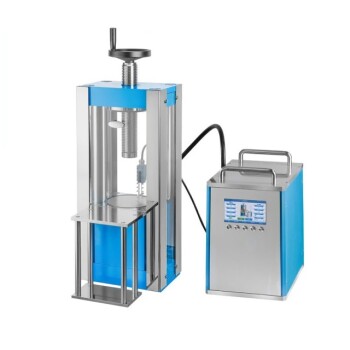
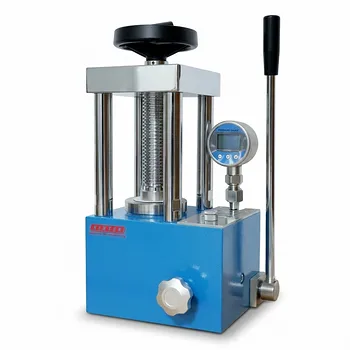
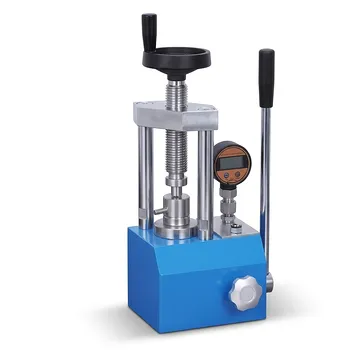
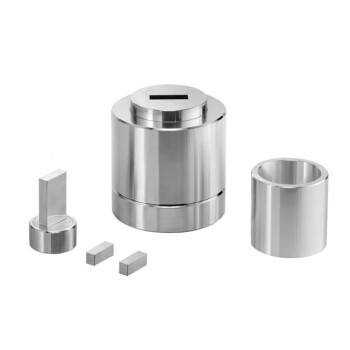
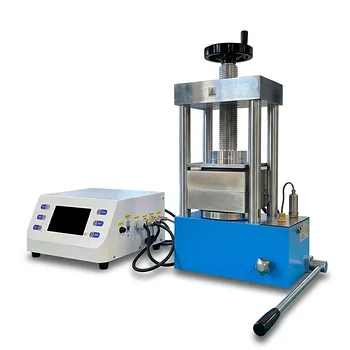
A laboratory hydraulic press functions as the critical densification tool in the fabrication of Li7P3S11 electrolyte pellets and all-solid-state batteries.
By applying immense pressure—specifically around 360 MPa for Li7P3S11—the press compacts loose powder into a solid, dense pellet and subsequently bonds the cathode, electrolyte, and anode layers together. This process is not merely about shaping materials; it is a fundamental requirement to establish the physical connectivity required for ionic transport.
Core Insight: The hydraulic press determines the electrochemical performance of the battery. Its primary function is to maximize density and minimize porosity, directly reducing grain boundary resistance to enable efficient lithium-ion flow.
Transforming Powder into Functional Electrolyte
The initial role of the hydraulic press is to convert loose Li7P3S11 powder into a usable solid structure. Without this step, the material lacks the physical continuity to function as an electrolyte.
Achieving High-Density Structures
The press applies high pressure (e.g., 360 MPa) to loose electrolyte powders. This force is sufficient to eliminate the air gaps and voids naturally present between powder particles.
The result is a dense pellet structure with significantly reduced porosity. High density is non-negotiable for solid-state batteries, as any remaining voids act as barriers to ion movement.
Enhancing Ionic Conductivity
When particles are pressed tightly together, the contact area between them increases.
This densification lowers grain boundary resistance, which is the resistance ions face when moving from one particle to the next. By minimizing this resistance, the press directly improves the overall ionic conductivity of the Li7P3S11 pellet.
Establishing Ion Transport Channels
Supplementary data on similar sulfide electrolytes suggests that high-pressure consolidation creates continuous channels for ions.
By inducing plastic deformation in the particles, the press ensures there are no physical breaks in the material, allowing for a smooth, uninterrupted path for lithium ions to travel.
Critical Role in Battery Assembly
Once the electrolyte is formed, the hydraulic press serves a secondary, equally vital role in the construction of the full battery cell.
Ensuring Interfacial Contact
During final assembly, the press compresses the cathode, electrolyte, and anode layers together.
This ensures tight contact between the distinct layers. In liquid batteries, the liquid fills the gaps; in solid-state batteries, the press must mechanically force these solid layers to touch perfectly to facilitate ion transfer.
Improving Cycling Stability
The structural integrity provided by this high-pressure assembly prevents the layers from delaminating (separating) over time.
A robust, well-pressed assembly maintains its connectivity during repeated charge and discharge cycles, leading to better long-term cycling stability.
Understanding the Trade-offs
While high pressure is essential, the application of force must be precise rather than indiscriminate.
Precision vs. Brute Force
Applying pressure is not simply about reaching the maximum tonnage; it is about reaching a specific, controlled pressure.
As seen in supplementary contexts (such as with LATP or green pellets), different stages may require different pressures (e.g., 12 MPa for molding vs. 360 MPa for densification).
Porosity Control
The goal is to reduce porosity, but the specific pressure dictates the final geometric shape and mechanical strength.
Inaccurate pressure application can lead to pellets that are structurally unsound or lack the specific density required for the material to perform its electrochemical duties effectively.
Making the Right Choice for Your Goal
When utilizing a hydraulic press for Li7P3S11 and solid-state battery fabrication, align your parameters with your specific objective.
- If your primary focus is maximizing Ionic Conductivity: Target higher pressures (around 360 MPa) to minimize grain boundary resistance and maximize relative density.
- If your primary focus is Cell Assembly: Prioritize the uniformity of pressure to ensure even contact between the cathode, anode, and electrolyte without crushing the active materials.
- If your primary focus is Pre-Sintering (Green Bodies): Use lower, precise pressures (e.g., 10-12 MPa) to form a shape that will retain its integrity during subsequent heating processes.
Ultimately, the hydraulic press is the enabler of solid-state performance, turning high pressure into low resistance.
Summary Table:
| Application Stage | Recommended Pressure | Primary Role |
|---|---|---|
| Powder Molding | 10 - 12 MPa | Formation of green bodies and pre-sintering shapes |
| Densification | ~360 MPa | Minimizing porosity and increasing ionic conductivity |
| Cell Assembly | Uniform/High Pressure | Ensuring tight interfacial contact between layers |
| Post-Processing | Controlled Tonnage | Improving mechanical strength and cycling stability |
Maximize Your Battery Research Performance with KINTEK
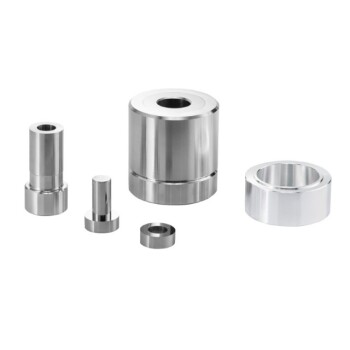
Precision densification is the cornerstone of high-performance solid-state electrolytes. KINTEK specializes in advanced laboratory equipment designed to meet the rigorous demands of material science. Our comprehensive range of manual and electric hydraulic presses (pellet, hot, and isostatic) ensures you achieve the exact pressure—up to 360 MPa and beyond—required to minimize grain boundary resistance and maximize ionic conductivity in Li7P3S11 electrolyte pellets.
From high-temperature vacuum furnaces for material synthesis to specialized crushing and milling systems for powder preparation, KINTEK provides the end-to-end solutions necessary for cutting-edge battery research. Our target customers in research and industry rely on us for accuracy, durability, and expert support.
Ready to elevate your solid-state battery fabrication?
Contact KINTEK Experts Today to find the perfect hydraulic press and laboratory consumables for your workflow!
Related Products
- Automatic Laboratory Hydraulic Pellet Press Machine for Lab Use
- kbr pellet press 2t
- Automatic Laboratory Hydraulic Press for XRF & KBR Pellet Press
- Laboratory Hydraulic Press Split Electric Lab Pellet Press
- Laboratory Hydraulic Pellet Press for XRF KBR FTIR Lab Applications
People Also Ask
- What is the role of a laboratory hydraulic pellet press and stainless steel molds in the fabrication of RuO2/NbC anodes?
- What role does a laboratory pellet press play in the enhancement of biomass energy products? Optimize Fuel Efficiency
- What is the purpose of using a laboratory pellet press when evaluating the electronic conductivity of carbon powders? Guide
- How does a laboratory hydraulic pellet press contribute to SiCw/2024 aluminum composite preforms? Optimize Densification
- What is the significance of applying 200 MPa of pressure with a laboratory hydraulic pellet press for composite ceramics?