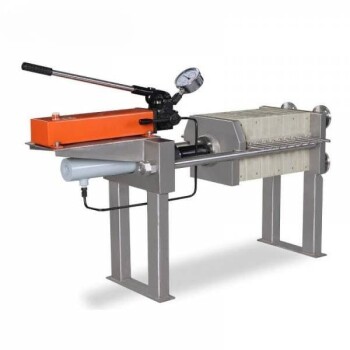
The primary role of a laboratory hydraulic press in this context is to apply high-precision vertical pressure to compress mixtures of glycerol-derived additives and solid fuel matrices into uniform test pellets. By creating dense, consistent samples, the equipment eliminates physical variables, ensuring that performance metrics such as combustion rate and calorific value reflect the true chemistry of the additive rather than irregularities in the sample's shape.
The hydraulic press acts as a standardization tool. It transforms loose fuel mixtures into high-density pellets with a consistent density gradient, ensuring experimental data is repeatable and possesses genuine industrial reference value.
Creating Standardized Test Specimens
Compressing Fuel Matrices
The fundamental function of the press is to consolidate loose materials. It combines glycerol-derived additives with solid fuel matrices or specific carrier materials using significant force.
Forming Dense Pellets
The press utilizes vertical pressure to compact these mixtures into a single, solid unit. The result is a uniformly shaped test pellet that is easier to handle and analyze than loose powder or liquid-soaked grains.
Achieving High-Precision Control
The "high-precision" aspect of the equipment is critical. It allows researchers to apply exact pressure levels, ensuring that every pellet produced in a batch undergoes the exact same forming conditions.
Ensuring Experimental Validity
Consistent Density Gradients
For fuel testing, how the material is packed matters as much as what the material is. The hydraulic press ensures the density gradient across the pellet remains consistent.
Accurate Combustion Analysis
A uniform density gradient is required for steady combustion. If the sample density varies, the burn rate will fluctuate unpredictably, skewing data regarding the glycerol additive's performance.
Reliable Calorific Value Measurement
When measuring the energy content (calorific value) of the fuel, the sample must be stable. Compressed pellets provide a defined mass and shape, allowing for accurate thermal measurements that can be compared against industrial standards.
Critical Considerations for Accuracy
The Risk of Inconsistent Pressure
While the press is a tool for consistency, it relies on precise operation. If the vertical pressure applied fluctuates between samples, the density of the resulting pellets will vary.
Impact on Data Repeatability
Inconsistent pellet density leads to non-repeatable experimental data. Without the uniformity provided by a properly operated high-precision press, the results may lack the reliability necessary for industrial application.
Making the Right Choice for Your Goal
To maximize the value of your performance testing, focus on how the physical state of your sample influences your specific analytical goals.
- If your primary focus is Repeatability: Prioritize the precision of the vertical pressure application to ensure every pellet has an identical density gradient.
- If your primary focus is Industrial Relevance: Ensure the compression levels used in the lab mimic the density of solid fuels used in actual industrial combustion scenarios.
Standardizing your sample preparation is the first step toward validating the efficiency of glycerol-based fuel additives.
Summary Table:
| Feature | Role in Fuel Additive Testing | Impact on Research |
|---|---|---|
| Sample Compression | Consolidates glycerol mixtures into solid pellets | Eliminates variables from loose powders |
| Precision Pressure | Applies exact vertical force across batches | Ensures high data repeatability and consistency |
| Density Control | Creates uniform internal density gradients | Enables steady, predictable combustion rates |
| Standardization | Produces uniform specimen shapes/mass | Facilitates accurate calorific value measurements |
Enhance Your Fuel Research with KINTEK Precision
Achieving reliable combustion data starts with flawless sample preparation. KINTEK specializes in high-performance laboratory hydraulic presses (pellet, hot, and isostatic) designed to provide the high-precision control necessary for testing glycerol-based fuel additives and solid fuel matrices.
From crushing and milling systems to our comprehensive range of high-temperature furnaces and high-pressure reactors, we provide the essential tools that global researchers trust for industrial-grade accuracy. Contact KINTEK today to optimize your lab's testing capabilities and ensure your experimental results have genuine industrial value.
References
- Andrey Smirnov, V. А. Yakovlev. Acetalization Catalysts for Synthesis of Valuable Oxygenated Fuel Additives from Glycerol. DOI: 10.3390/catal8120595
This article is also based on technical information from Kintek Solution Knowledge Base .
Related Products
- Laboratory Hydraulic Press Split Electric Lab Pellet Press
- Laboratory Hydraulic Press Lab Pellet Press Machine for Glove Box
- Laboratory Hydraulic Press Lab Pellet Press for Button Battery
- Automatic Laboratory Hydraulic Pellet Press Machine for Lab Use
- Automatic Laboratory Hydraulic Press for XRF & KBR Pellet Press
People Also Ask
- What role does a laboratory hydraulic press play in platinum recovery research? Enhancing Sample Precision
- What are the specific applications of a lab hydraulic press in biochar evaluation? Optimize density and data accuracy.
- What are the roles of a laboratory hydraulic press and stainless steel molds in the preparation of graphite samples?
- What is the role of a laboratory hydraulic press in electrode prep? Maximize Energy Density & Sealing Precision
- Why must a laboratory hydraulic press equipped with cylindrical molds be used when preparing BZY green bodies? High Density