Knowledge What is the role of a mechanical sieve shaker and standard sieve sets in the grading analysis of crushed glass for concrete? Precision Sieving for Quality Aggregates
Author avatar

Tech Team · Kintek Solution

Updated 2 days ago

What is the role of a mechanical sieve shaker and standard sieve sets in the grading analysis of crushed glass for concrete? Precision Sieving for Quality Aggregates


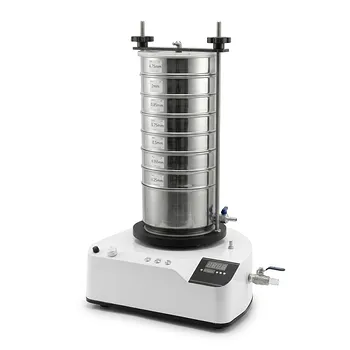
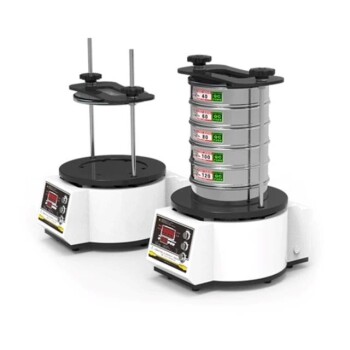
The mechanical sieve shaker and standard sieve sets form the backbone of quality control for concrete aggregates. By applying high-frequency mechanical vibration, this equipment systematically separates crushed glass particles into distinct size fractions using a stack of graduated screens. This physical separation is the prerequisite for calculating the Fineness Modulus and generating grading curves, data points that are critical for certifying crushed glass as a safe and stable replacement for natural fine aggregates.

The primary function of this system is to translate physical material into actionable data. It provides the quantitative proof required to ensure that a specific batch of crushed glass will not compromise the structural stability or workability of the concrete mixture.

The Mechanics of Separation

High-Frequency Vibration

The mechanical sieve shaker replaces the inconsistency of manual methods with precision.

It utilizes high-frequency vibration to agitate the material. This ensures that particles are oriented correctly to pass through the mesh openings if they are small enough.

The Standard Specification Sets

The "standard sets" refer to a stack of sieves with progressively smaller mesh openings.

As the shaker vibrates, the glass passes through the stack until it lands on a screen too fine for it to pass. This segregates the material into precise size ranges, or "fractions."

Translating Separation into Data

Calculating Fineness Modulus

One of the key outputs of this analysis is the Fineness Modulus (FM).

This is a single numerical value derived from the cumulative percentages retained on standard sieves. It provides a quick index of the average particle size of the crushed glass.

Constructing Grading Curves

The raw data is also used to plot grading curves.

These graphs visualize the particle size distribution across the entire sample. They allow engineers to instantly see if the glass is "well-graded" (having a good mix of sizes) or "gap-graded" (missing specific sizes).

Ensuring Concrete Suitability

Qualifying as Aggregate Replacement

Not all crushed glass is suitable for concrete.

The analysis determines if the material meets specific technical standards. Without this verification, crushed glass cannot be officially qualified as a legitimate aggregate replacement.

Maintaining Mixture Stability

The ultimate goal of grading analysis is mixture stability.

If the particle distribution is incorrect, the concrete may segregate or lose strength. The sieve analysis ensures the glass will integrate cohesively with the cement paste and other aggregates.

Understanding the Trade-offs

Equipment Calibration vs. Accuracy

While mechanical shakers provide consistency, they are mechanical devices subject to wear.

If the vibration frequency drifts or the timer is inaccurate, the results will be skewed. Regular calibration is a necessary "cost" of relying on this data.

Sieve Wear and Tear

The standard sieve sets are delicate precision instruments.

Abrasive materials like crushed glass can wear down the wire mesh over time, enlarging the openings. This can lead to false "coarser" readings if the sieves are not inspected and replaced regularly.

Making the Right Choice for Your Project

To ensure your concrete mix performs as intended, you must use the data from the sieve analysis to drive your decisions.

  • If your primary focus is consistency: Establish a strict testing schedule using the same mechanical shaker settings to track the Fineness Modulus of every new batch of glass.
  • If your primary focus is mix design: Prioritize the grading curve data to ensure the crushed glass complements the size distribution of your other aggregates, filling voids efficiently.

Reliable concrete begins with reliable data; the mechanical sieve shaker is the gatekeeper that ensures only suitable crushed glass enters your mix.

Summary Table:

Component/Metric Function in Grading Analysis Impact on Concrete Quality
Mechanical Shaker High-frequency agitation and material separation Ensures consistent, repeatable particle sizing
Standard Sieve Sets Graduated mesh screens (coarse to fine) Provides precise particle size distribution (PSD)
Fineness Modulus (FM) Index of average particle size Predicts workability and water demand of the mix
Grading Curves Visual distribution of size fractions Identifies well-graded vs. gap-graded materials
Calibration/Maintenance Ensuring mesh integrity and vibration frequency Prevents false readings and structural instability

Optimize Your Aggregate Testing with KINTEK Precision

Ensure the structural integrity of your concrete mixes with KINTEK’s high-performance crushing, milling, and sieving equipment. As specialists in laboratory equipment and consumables, we provide the tools you need to achieve precise grading analysis for crushed glass and other aggregates.

How KINTEK Empowers Your Laboratory:

  • Durable Sieve Shakers: Consistent, high-frequency vibration for reliable Fineness Modulus calculation.
  • Standard Sieve Sets: Precision-engineered mesh for accurate grading curves and material certification.
  • Full Lab Ecosystem: From sample preparation with our crushing and milling systems to material processing in high-temperature furnaces, we offer a comprehensive range of solutions for material science.

Don't compromise on data accuracy. Contact our technical experts today to find the perfect sieving solution for your quality control needs!

Related Products

People Also Ask

Related Products

Laboratory Test Sieves and Sieving Machines

Laboratory Test Sieves and Sieving Machines

Precision lab test sieves & sieving machines for accurate particle analysis. Stainless steel, ISO-compliant, 20μm-125mm range. Request specs now!

Laboratory Test Sieves and Vibratory Sieve Shaker Machine

Laboratory Test Sieves and Vibratory Sieve Shaker Machine

Efficiently process powders, granules, and small blocks with a high-frequency vibration sieve. Control vibration frequency, screen continuously or intermittently, and achieve accurate particle size determination, separation, and classification.

Laboratory Vibratory Sieve Shaker Machine for Dry and Wet Three-Dimensional Sieving

Laboratory Vibratory Sieve Shaker Machine for Dry and Wet Three-Dimensional Sieving

KT-VD200 can be used for sieving tasks of dry and wet samples in the laboratory. The screening quality is 20g-3kg. The product is designed with a unique mechanical structure and an electromagnetic vibrating body with a vibration frequency of 3000 times per minute.

Laboratory Vibratory Sieve Shaker Machine Slap Vibrating Sieve

Laboratory Vibratory Sieve Shaker Machine Slap Vibrating Sieve

KT-T200TAP is a slapping and oscillating sieving instrument for laboratory desktop use, with 300 rpm horizontal circular motion and 300 vertical slapping motions to simulate manual sieving to help sample particles pass through better.

Vibratory Sieve Shaker Machine Dry Three-Dimensional Vibrating Sieve

Vibratory Sieve Shaker Machine Dry Three-Dimensional Vibrating Sieve

The KT-V200 product focuses on solving common sieving tasks in the laboratory. It is suitable for sieving 20g-3kg dry samples.

Electric Lab Cold Isostatic Press CIP Machine for Cold Isostatic Pressing

Electric Lab Cold Isostatic Press CIP Machine for Cold Isostatic Pressing

Produce dense, uniform parts with improved mechanical properties with our Electric Lab Cold Isostatic Press. Widely used in material research, pharmacy, and electronic industries. Efficient, compact, and vacuum-compatible.

Laboratory High Pressure Horizontal Autoclave Steam Sterilizer for Lab Use

Laboratory High Pressure Horizontal Autoclave Steam Sterilizer for Lab Use

The horizontal autoclave steam sterilizer adopts the gravity displacement method to remove the cold air in the inner chamber, so that the inner steam and cold air content is less, and the sterilization is more reliable.

Metallographic Specimen Mounting Machine for Laboratory Materials and Analysis

Metallographic Specimen Mounting Machine for Laboratory Materials and Analysis

Precision metallographic mounting machines for labs—automated, versatile, and efficient. Ideal for sample prep in research and quality control. Contact KINTEK today!

Custom PTFE Teflon Parts Manufacturer for PTFE Mesh F4 Sieve

Custom PTFE Teflon Parts Manufacturer for PTFE Mesh F4 Sieve

PTFE mesh sieve is a specialized test sieve designed for particle analysis in various industries, featuring a non-metallic mesh woven from PTFE filament. This synthetic mesh is ideal for applications where metal contamination is a concern . PTFE sieves are crucial for maintaining the integrity of samples in sensitive environments, ensuring accurate and reliable results in particle size distribution analysis.

Lab Electrochemical Workstation Potentiostat for Laboratory Use

Lab Electrochemical Workstation Potentiostat for Laboratory Use

Electrochemical workstations, also known as laboratory electrochemical analyzers, are sophisticated instruments designed for precise monitoring and control in various scientific and industrial processes.

Laboratory Sterilizer Lab Autoclave Herbal Powder Sterilization Machine for Plant

Laboratory Sterilizer Lab Autoclave Herbal Powder Sterilization Machine for Plant

The herbal powder sterilization autoclave machine for Chinese medicine uses saturated steam for effective sterilization. It utilizes the heat and penetrative properties of steam, achieves sterilization after heat preservation, and maintains a good drying effect with a dedicated drying system.

Lab Plastic PVC Calender Stretch Film Casting Machine for Film Testing

Lab Plastic PVC Calender Stretch Film Casting Machine for Film Testing

The cast film machine is designed for the molding of polymer cast film products and has multiple processing functions such as casting, extrusion, stretching, and compounding.

Single Punch Tablet Press Machine and Mass Production Rotary Tablet Punching Machine for TDP

Single Punch Tablet Press Machine and Mass Production Rotary Tablet Punching Machine for TDP

Rotary tablet punching machine is an automatic rotating and continuous tableting machine. It is mainly used for tablet manufacturing in the pharmaceutical industry, and is also suitable for industrial sectors such as food, chemicals, batteries, electronics, ceramics, etc. to compress granular raw materials into tablets.

Automatic Heated Hydraulic Press Machine with Heated Plates for Laboratory Hot Press 25T 30T 50T

Automatic Heated Hydraulic Press Machine with Heated Plates for Laboratory Hot Press 25T 30T 50T

Efficiently prepare your samples with our Automatic Heated Lab Press. With a pressure range up to 50T and precise control, it's perfect for various industries.

Single Punch Electric Tablet Press Machine TDP Tablet Punching Machine

Single Punch Electric Tablet Press Machine TDP Tablet Punching Machine

The electric tablet punching machine is a laboratory equipment designed for pressing various granular and powdery raw materials into discs and other geometric shapes. It is commonly used in pharmaceutical, healthcare products, food, and other industries for small batch production and processing. The machine is compact, lightweight, and easy to operate, making it suitable for use in clinics, schools, laboratories, and research units.

Cold Isostatic Pressing Machine CIP for Small Workpiece Production 400Mpa

Cold Isostatic Pressing Machine CIP for Small Workpiece Production 400Mpa

Produce uniformly high-density materials with our Cold Isostatic Press. Ideal for compacting small workpieces in production settings. Widely used in powder metallurgy, ceramics, and biopharmaceutical fields for high-pressure sterilization and protein activation.

Automatic Lab Cold Isostatic Press CIP Machine Cold Isostatic Pressing

Automatic Lab Cold Isostatic Press CIP Machine Cold Isostatic Pressing

Efficiently prepare samples with our Automatic Lab Cold Isostatic Press. Widely used in material research, pharmacy, and electronic industries. Provides greater flexibility and control compared to electric CIPs.

Electric Split Lab Cold Isostatic Press CIP Machine for Cold Isostatic Pressing

Electric Split Lab Cold Isostatic Press CIP Machine for Cold Isostatic Pressing

Split cold isostatic presses are capable of providing higher pressures, making them suitable for testing applications that require high pressure levels.

Heated Hydraulic Press Machine with Integrated Manual Heated Plates for Lab Use

Heated Hydraulic Press Machine with Integrated Manual Heated Plates for Lab Use

Efficiently process heat-pressing samples with our Integrated Manual Heated Lab Press. With a heating range up to 500°C, it's perfect for various industries.

Automatic Laboratory Hydraulic Pellet Press Machine for Lab Use

Automatic Laboratory Hydraulic Pellet Press Machine for Lab Use

Experience efficient sample preparation with our Automatic Lab Press Machine. Ideal for material research, pharmacy, ceramics, and more. Features a compact size and hydraulic press functionality with heating plates. Available in various sizes.


Leave Your Message