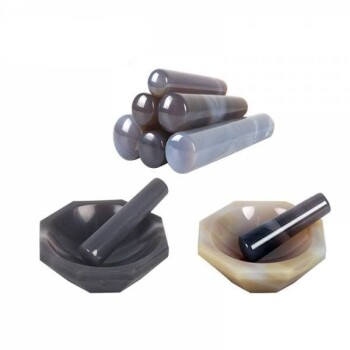
The primary role of an agate mortar and pestle in the preliminary preparation of all-solid-state sodium-sulfur battery cathodes is to facilitate the manual grinding and mixing of specific precursor materials, including sodium sulfide ($Na_2S$), phosphorus pentasulfide ($P_2S_5$), and CMK-3 mesoporous carbon. Conducted within an inert gas-filled glovebox, this process ensures a macroscopically uniform distribution of components, creating the essential foundation required for subsequent high-temperature melt-casting processes.
Core Takeaway While manual grinding appears rudimentary, the agate mortar provides a chemically inert, low-wear environment critical for homogenizing reactive precursors. This step ensures effective solid-solid contact without introducing metallic impurities or subjecting the materials to excessive mechanical stress that could degrade their structure before thermal processing.
The Mechanics of Precursor Preparation
Achieving Macroscopic Uniformity
The immediate goal of this process is to transform distinct starting materials—$Na_2S$, $P_2S_5$, and CMK-3—into a cohesive mixture.
By manually grinding these components, you break down agglomerates and ensure the sulfur sources and carbon framework are intimately mixed.
This macroscopic uniformity is a prerequisite for the high-temperature melt-casting step, ensuring that the chemical reactions and phase changes occurring later proceed consistently throughout the material.
Environmental Control Requirements
This preparation is not performed on an open bench; it occurs strictly within an inert gas-filled glovebox.
The precursor materials, particularly sulfide compounds, are highly sensitive to moisture and oxygen.
Using the mortar and pestle in this controlled environment protects the chemical integrity of the reactants during the physical mixing phase.
Why Agate is the Material of Choice
Preventing Metallic Contamination
Agate is used specifically for its chemical inertness.
Metal grinding tools can shed microscopic metallic particles into the mixture, which can introduce harmful impurities or trigger unwanted side reactions in high-voltage cathode materials.
Agate prevents this cross-contamination, ensuring the purity of the sodium-sulfur cathode composite.
Balancing Hardness and Wear Resistance
Agate possesses high hardness and superior wear resistance.
This durability ensures that the tool itself does not degrade and contaminate the sample during the grinding process.
Simultaneously, its smooth surface facilitates the recovery of the mixed powder, minimizing material loss.
Preserving Particle Integrity
Manual mixing with agate applies gentle mechanical force compared to automated high-energy milling.
This helps avoid excessive mechanical shear forces that could damage the structural integrity of the mesoporous carbon (CMK-3) or deform the solid electrolyte particles.
It establishes sufficient contact for ion channels without destroying the delicate architecture of the active materials.
Understanding the Trade-offs
Manual Variability
Because the process is manual, it is subject to operator variability.
Inconsistencies in grinding pressure or duration can lead to slight variations in particle size distribution between different batches.
Scalability Limitations
The use of a mortar and pestle is inherently a lab-scale technique.
While excellent for research and preliminary synthesis, this method is not viable for large-scale manufacturing, which requires automated, continuous mixing solutions.
Making the Right Choice for Your Goal
To determine if this preparation method aligns with your project requirements, consider the following:
- If your primary focus is high-purity research: Manual mixing with agate is ideal as it eliminates the risk of metallic contamination and protects the structural integrity of delicate mesoporous carbon.
- If your primary focus is mass production: You must look beyond manual grinding toward scalable mechanical milling processes that can replicate this uniformity without human intervention.
Ultimately, the agate mortar acts as the gatekeeper of quality, ensuring that your raw precursors are perfectly primed for the thermal processing that gives the battery its final electrochemical properties.
Summary Table:
| Feature | Role & Benefit in Cathode Preparation |
|---|---|
| Primary Function | Manual grinding & macroscopic homogenization of $Na_2S$, $P_2S_5$, and CMK-3 |
| Material Advantage | High-purity agate prevents metallic contamination and side reactions |
| Environment | Used within inert gas-filled gloveboxes to protect moisture-sensitive sulfides |
| Structural Care | Gentle mechanical force preserves the integrity of mesoporous carbon (CMK-3) |
| Wear Resistance | Superior durability prevents tool degradation from contaminating the sample |
Elevate Your Battery Research with KINTEK Precision
Consistency in material preparation is the foundation of breakthrough battery performance. KINTEK specializes in providing high-performance laboratory equipment tailored for advanced research. From agate mortar and pestles and crushing and milling systems for precursor homogenization to high-temperature furnaces for melt-casting and glovebox-compatible tools, we support every stage of your workflow.
Whether you are developing all-solid-state sodium-sulfur batteries or exploring next-generation energy storage, our comprehensive range of crucibles, ceramics, and high-pressure reactors ensures your materials remain pure and your results reproducible.
Ready to optimize your lab's efficiency? Contact us today to find the perfect tools for your research!
Related Products
- Nature Agate Mortar and Pestle for Grinding and Mixing
- Laboratory Jar Mill with Agate Grinding Jar and Balls
People Also Ask
- Why are agate mortars and pestles used for grinding iron oxide? Ensure Sample Purity for XRD Analysis
- What is the function of an agate mortar and pestle? Ensure Purity in Halide Solid-State Electrolyte Synthesis
- What is the primary function of an agate mortar and pestle? Optimize VO2+ CaZn2(PO4)2 Nanopowder Pre-Treatment
- Why is an agate mortar and pestle required for grinding Zr3(Al1-xSix)C2? Ensure Maximum Sample Purity
- Why is an agate mortar and pestle preferred for grinding MAX phase? Ensure Sample Purity & Zero Contamination