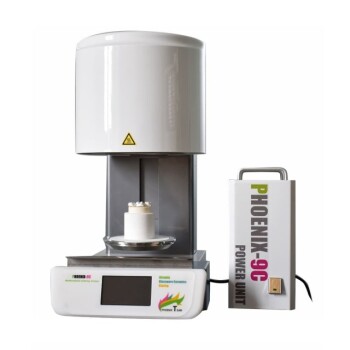
The industrial-grade graphitization sintering furnace serves as the foundational reactor for the first step of the pack cementation process. Its primary function is to generate a precise environment of approximately 1973 K within a protective Argon (Ar) atmosphere, driving the essential in-situ reaction between silicon, carbon, and the graphite substrate to form a dense β-SiC inner layer.
The core value of this furnace lies in its ability to facilitate "in-situ" synthesis. Rather than simply applying a coating, the furnace uses extreme heat to chemically grow the coating out of the substrate, ensuring superior adhesion and structural integrity.
Establishing Critical Process Conditions
Reaching Activation Temperatures
The formation of a robust oxidation protective coating requires overcoming significant energy barriers. The furnace creates a high-temperature environment of approximately 1973 K.
This extreme thermal energy is non-negotiable. It acts as the catalyst that mobilizes the silicon and carbon atoms, allowing the chemical conversion process to begin.
Maintaining an Inert Atmosphere
Temperature alone is insufficient; the chemical purity of the reaction is paramount. The furnace utilizes an Argon (Ar) protective atmosphere.
This inert gas shields the reactants from atmospheric oxygen and other contaminants during the heating phase. Without this shield, the materials would degrade or oxidize prematurely before the protective coating could form.
Driving the In-Situ Reaction
Interaction of Elemental Components
Under these specific furnace conditions, a complex interaction occurs between three key components:
- Silicon (Si) found in the embedding powder.
- Carbon powder included in the mix.
- The Graphite substrate itself.
Formation of the Inner Layer
The furnace heat drives these elements to react "in-situ," meaning the reaction happens directly at the site of application.
This reaction results in the synthesis of β-SiC (Beta Silicon Carbide). This is not a loose surface layer; it creates a dense inner layer that acts as the primary barrier against oxidation.
Achieving Chemical Bonding
Because the graphite substrate participates in the reaction, the coating is chemically rooted to the base material.
This results in excellent chemical bonding between the β-SiC layer and the graphite. This bond is far stronger than mechanical adhesion, significantly reducing the risk of delamination under stress.
Understanding Operational Constraints
The Necessity of Thermal Precision
While high heat is required, deviation from the 1973 K target can be detrimental. Inconsistent temperatures may lead to incomplete reactions or porous coating structures.
Atmosphere Integrity
The Argon atmosphere must be maintained rigorously. Any breach in the protective gas shield at these temperatures would immediately compromise the purity of the β-SiC layer, rendering the coating ineffective.
Making the Right Choice for Your Goal
To ensure the successful preparation of SiC/MoSi2-SiC-Si coatings, focus on these operational parameters:
- If your primary focus is Coating Adhesion: Prioritize the precision of the 1973 K temperature setpoint to drive the deep chemical bonding between the substrate and the coating.
- If your primary focus is Layer Density: Ensure the Argon atmosphere is strictly controlled to prevent impurities from disrupting the formation of the dense β-SiC structure.
The graphitization sintering furnace is not just a heat source; it is the precise tool that transforms raw powders into a unified, chemically bonded protective system.
Summary Table:
| Process Parameter | Specification | Functional Role in Coating Preparation |
|---|---|---|
| Temperature | 1973 K | Provides activation energy for in-situ SiC synthesis |
| Atmosphere | Argon (Ar) | Prevents premature oxidation and ensures chemical purity |
| Reaction Type | In-situ Synthesis | Creates deep chemical bonding between coating and substrate |
| Primary Output | Dense β-SiC Layer | Forms the foundational barrier against high-temperature oxidation |
| Core Advantage | Superior Adhesion | Eliminates delamination risk through molecular-level integration |
Elevate Your Material Research with KINTEK Precision
Ready to achieve superior coating integrity for your advanced materials? KINTEK specializes in high-performance laboratory equipment, offering industry-leading high-temperature furnaces (muffle, tube, vacuum, and CVD) and graphitization sintering systems designed for extreme thermal precision. Whether you are developing oxidation-resistant coatings or advancing battery research, our comprehensive portfolio—including high-pressure reactors, crushing and milling systems, and ceramic consumables—is engineered to meet the most rigorous scientific standards.
Don't compromise on thermal accuracy. Contact KINTEK today to discover how our expert heating solutions and high-temperature technology can optimize your synthesis process and drive your innovation forward!
References
- Xiaoyü Wei, Bing Liu. SiC/MoSi2-SiC-Si Oxidation Protective Coatings for HTR Graphite Spheres with Residual Si Optimized. DOI: 10.3390/ma15093203
This article is also based on technical information from Kintek Solution Knowledge Base .
Related Products
- Ultra-High Temperature Graphite Vacuum Graphitization Furnace
- Large Vertical Graphite Vacuum Graphitization Furnace
- Graphite Vacuum Furnace High Thermal Conductivity Film Graphitization Furnace
- Horizontal High Temperature Graphite Vacuum Graphitization Furnace
- Vertical High Temperature Graphite Vacuum Graphitization Furnace
People Also Ask
- What is the disadvantage of graphite furnace? Managing Reactivity and Contamination Risks
- Is a graphite melting point high or low? Discover Its Extreme Thermal Resilience
- What are the advantages and disadvantages of graphite furnace? Unlock Extreme Heat Performance
- What is the temperature of a graphite furnace? Achieve Extreme Heat Up to 3000°C
- What is the temperature range of a graphite furnace? Unlock up to 3000°C for advanced materials processing.