Knowledge What is the role of an industrial vacuum induction furnace in melting 12% Cr martensitic steel? Pure & Tough Alloys
Author avatar

Tech Team · Kintek Solution

Updated 1 day ago

What is the role of an industrial vacuum induction furnace in melting 12% Cr martensitic steel? Pure & Tough Alloys


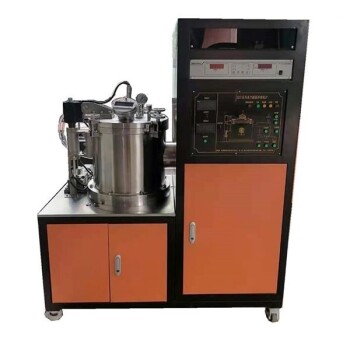
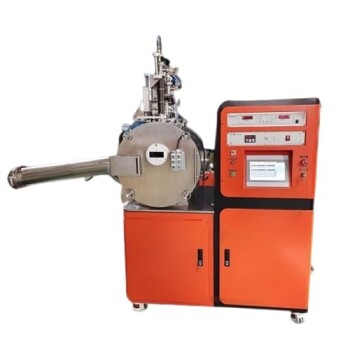
The primary role of an industrial vacuum induction furnace in melting 12% Cr martensitic steel is to ensure strict chemical purity by isolating the molten metal from the atmosphere. This equipment is the gatekeeper for quality, providing the specific environmental conditions necessary to achieve ultra-low nitrogen levels and prevent the oxidation of reactive alloying elements.

Core Takeaway The vacuum induction furnace is essential for 12% Cr martensitic steel because it reduces nitrogen content to below 0.01 wt.%. This specific threshold is critical to preventing the formation of brittle nitride particles, ensuring the steel maintains the ductility and toughness required for high-stress applications.

The Critical Need for Vacuum Isolation

Eliminating Atmospheric Nitrogen

The most significant threat to 12% Cr martensitic steel during melting is the absorption of nitrogen from the air.

Under normal atmospheric conditions, molten steel absorbs nitrogen rapidly. The vacuum induction furnace solves this by operating in a vacuum or protective atmosphere.

For this specific steel grade, the furnace ensures the nitrogen content remains strictly below 0.01 wt.%.

Preventing Brittle Inclusions

High nitrogen content leads to chemical reactions with other elements in the alloy.

Without the vacuum environment, nitrogen reacts with boron or aluminum to form boron nitride or aluminum nitride.

These nitrides appear as brittle particles within the steel matrix. These particles act as stress concentrators, significantly reducing the material's durability and leading to premature failure.

Precision Control of Chemical Composition

Protecting Reactive Elements

Chromium (Cr), which makes up 12% of this steel, is highly reactive with oxygen at melting temperatures.

The vacuum environment effectively inhibits oxidation reactions. This preserves the expensive Chromium content and prevents it from turning into slag or oxide inclusions.

This protection extends to other active alloying elements often present in these steels, such as Vanadium (V) and Niobium (Nb), which are crucial for radiation resistance and mechanical strength.

The Mechanism of Induction Heating

The furnace utilizes medium frequency induction heating.

This method not only generates heat but also creates electromagnetic stirring within the molten bath.

This natural stirring action ensures a homogenous chemical composition and uniform temperature distribution throughout the melt before pouring.

Understanding the Process Boundaries

The Scope of Melting vs. Heat Treatment

It is vital to distinguish between the melting furnace and subsequent heat treatment equipment.

The vacuum induction furnace handles the charging, melting, refining, and pouring stages. Its job is to create a chemically perfect ingot.

It does not manage the phase transformation of $\delta$-ferrite into austenite. That requires a separate high-temperature heat treatment furnace (operating at 1050°C–1150°C) after the steel has solidified.

Limitations of the Equipment

While the vacuum induction furnace excels at chemical control, it is a batch process.

It relies on precise "charging" (loading materials) and maintaining a strict vacuum seal. Any breach in the seal or the observation window immediately compromises the low-nitrogen mandate.

Making the Right Choice for Your Goal

When planning the production line for 12% Cr martensitic steel, consider the following:

  • If your primary focus is Impact Toughness: You must use vacuum induction melting to keep nitrogen <0.01 wt.% and eliminate brittle nitride inclusions.
  • If your primary focus is Alloy Consistency: Rely on the induction stirring capability of the furnace to prevent segregation of heavy elements like Niobium.
  • If your primary focus is Microstructure Balance: Remember that this furnace only sets the chemistry; you must follow it with precise thermomechanical treatment to reduce $\delta$-ferrite content.

The vacuum induction furnace is the foundational tool that establishes the chemical baseline required for high-performance martensitic steel.

Summary Table:

Feature Function in 12% Cr Steel Production Key Benefit
Vacuum Isolation Eliminates atmospheric nitrogen and oxygen Prevents brittle nitride inclusions and Cr oxidation
Induction Heating Provides medium frequency electromagnetic stirring Ensures uniform chemical composition and temperature
Nitrogen Control Maintains nitrogen content below 0.01 wt.% Increases impact toughness and ductility
Elemental Protection Prevents loss of reactive elements (V, Nb, Cr) Guarantees precise alloy chemistry and radiation resistance

Elevate Your Alloy Quality with KINTEK Precision

Don't let atmospheric contamination compromise your high-performance materials. KINTEK specializes in advanced vacuum induction melting furnaces and a comprehensive range of high-temperature solutions—including muffle, tube, and vacuum furnaces—designed to meet the strictest metallurgical standards.

Whether you are refining 12% Cr martensitic steel or developing next-generation aerospace alloys, our equipment provides the environmental control and thermal precision your laboratory or production facility demands. From induction melting systems to high-pressure reactors and PTFE consumables, KINTEK is your partner in material excellence.

Ready to achieve ultra-low nitrogen levels and superior alloy consistency? Contact our technical experts today to find the perfect melting solution!

References

  1. A. Fedoseeva, Rustam Kaibyshev. Thermo-Mechanical Processing as Method Decreasing Delta-Ferrite and Improving the Impact Toughness of the Novel 12% Cr Steels with Low N and High B Contents. DOI: 10.3390/ma15248861

This article is also based on technical information from Kintek Solution Knowledge Base .

Related Products

People Also Ask

Related Products

Laboratory Vacuum Tilt Rotary Tube Furnace Rotating Tube Furnace

Laboratory Vacuum Tilt Rotary Tube Furnace Rotating Tube Furnace

Discover the versatility of Laboratory Rotary Furnace: Ideal for calcination, drying, sintering, and high-temperature reactions. Adjustable rotating and tilting functions for optimal heating. Suitable for vacuum and controlled atmosphere environments. Learn more now!

Ultra-High Temperature Graphite Vacuum Graphitization Furnace

Ultra-High Temperature Graphite Vacuum Graphitization Furnace

The ultra-high temperature graphitization furnace utilizes medium frequency induction heating in a vacuum or inert gas environment. The induction coil generates an alternating magnetic field, inducing eddy currents in the graphite crucible, which heats up and radiates heat to the workpiece, bringing it to the desired temperature. This furnace is primarily used for graphitization and sintering of carbon materials, carbon fiber materials, and other composite materials.

Small Vacuum Heat Treat and Tungsten Wire Sintering Furnace

Small Vacuum Heat Treat and Tungsten Wire Sintering Furnace

The small vacuum tungsten wire sintering furnace is a compact experimental vacuum furnace specially designed for universities and scientific research institutes. The furnace features a CNC welded shell and vacuum piping to ensure leak-free operation. Quick-connect electrical connections facilitate relocation and debugging, and the standard electrical control cabinet is safe and convenient to operate.

600T Vacuum Induction Hot Press Furnace for Heat Treat and Sintering

600T Vacuum Induction Hot Press Furnace for Heat Treat and Sintering

Discover the 600T Vacuum Induction Hot Press Furnace, designed for high-temperature sintering experiments in vacuum or protected atmospheres. Its precise temperature and pressure control, adjustable working pressure, and advanced safety features make it ideal for nonmetal materials, carbon composites, ceramics, and metal powders.

Horizontal High Temperature Graphite Vacuum Graphitization Furnace

Horizontal High Temperature Graphite Vacuum Graphitization Furnace

Horizontal Graphitization Furnace: This type of furnace is designed with the heating elements placed horizontally, allowing for uniform heating of the sample. It's well-suited for graphitizing large or bulky samples that require precise temperature control and uniformity.

Vacuum Heat Treat Sintering Brazing Furnace

Vacuum Heat Treat Sintering Brazing Furnace

A vacuum brazing furnace is a type of industrial furnace used for brazing, a metalworking process that joins two pieces of metal using a filler metal that melts at a lower temperature than the base metals. Vacuum brazing furnaces are typically used for high-quality applications where a strong, clean joint is required.

2200 ℃ Tungsten Vacuum Heat Treat and Sintering Furnace

2200 ℃ Tungsten Vacuum Heat Treat and Sintering Furnace

Experience the ultimate refractory metal furnace with our Tungsten vacuum furnace. Capable of reaching 2200℃, perfect for sintering advanced ceramics and refractory metals. Order now for high-quality results.

Laboratory Rapid Thermal Processing (RTP) Quartz Tube Furnace

Laboratory Rapid Thermal Processing (RTP) Quartz Tube Furnace

Get lightning-fast heating with our RTP Rapid Heating Tube Furnace. Designed for precise, high-speed heating and cooling with convenient sliding rail and TFT touch screen controller. Order now for ideal thermal processing!

Vacuum Heat Treat and Molybdenum Wire Sintering Furnace for Vacuum Sintering

Vacuum Heat Treat and Molybdenum Wire Sintering Furnace for Vacuum Sintering

A vacuum molybdenum wire sintering furnace is a vertical or bedroom structure, which is suitable for withdrawal, brazing, sintering and degassing of metal materials under high vacuum and high temperature conditions. It is also suitable for dehydroxylation treatment of quartz materials.

Non Consumable Vacuum Arc Induction Melting Furnace

Non Consumable Vacuum Arc Induction Melting Furnace

Explore the benefits of Non-Consumable Vacuum Arc Furnace with high melting point electrodes. Small, easy to operate & eco-friendly. Ideal for laboratory research on refractory metals & carbides.

Vacuum Sealed Continuous Working Rotary Tube Furnace Rotating Tube Furnace

Vacuum Sealed Continuous Working Rotary Tube Furnace Rotating Tube Furnace

Experience efficient material processing with our vacuum-sealed rotary tube furnace. Perfect for experiments or industrial production, equipped with optional features for controlled feeding and optimized results. Order now.

Molybdenum Vacuum Heat Treat Furnace

Molybdenum Vacuum Heat Treat Furnace

Discover the benefits of a high-configuration molybdenum vacuum furnace with heat shield insulation. Ideal for high-purity, vacuum environments like sapphire crystal growth and heat treatment.

Graphite Vacuum Furnace High Thermal Conductivity Film Graphitization Furnace

Graphite Vacuum Furnace High Thermal Conductivity Film Graphitization Furnace

The high thermal conductivity film graphitization furnace has uniform temperature, low energy consumption and can operate continuously.

Graphite Vacuum Furnace IGBT Experimental Graphitization Furnace

Graphite Vacuum Furnace IGBT Experimental Graphitization Furnace

IGBT experimental graphitization furnace, a tailored solution for universities and research institutions, with high heating efficiency, user-friendliness, and precise temperature control.

Vacuum Heat Treat Furnace with Ceramic Fiber Liner

Vacuum Heat Treat Furnace with Ceramic Fiber Liner

Vacuum furnace with polycrystalline ceramic fiber insulation liner for excellent heat insulation and uniform temperature field. Choose from 1200℃ or 1700℃ max. working temperature with high vacuum performance and precise temperature control.

Vacuum Heat Treat and Sintering Furnace with 9MPa Air Pressure

Vacuum Heat Treat and Sintering Furnace with 9MPa Air Pressure

The air pressure sintering furnace is a high-tech equipment commonly used for the sintering of advanced ceramic materials. It combines vacuum sintering and pressure sintering techniques to achieve high-density and high-strength ceramics.

Vacuum Heat Treat Furnace and Levitation Induction Melting Furnace

Vacuum Heat Treat Furnace and Levitation Induction Melting Furnace

Experience precise melting with our Vacuum Levitation Melting Furnace. Ideal for high melting point metals or alloys, with advanced technology for effective smelting. Order now for high-quality results.

1400℃ Controlled Atmosphere Furnace with Nitrogen and Inert Atmosphere

1400℃ Controlled Atmosphere Furnace with Nitrogen and Inert Atmosphere

Achieve precise heat treatment with KT-14A controlled atmosphere furnace. Vacuum sealed with a smart controller, it's ideal for lab and industrial use up to 1400℃.

1800℃ Muffle Oven Furnace for Laboratory

1800℃ Muffle Oven Furnace for Laboratory

KT-18 muffle furnace with Japan Al2O3 polycrystalline fibe and Silicon Molybdenum heating element, up to 1900℃, PID temperature control and 7" smart touch screen. Compact design, low heat loss, and high energy efficiency. Safety interlock system and versatile functions.

Vacuum Dental Porcelain Sintering Furnace

Vacuum Dental Porcelain Sintering Furnace

Get precise and reliable results with KinTek's Vacuum Porcelain Furnace. Suitable for all porcelain powders, it features hyperbolic ceramic furnace function, voice prompt, and automatic temperature calibration.


Leave Your Message