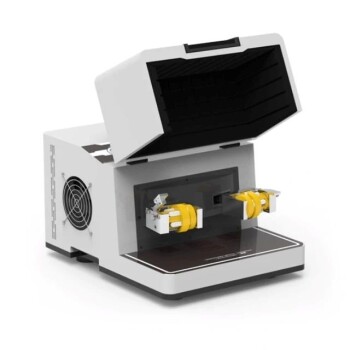
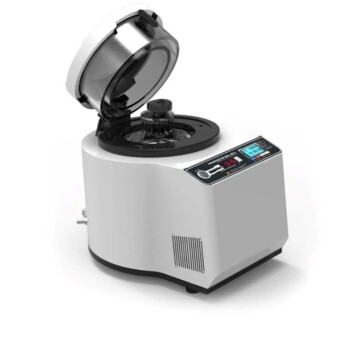
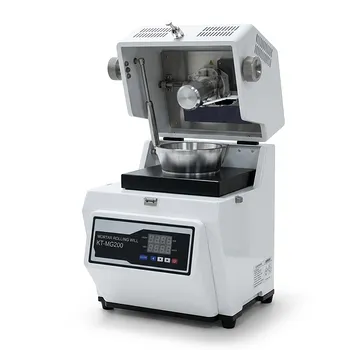
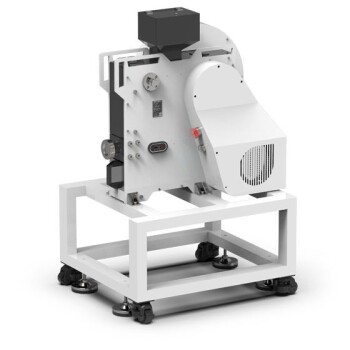
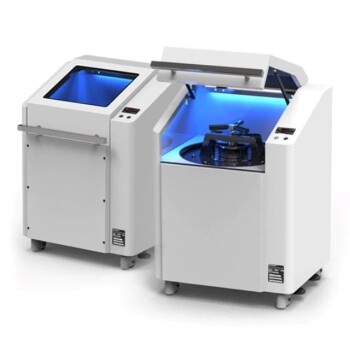
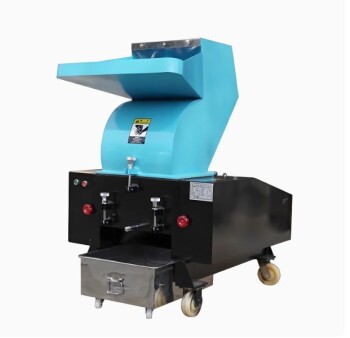
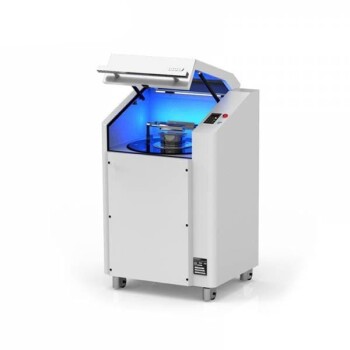
The primary role of cryogenic grinding equipment is to create an ultra-low temperature environment that preserves the physical state of Polytetrafluoroethylene (PTFE) binders during processing. By neutralizing the heat naturally generated by mechanical friction, this equipment prevents the PTFE from turning into fibers or clumping together before it is mixed with active materials. This ensures the binder remains a fine, workable powder, which is a prerequisite for high-quality dry electrode manufacturing.
Cryogenic grinding serves as a critical process safeguard, preventing premature fiberization to ensure PTFE remains uniformly dispersible. This directly leads to optimized microstructural integrity and reduced ionic resistance in the final battery cell.
The Mechanics of PTFE Preservation
Controlling Temperature to Prevent Fiberization
PTFE is highly sensitive to shear force and heat. Under normal grinding conditions, the friction would generate enough heat to cause the PTFE particles to "fiberize"—turning into sticky strings—or agglomerate into clumps.
Cryogenic equipment counters this by maintaining temperatures low enough to keep the PTFE below its transition point. This ensures the material behaves as a brittle solid rather than a ductile plastic during the grinding phase.
Achieving Uniform Dispersion
For a dry electrode to function correctly, the binder must be spread evenly among the active material particles.
Cryogenic grinding refines the PTFE into a consistent, fine powder. Because the particles are prevented from sticking together, they can be distributed uniformly throughout the electrode mixture later in the process.
Impact on Electrode Performance
Optimizing Microstructural Integrity
The physical structure of the electrode determines its durability and lifespan.
By preventing the PTFE from fibrillating too early, cryogenic grinding allows manufacturers to control exactly when the fiber network is formed (usually during the subsequent rolling or calendering steps). This control results in a robust, cohesive electrode structure.
Reducing Ionic Resistance
Agglomerated or poorly dispersed binder creates "dead zones" that impede the flow of ions within the battery.
The uniform dispersion achieved through cryogenic pre-treatment ensures that the binder holds the electrode together without blocking ion pathways. This significantly reduces the ionic resistance of the electrode, leading to better power delivery and efficiency.
Operational Considerations and Trade-offs
Equipment Dependency and Process Sensitivity
The use of cryogenic grinding introduces a critical dependency on thermal management systems.
Unlike standard milling, there is zero margin for error regarding temperature. If the cryogenic cooling fails even momentarily, the mechanical energy will immediately convert to heat, causing rapid fiberization that can ruin the entire batch of material.
Applying This to Your Production
To leverage cryogenic grinding effectively, align your process controls with your specific performance targets:
- If your primary focus is maximizing cell efficiency: Prioritize the fineness of the grind to ensure the highest level of dispersion, which directly lowers ionic resistance.
- If your primary focus is process consistency: Implement rigorous temperature monitoring to prevent localized heating zones that could lead to batch-to-batch structural variations.
Effective thermal management during the grinding phase is the foundational step for achieving a high-performance dry electrode.
Summary Table:
| Feature | Role of Cryogenic Grinding | Impact on Production |
|---|---|---|
| Temperature Control | Maintains PTFE below transition point | Prevents clumping and premature fiberization |
| Material State | Keeps PTFE as a fine, brittle powder | Enables uniform mixing with active materials |
| Structural Control | Delays fibrillation until the calendering step | Optimizes microstructural integrity of the electrode |
| Ion Flow | Eliminates binder "dead zones" | Significantly reduces ionic resistance |
| Process Stability | Neutralizes mechanical friction heat | Ensures batch-to-batch consistency and quality |
Elevate Your Battery Research with KINTEK Precision Solutions
High-performance dry electrodes require flawless material preparation. At KINTEK, we specialize in providing the advanced laboratory equipment necessary to master these complex processes. From cryogenic grinding and milling systems to high-temperature furnaces and hydraulic pellet presses, our tools are engineered to meet the rigorous demands of battery innovation.
Why choose KINTEK?
- Precision Milling: Achieve the perfect PTFE particle size for optimal dispersion.
- Comprehensive Range: Access everything from crushing systems to high-temperature reactors and CVD systems.
- Expert Support: We provide the technical reliability required for sensitive thermal management applications.
Ready to optimize your electrode microstructural integrity? Contact us today to discuss how our specialized equipment can enhance your lab’s efficiency and performance!
Related Products
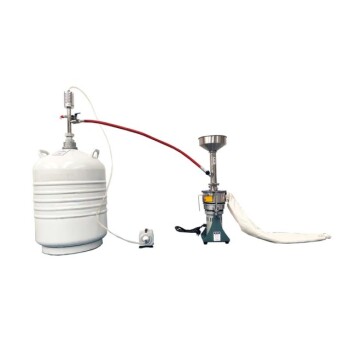
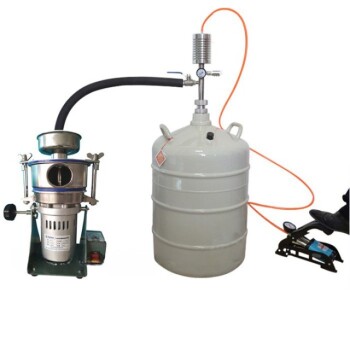
- Liquid Nitrogen Cryogenic Grinder Mill Cryomill Airflow Ultrafine Pulverizer
- Small Cryogenic Grinder Cryomill Cryogrinder with Liquid Nitrogen for Laboratory Use
- lab cryogenic grinding use liquid-nitrogen for pulverizing plastic raw materials and heat sensitive materials
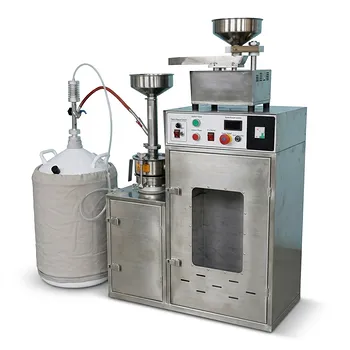
- Liquid Nitrogen Cryogenic Grinder Mill Cryomill with Screw Feeder
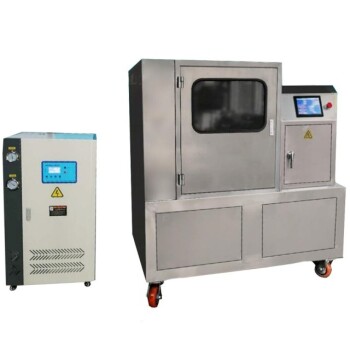
- Low-Temperature Water-Cooled Touchscreen Vibratory Ultrafine Pulverizer
People Also Ask
- What is cryogenic grinding of crumb rubber? Achieve Fine, High-Quality Rubber Powder
- What are the advantages of using a cryogenic grinder? Achieve Nanoscale Precision for All-Solid-State Battery Cathodes
- What is the role of a cryogenic grinder in PET recycling? Transform Waste into High-Reactive Micron Powders
- Why is a cryogenic grinder required for cured alkyd resin HRMAS NMR? Ensure Structural Integrity & Sample Precision
- What is the temperature of cryogenic grinding? Achieve Superior Particle Size & Preserve Heat-Sensitive Materials