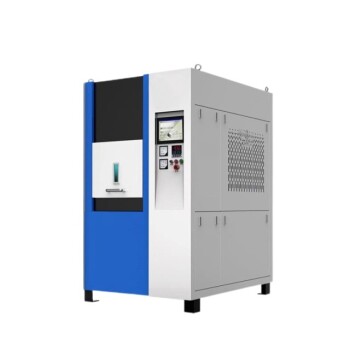
High-temperature atmosphere control furnaces act as the critical processing environment for transforming 316L stainless steel powder into structural metal. These systems maintain a stable inert gas atmosphere, typically using argon, while sustaining temperatures around 1280 °C. This specific environment is required to prevent the oxidation of stainless steel powders while providing the thermal energy needed for atomic migration, converting a pressed "green" compact into a dense, high-strength material.
Achieving the desired mechanical properties in 316L stainless steel requires more than just heat; it demands a chemically inert environment. The primary role of the atmosphere furnace is to facilitate atomic diffusion without the destructive interference of atmospheric oxygen.
The Dual Role of Atmosphere and Heat
The sintering process relies on two synchronized functions: chemical protection and thermal activation.
Preventing Material Degradation
316L stainless steel powder is highly susceptible to oxidation at elevated temperatures. If exposed to oxygen during heating, the powder particles form oxide scales that inhibit bonding.
The Necessity of Inert Gas
The furnace utilizes an inert gas, primarily argon, to displace oxygen. This creates a protective shield around the material, ensuring that the surface of the metal remains pure. This purity is essential for the subsequent physical bonding of particles.
Providing Thermal Energy for Diffusion
The furnace must reach and maintain temperatures around 1280 °C. This specific thermal energy triggers atomic migration and diffusion. It allows atoms to move across powder boundaries, effectively merging separate particles into a solid, cohesive mass.
Achieving Microstructural Integrity
Beyond basic heating, the precision of these furnaces determines the final quality of the steel.
Densification of the Green Compact
Before sintering, the material is a "green compact"—pressed powder held together mechanically. The furnace drives the transformation into a dense material. Through diffusion, the void spaces between particles are eliminated, significantly increasing the material's density.
Precise Temperature Control
High-quality furnaces minimize temperature fluctuations. Maintaining a stable thermal field is vital because 316L stainless steel is sensitive to thermal variations. Inconsistencies can lead to uneven sintering or reduced mechanical properties.
Facilitating Recrystallization
While the primary goal of sintering is densification, the thermal stability provided by the furnace also influences the crystalline structure. Controlled heating allows for full recrystallization, which helps eliminate defects and establishes a uniform grain structure necessary for corrosion resistance.
Understanding the Trade-offs
While atmosphere control furnaces are essential for high-quality sintering, they introduce specific challenges and limitations.
Operational Complexity and Cost
Using high-purity inert gases like argon significantly increases operational costs compared to standard air furnaces. The equipment also requires complex vacuum or gas flow systems to ensure the chamber is fully purged of contaminants.
Sensitivity to Thermal Mismatch
Even with a controlled atmosphere, rapid heating or cooling can cause issues. Mismatches in thermal expansion coefficients (if oxide scales were to form or if the material is layered) can lead to brittle cracking or spalling. The furnace must offer precise control over thermal cycles to avoid these thermo-mechanical failures.
Making the Right Choice for Your Goal
The configuration of your furnace should depend on the specific properties you need to maximize in your 316L stainless steel components.
- If your primary focus is mechanical strength and density: Prioritize a furnace capable of reaching and sustaining exactly 1280 °C with high uniformity to maximize atomic migration and eliminate porosity.
- If your primary focus is corrosion resistance and surface purity: Prioritize a furnace with a high-integrity vacuum or gas sealing system to ensure zero oxygen ingress, as oxidation is the primary antagonist to corrosion resistance.
Ultimately, the high-temperature atmosphere furnace is not just a heating tool, but a precision instrument that dictates the structural and chemical destiny of the final steel product.
Summary Table:
| Feature | Function in 316L Sintering | Key Benefit |
|---|---|---|
| Inert Atmosphere | Displaces oxygen using Argon gas | Prevents oxidation & ensures surface purity |
| Thermal Energy | Reaches temperatures ~1280 °C | Triggers atomic migration & diffusion |
| Thermal Control | Maintains stable thermal fields | Ensures uniform density & reduces defects |
| Controlled Cooling | Manages recrystallization cycles | Prevents brittle cracking & thermal mismatch |
Elevate Your Metal Research with KINTEK Precision
Unlock the full potential of your 316L stainless steel sintering and material science projects. KINTEK specializes in advanced laboratory solutions, providing high-performance high-temperature atmosphere furnaces, vacuum furnaces, and tube furnaces designed to deliver the precise thermal environments and chemical purity required for superior densification and corrosion resistance.
Whether you are focusing on metallurgy, battery research, or complex material synthesis, our comprehensive range—from crushing and milling systems to high-pressure reactors and PTFE consumables—ensures your lab operates at peak efficiency.
Ready to achieve superior microstructural integrity? Contact our technical experts today to find the perfect furnace or lab equipment for your specific application!
References
- Marcelo Broch, María Cristina Moré Farias. Scratch Response of Hollow Cathode Radiofrequency Plasma-Nitrided and Sintered 316L Austenitic Stainless Steel. DOI: 10.3390/coatings14030334
This article is also based on technical information from Kintek Solution Knowledge Base .
Related Products
- 1700℃ Controlled Atmosphere Furnace Nitrogen Inert Atmosphere Furnace
- 1400℃ Controlled Atmosphere Furnace with Nitrogen and Inert Atmosphere
- High Temperature Muffle Oven Furnace for Laboratory Debinding and Pre Sintering
- 1200℃ Controlled Atmosphere Furnace Nitrogen Inert Atmosphere Furnace
- Vacuum Heat Treat and Pressure Sintering Furnace for High Temperature Applications
People Also Ask
- What is a controlled atmosphere furnace for heat treatment? Master Surface Chemistry and Metallurgy
- What are the two primary purposes of using a controlled atmosphere? Master Protection vs. Material Modification
- What is the necessity of a controlled atmosphere furnace for corrosion research? Replicating Realistic Industrial Risks
- What is the necessity of controlled atmosphere furnaces for gas corrosion? Ensure Precise Material Failure Modeling
- How is oxygen (O2) used in controlled furnace atmospheres? Mastering Surface Engineering for Metals