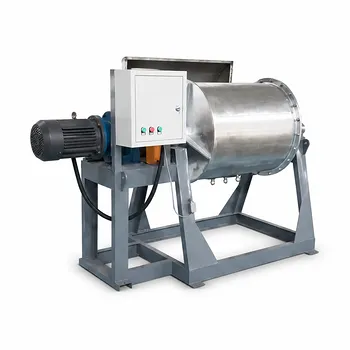
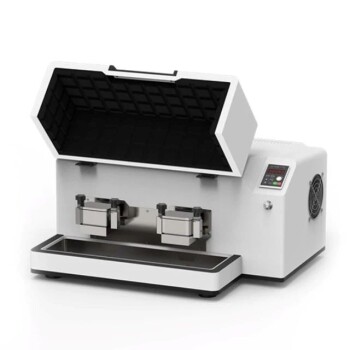
The primary role of the ball milling process in this context is to mechanically force a uniform distribution of Zirconium Carbide (ZrC) particles within the CrMnFeCoNi high-entropy alloy matrix. Because these two materials possess significantly different physical properties, simple blending is insufficient; ball milling is required to overcome these discrepancies and create a homogeneous composite powder suitable for advanced coating applications.
Core Takeaway Ball milling acts as a mechanical equalizer, neutralizing the natural segregation caused by the differing densities and fluidities of the alloy and ceramic powders. This uniform dispersion is the non-negotiable foundation for achieving consistent quality and stable performance in subsequent plasma surfacing processes.
Overcoming Physical Incompatibilities
Addressing Density and Fluidity Mismatches
The CrMnFeCoNi alloy and ZrC ceramic powders possess inherently different densities and flow characteristics (fluidity). Without active intervention, these differences would cause the powders to separate or stratify during handling. Ball milling applies mechanical energy to counteract these natural tendencies, preventing the heavier or more fluid particles from segregating from the mixture.
Ensuring Microscopic Dispersion
The process does more than just blend; it ensures a highly dispersed distribution of ZrC particles within the alloy matrix. By subjecting the powders to mechanical forces, the process breaks down agglomerates and positions the ceramic particles evenly throughout the metal powder. This level of mixing creates a uniform composite structure that cannot be achieved through standard stirring methods.
The Critical Link to Processing Success
A Prerequisite for Plasma Surfacing
The primary reference identifies ball milling as a "critical prerequisite" for the specific technique of plasma surfacing. Plasma surfacing is highly sensitive to input material consistency; any fluctuation in powder composition leads to defects in the final layer. Ball milling ensures that every portion of the powder feed contains the correct ratio of alloy to ceramic.
Stabilizing Coating Performance
The ultimate goal of the process is to produce a composite coating with a homogeneous composition. Uniform powder leads directly to a uniform coating, which ensures the material exhibits stable performance characteristics in its final application. Without the homogeneity provided by ball milling, the final coating would likely suffer from localized weak points or inconsistent hardness.
Understanding the Risks and Trade-offs
The Consequence of Insufficient Milling
If the ball milling process is shortened or omitted, the density difference between CrMnFeCoNi and ZrC becomes a failure point. This results in segregation, where the ceramic reinforcement is not evenly distributed, leading to unpredictable material properties. In a coating context, this could result in areas that lack reinforcement entirely, compromising the structural integrity of the part.
Mechanical Energy vs. Material Integrity
While essential for mixing, ball milling involves high-energy collisions and mechanical stresses. It is necessary to balance the energy input to achieve dispersion without degrading the powder quality or introducing excessive contamination from the milling media. The process forces physical proximity and interlocking of particles, which is far more aggressive than passive mixing but necessary for these specific materials.
Making the Right Choice for Your Goal
To ensure the success of your CrMnFeCoNi/ZrC composite preparation:
- If your primary focus is Coating Uniformity: Ensure the ball milling parameters are aggressive enough to overcome the density disparity, as this is the leading cause of composition gradients in the final layer.
- If your primary focus is Process Stability: Monitor the fluidity of the milled powder; successful milling should result in a mixture that flows consistently without separating during the plasma feeding stage.
Ball milling is not merely a mixing step; it is the structural foundation that allows distinct materials to function as a single, high-performance composite.
Summary Table:
| Feature | Role of Ball Milling in CrMnFeCoNi/ZrC Preparation |
|---|---|
| Primary Function | Mechanical equalization and uniform dispersion of ZrC in alloy matrix |
| Problem Solved | Overcomes density and fluidity mismatches that cause segregation |
| Impact on Coating | Ensures consistent composition and stable performance in plasma surfacing |
| Risk of Failure | Insufficient milling leads to localized weak points and material stratification |
| Material Synergy | Creates a structural foundation for distinct materials to act as a single composite |
Elevate Your Material Research with KINTEK Precision Equipment
Achieving the perfect composite homogeneity requires more than just a process—it requires the right tools. KINTEK specializes in high-performance laboratory solutions designed for advanced material synthesis. Whether you are preparing CrMnFeCoNi high-entropy alloys or complex ceramic composites, our crushing and milling systems provide the mechanical energy precision necessary to prevent segregation and ensure microscopic dispersion.
From high-temperature furnaces for alloy sintering to hydraulic presses and specialized consumables like ceramics and crucibles, KINTEK supports your entire workflow. Don't let density mismatches compromise your results.
Contact KINTEK today to find the ideal milling and heating solutions for your lab!
References
- Long Huang, Guodong Zhang. Effect of ZrC on the Microstructure and Properties of CrMnFeCoNi High-Entropy Alloy Coatings Prepared by a Plasma Transferred Arc Process. DOI: 10.3390/ma16237401
This article is also based on technical information from Kintek Solution Knowledge Base .
Related Products
- Stainless Steel Laboratory Ball Mill for Dry Powder and Liquid with Ceramic Polyurethane Lining
- Laboratory Planetary Ball Mill Rotating Ball Milling Machine
- High-Energy Omnidirectional Planetary Ball Mill Milling Machine for Laboratory
- Laboratory Ball Mill Jar Mill with Metal Alloy Grinding Jar and Balls
- High Energy Planetary Ball Mill Milling Machine for Laboratory
People Also Ask
- How do laboratory ball mills facilitate the mechanochemical synthesis of ZIF-8? Solvent-Free Synthesis Explained
- What is the primary function of a laboratory ball mill in the modification of sulfide-based solid electrolytes with LiPO2F2?
- How does a laboratory ball mill ensure the mixing quality of Mn3Zn0.8Sn0.2N and Ti? Achieve Perfect Homogeneity
- What is the function of a laboratory ball mill in the preparation of AMMCs? Optimize Dispersion & Grain Refinement
- In what way does a laboratory ball mill affect material properties when modifying PHBV/pulp fiber composites?