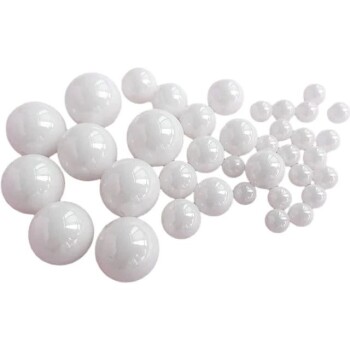
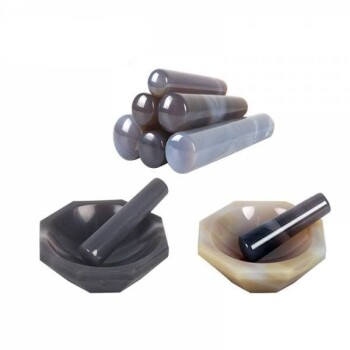
Zirconia grinding media serves as the critical enabler for producing high-performance Carbon Fiber/Silicon Nitride (C_fiber/Si3N4) composites. Specifically, zirconia jars and balls provide the necessary hardness to break down powder agglomerates and uniformly disperse carbon fibers within the silicon nitride matrix, all while preventing metallic contamination that would degrade the final ceramic's purity.
Core Takeaway The preparation of C_fiber/Si3N4 composites requires a delicate balance of aggressive mechanical mixing and strict contamination control. Zirconia is utilized because it offers the extreme hardness required to disperse fibers and pulverize agglomerates, combined with chemical inertness that eliminates the risk of introducing metallic impurities during the milling process.
The Mechanics of Effective Milling
Breaking Down Agglomerates
To create a high-quality composite, the silicon nitride matrix powder must be free of clumps. Zirconia grinding balls possess high hardness and superior wear resistance. This allows them to efficiently crush and break down powder agglomerates that inevitably form during the handling of fine ceramic powders.
Ensuring Uniform Dispersion
The performance of a C_fiber/Si3N4 composite depends heavily on the homogeneity of the mixture. Zirconia media is used to mechanically force the uniform dispersion of carbon fibers throughout the silicon nitride matrix. This prevents fiber bundling, which would otherwise create weak points in the final structural material.
Efficient Energy Transfer
Drawing on the principles of high-energy milling, zirconia’s high density provides significant impact kinetic energy. This ensures that the mechanical energy is effectively transferred to the powder mixture, facilitating the physical blending required for these hard ceramic precursors without requiring excessive milling times.
Preserving Material Purity
Chemical Stability
Silicon nitride composites often require long-duration grinding to achieve the necessary fineness and mixing. Zirconia is chemically stable, meaning it does not react with the carbon fibers or the silicon nitride powder. This inertness is vital for maintaining the stoichiometry of the composite.
Eliminating Metallic Contamination
Standard steel grinding media sheds microscopic iron fragments due to wear. Zirconia’s superior wear resistance prevents the introduction of metallic impurities. Maintaining this high purity is essential, as metallic contaminants can degrade the mechanical and thermal properties of the final ceramic product.
Understanding the Trade-offs
The Necessity of Compatibility
While zirconia is superior for ceramics, it is chosen specifically because the wear debris it does produce (zirconia dust) is generally compatible with ceramic matrices or negligible in volume. Using a medium that is harder but chemically reactive, or softer and prone to shedding (like steel), would compromise the structural integrity of the composite.
Impact on Milling Efficiency
Zirconia is dense, but less dense than tungsten carbide. However, for C_fiber/Si3N4 preparation, zirconia strikes the optimal balance. It is heavy enough to provide impact energy but hard enough to resist the abrasion caused by the silicon nitride and carbon fibers, preventing the rapid degradation of the grinding media itself.
Making the Right Choice for Your Goal
To achieve the best results in composite preparation, align your process with your specific purity and structural requirements.
- If your primary focus is Structural Homogeneity: Prioritize the use of high-hardness zirconia balls to ensure the complete breakdown of agglomerates and the uniform distribution of carbon fibers.
- If your primary focus is High Purity: Rely on zirconia’s chemical inertness and wear resistance to prevent metallic contamination during long milling cycles.
Zirconia grinding media is not just a tool for size reduction; it is a fundamental component for preserving the chemical identity and structural potential of advanced ceramic composites.
Summary Table:
| Feature | Role in C_fiber/Si3N4 Preparation | Benefit |
|---|---|---|
| High Hardness | Breaks down powder agglomerates | Ensures fine, consistent matrix powder |
| Superior Density | Provides high impact kinetic energy | Facilitates efficient mechanical blending |
| Wear Resistance | Minimizes media degradation | Prevents metallic impurity introduction |
| Chemical Inertness | Non-reactive with fibers or matrix | Preserves the stoichiometry of the composite |
| High Wear Stability | Promotes uniform fiber dispersion | Eliminates weak points caused by fiber bundling |
Elevate Your Advanced Ceramic Research with KINTEK
Precise material preparation is the foundation of high-performance composites. KINTEK specializes in premium laboratory equipment and consumables, offering high-durability zirconia grinding jars and balls, crushing and milling systems, and sieving equipment designed to meet the rigorous purity standards of ceramic engineering.
Whether you are developing Carbon Fiber/Silicon Nitride composites or exploring battery research, our comprehensive portfolio—from high-temperature furnaces (vacuum, CVD, dental) to hydraulic presses (pellet, isostatic)—provides the reliability you need.
Ready to optimize your milling efficiency and material purity? Contact our technical experts today to find the perfect solution for your lab!
Related Products
- Laboratory Jar Ball Mill with Alumina Zirconia Grinding Jar and Balls
- Precision Machined Zirconia Ceramic Ball for Engineering Advanced Fine Ceramics
- Laboratory Jar Mill with Agate Grinding Jar and Balls
- Laboratory Ball Mill Jar Mill with Metal Alloy Grinding Jar and Balls
- Laboratory Four-Body Horizontal Jar Mill
People Also Ask
- What are the primary functions of using a ball mill for BZCY72 powder? Achieve High Purity and Enhanced Sintering
- In what way does a laboratory ball mill affect material properties when modifying PHBV/pulp fiber composites?
- Why is a laboratory ball mill required for ultra-fine fly ash? Unlock Nano-Scale Adsorption Power
- What is the function of a laboratory ball mill in the preparation of AMMCs? Optimize Dispersion & Grain Refinement
- What is the function of a laboratory ball mill in the pretreatment of waste tire char (WTC)? Optimize Material Reactivity