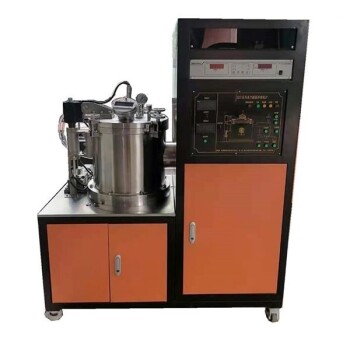
The significance of the vacuum furnace in this process lies in its ability to facilitate atomic-level bonding while preventing material degradation. By creating a high-vacuum environment with precise pressure control, the furnace enables the diffusion bonding of multilayer titanium alloy sheets. This transforms separate layers into a single, high-strength structural component without the weaknesses associated with traditional welding or mechanical fastening.
Core Takeaway: The vacuum furnace is not merely a heating vessel; it is a critical processing environment that prevents titanium oxidation and embrittlement, enabling atoms to migrate across layer boundaries to create a pore-free, isotropic material with exceptional strength and toughness.
The Role of the Environment: Controlling Oxidation
Preventing Material Embrittlement
Titanium alloys are highly reactive to oxygen, particularly at the elevated temperatures required for bonding. Without a vacuum or inert atmosphere (such as argon), the metal would rapidly oxidize.
Oxidation leads to the formation of a brittle surface layer. This layer prevents successful bonding and compromises the mechanical integrity of the final laminate.
Ensuring Surface Cleanliness
For diffusion bonding to occur, the mating surfaces must be pristine. The high-vacuum environment effectively inhibits gas absorption and removes volatile contaminants.
This cleanliness allows the titanium surfaces to come into direct contact at the microscopic level, which is a prerequisite for atom migration.
The Mechanism: Achieving Atomic Continuity
Solid-State Diffusion
Unlike welding, which melts the base metal, diffusion bonding in a vacuum furnace occurs in the solid state. Under heat and uniform pressure (often applied via a flexible membrane), atoms migrate across the interface boundaries.
This process essentially erases the distinction between the layers. The result is a structure with indistinct interfaces where the bond line is virtually invisible.
Elimination of Interfacial Pores
A critical function of the combined pressure and vacuum is the closure of voids. As atoms diffuse, they fill the microscopic gaps between the sheets.
Eliminating these interfacial pores is vital for preventing stress concentrations that could lead to premature fracture or failure under load.
The Result: Superior Mechanical Properties
Isotropic Performance
Because the layers bond at an atomic level, the finished laminate exhibits isotropic mechanical properties. This means the material possesses uniform strength and behavior in all directions, similar to a solid block of metal.
Enhanced Toughness and Microstructure
The vacuum process preserves the alloy's microstructure, specifically maintaining uniform equiaxed alpha grains. This specific grain structure contributes directly to the material's ability to withstand impact loads.
The resulting laminate offers an excellent balance of low weight, high fracture strength, and superior impact toughness.
Understanding the Trade-offs
Process Complexity and Cycle Time
While the results are superior, diffusion bonding in a vacuum furnace is a slow, batch-oriented process. It requires precise temperature cycling and pressure regulation over extended periods to ensure full atomic diffusion.
Equipment Sensitivity
The quality of the bond is entirely dependent on maintaining a pristine vacuum. Any leakage or failure in the inert gas protection system will result in immediate oxidation, rendering the expensive titanium scrap.
Making the Right Choice for Your Project
To maximize the benefits of vacuum diffusion bonding for titanium laminates, consider your specific performance requirements:
- If your primary focus is Impact Resistance: Ensure your process parameters create uniform equiaxed alpha grains, as this microstructure directly correlates to toughness.
- If your primary focus is Structural Consistency: Prioritize the elimination of interfacial pores through precise pressure application (such as argon gas via membranes) to guarantee isotropic behavior.
The vacuum furnace transforms layered titanium from a stack of sheets into a unified, high-performance material capable of surviving extreme structural demands.
Summary Table:
| Feature | Vacuum Diffusion Bonding Impact | Benefit to Titanium Laminates |
|---|---|---|
| Atmosphere Control | Eliminates oxygen and nitrogen | Prevents embrittlement and surface oxidation |
| Bonding Mechanism | Solid-state atomic migration | Creates a single, unified structure with no weak weld lines |
| Microstructure | Preserves equiaxed alpha grains | Enhances impact toughness and fracture resistance |
| Interface Quality | Closure of interfacial pores | Ensures isotropic mechanical properties and structural integrity |
| Surface State | Removes volatile contaminants | Facilitates pristine contact for superior bond strength |
Elevate Your Advanced Manufacturing with KINTEK
Precision is paramount when processing reactive materials like titanium. KINTEK specializes in high-performance laboratory and industrial equipment designed to meet the rigorous demands of vacuum diffusion bonding. Whether you require advanced vacuum furnaces, high-temperature high-pressure reactors, or hot hydraulic presses, our solutions ensure the pristine environment and uniform pressure control needed to achieve atomic continuity.
From aerospace components to medical implants, empower your research and production with KINTEK’s comprehensive range of furnaces, crushing systems, and cooling solutions. Contact our experts today to find the perfect equipment to transform your material performance.
References
- Elena Ionela Neacşu, L. Done. ow and intermediate level aqueous radioactive waste treatment in a modular installation. DOI: 10.21175/rad.abstr.book.2023.44.5
This article is also based on technical information from Kintek Solution Knowledge Base .
Related Products
- Vacuum Hot Press Furnace Heated Vacuum Press Machine Tube Furnace
- 600T Vacuum Induction Hot Press Furnace for Heat Treat and Sintering
- Vacuum Hot Press Furnace Machine Heated Vacuum Press
- Vacuum Heat Treat Furnace and Levitation Induction Melting Furnace
- 2200 ℃ Tungsten Vacuum Heat Treat and Sintering Furnace
People Also Ask
- What advantages does a vacuum hot press furnace provide for LSLBO ceramic electrolytes? Achieve 94% Relative Density
- What role does a Vacuum Hot Press (VHP) furnace play in the densification of austenitic stainless steel 316 composites?
- What are the advantages of using a vacuum hot pressing furnace? Superior Densification for 2024Al/Gr/SiC Composites
- What are the advantages of a vacuum hot press furnace for LTPO solid electrolytes? Boost Density and Conductivity
- What core processing conditions does a vacuum hot press furnace provide? Achieve High-Density Cu-SiC/Diamond Composites