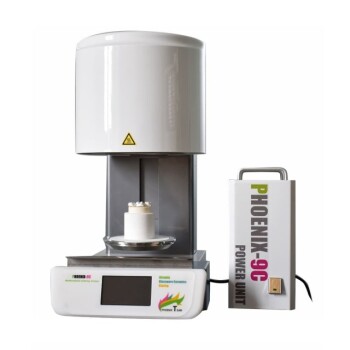
The significance of using a high-temperature box furnace lies in its ability to facilitate the unique "one-step" nature of the Solid-State Reactive Sintering (SSRS) process. By maintaining a precise, uniform environment between 1400°C and 1500°C, the furnace enables the chemical formation of the BZY20 perovskite structure and the physical densification of the material to occur simultaneously.
Core Takeaway The high-temperature box furnace is the technological driver that makes the SSRS process viable. It integrates two traditionally separate manufacturing stages—phase synthesis and grain densification—into a single thermal cycle, thereby eliminating the need for pre-sintering and significantly streamlining the production of BZY20 ceramics.
The Mechanics of Simultaneous Processing
Enabling the "Reactive" Phase
The primary function of the furnace in this context is to drive Solid-State Reactive Sintering.
Standard processes often require you to synthesize the powder first (calcination) and then sinter it. In the SSRS process facilitated by this furnace, the raw precursors react chemically to form the desired perovskite phase during the heating cycle.
Achieving Physical Densification
While the chemical reaction is occurring, the furnace simultaneously drives the physical consolidation of the material.
The high thermal energy promotes grain growth and eliminates porosity. This results in a dense, structurally sound ceramic component without requiring a secondary firing step.
Critical Thermal Requirements
Extreme Temperature Stability
BZY20 ceramics require a punishing thermal environment to process correctly.
The box furnace must reliably reach and hold temperatures between 1400°C and 1500°C. Fluctuations in this range could interrupt the reaction or lead to incomplete densification.
Long-Duration Uniformity
The SSRS process is not instantaneous; it requires extended dwell times, often lasting up to 24 hours.
The significance of the box furnace is its ability to maintain excellent temperature uniformity across the entire chamber for this duration. This ensures that every part of the ceramic sample undergoes the same phase transformation and densification, preventing structural gradients or defects.
Understanding the Capabilities and Trade-offs
Process Efficiency vs. Equipment Demands
The main advantage here is efficiency. You are effectively skipping the calcination (pre-sintering) step.
However, this places a heavy burden on the equipment. The furnace must be robust enough to operate at near-maximum ratings for day-long cycles repeatedly. Lower-grade furnaces may struggle to maintain the required uniformity over 24 hours, leading to batch inconsistencies.
Beyond Sintering: Atmosphere Control
While the primary significance in SSRS is thermal stability, advanced high-temperature furnaces often offer atmosphere control.
This is critical for broader BZY20 research. As noted in supplementary data, the ability to switch between dry and water-saturated argon allows researchers to control proton defects. While this is distinct from the sintering step itself, using a furnace with this dual capability adds value by allowing you to both synthesize the material (SSRS) and characterize its electrochemical performance under humidity in the same unit.
Making the Right Choice for Your Goal
To maximize the utility of a high-temperature box furnace for BZY20, align your equipment use with your specific objective:
- If your primary focus is Production Efficiency: Prioritize a furnace with exceptional thermal uniformity at 1500°C to ensure successful one-step SSRS and eliminate the pre-sintering phase.
- If your primary focus is Material Characterization: Select a furnace that offers precise atmosphere control (e.g., wet/dry argon switching) to accurately study proton conductivity and defect concentrations.
The high-temperature box furnace transforms BZY20 fabrication from a multi-step chore into a streamlined, integrated thermal event.
Summary Table:
| Feature | SSRS Requirement for BZY20 | Box Furnace Significance |
|---|---|---|
| Temperature Range | 1400°C to 1500°C | Facilitates chemical reaction & physical densification |
| Thermal Stability | Long dwell times (up to 24h) | Ensures consistent grain growth without porosity |
| Process Efficiency | One-step thermal cycle | Eliminates the need for pre-sintering/calcination |
| Advanced Control | Controlled atmospheres | Allows for study of proton defects and conductivity |
Elevate Your Material Research with KINTEK Precision
Streamline your BZY20 production and achieve superior material density with KINTEK’s high-performance high-temperature box furnaces. Designed for the rigorous demands of Solid-State Reactive Sintering (SSRS), our equipment provides the extreme temperature stability and long-duration uniformity required for advanced ceramics.
Beyond sintering, KINTEK specializes in a comprehensive range of laboratory solutions, including high-pressure reactors, muffle and vacuum furnaces, and specialized crushing and milling systems. Whether you are focused on production efficiency or detailed material characterization, our team is ready to provide the precision tools your lab needs to succeed.
Contact KINTEK today for a consultation on our high-temperature solutions!
Related Products
- 1700℃ Muffle Oven Furnace for Laboratory
- High Temperature Muffle Oven Furnace for Laboratory Debinding and Pre Sintering
- 1400℃ Muffle Oven Furnace for Laboratory
- 1200℃ Muffle Furnace Oven for Laboratory
- 1800℃ Muffle Oven Furnace for Laboratory
People Also Ask
- Why is a laboratory high-temperature muffle furnace required for the post-annealing treatment of copper oxide?
- How does a muffle furnace ensure reliability in calcification roasting? Achieve Precision in Pellets Conversion
- What role does a laboratory high-temperature muffle furnace play in iron-based composite phase structure development?
- How is a laboratory high-temperature muffle furnace utilized in sol-gel synthesis for perovskite catalysts?
- How does a muffle furnace influence 8YSZ ceramic densification? Master Precision Sintering at 1500°C