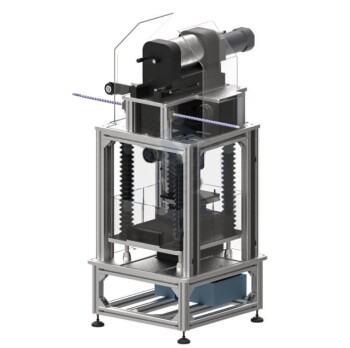
Precision analysis sieves act as a fundamental quality control mechanism in the synthesis of carbon nanotubes (CNTs) by rigorously standardizing the catalyst particle size. By screening dried catalysts through specific mesh sizes, these tools create a uniform powder distribution that eliminates variables in the upstream processing. This physical consistency is the prerequisite for predictable chemical behavior inside the reactor.
While often overlooked, the sieving process determines the catalyst's specific surface area. This uniformity is the key driver for efficient heat and mass transfer, directly resulting in the stable and controlled growth of carbon nanotubes.
The Physics of Catalyst Preparation
To understand the significance of sieving, one must look at how the physical properties of the catalyst dictate the chemical reaction.
Controlling Specific Surface Area
The primary function of the precision sieve is to sort dried catalysts into a batch with uniform particle distribution.
In chemical kinetics, the reaction rate is often proportional to the surface area available. By ensuring all catalyst particles are roughly the same size, you ensure they possess a consistent specific surface area.
This consistency guarantees that each particle exposes the same amount of active material to the reactant gases.
Optimizing Heat and Mass Transfer
Once inside a Chemical Vapor Deposition (CVD) reactor, the catalyst is subjected to intense thermal and chemical environments.
Uniform particle sizes allow for efficient heat transfer throughout the catalyst bed. If particles vary wildly in size, heat distribution becomes uneven, leading to "hot spots" or cold zones.
Furthermore, uniform spacing between particles facilitates better mass transfer. This ensures the carbon-bearing gases can flow evenly around every catalyst particle, preventing localized starvation or saturation.
Impact on Carbon Nanotube Growth
The preparation of the catalyst directly correlates to the quality of the final nanotube product.
Achieving Process Stability
The ultimate goal of using precision sieves is to create a stable growth environment.
When heat and mass transfer are consistent, the nucleation and growth of the nanotubes become predictable.
Ensuring Controlled Growth
Without the standardization provided by sieving, growth becomes erratic.
Precision sieving ensures that the growth is controlled, leading to a final product that meets structural and dimensional specifications.
Operational Considerations and Trade-offs
While sieving is critical, it introduces specific process variables that must be managed.
The Sensitivity of Mesh Selection
The efficacy of this process relies entirely on selecting the specific mesh size appropriate for your catalyst and reactor type.
Choosing a mesh that is too coarse will fail to achieve the necessary uniformity, negating the benefits of the process.
Conversely, utilizing a mesh that is too fine may result in excessive catalyst loss or processing time without yielding proportional benefits in growth stability.
Making the Right Choice for Your Goal
The integration of precision sieving is a strategic decision to reduce variance in your final material.
- If your primary focus is Structural Homogeneity: Select the tightest mesh tolerance possible to ensure identical specific surface area across all catalyst particles.
- If your primary focus is Process Repeatability: Standardize your sieving protocol to guarantee that heat and mass transfer rates remain constant between different production batches.
Precision in the physical preparation of the catalyst is the most effective way to guarantee precision in the chemical growth of the nanotube.
Summary Table:
| Factor | Role of Precision Sieving | Impact on Carbon Nanotubes (CNTs) |
|---|---|---|
| Particle Size | Standardizes catalyst powder distribution | Ensures predictable chemical behavior in the reactor |
| Surface Area | Creates uniform specific surface area | Guarantees consistent reaction rates and active material exposure |
| Heat Transfer | Eliminates uneven particle sizing | Prevents "hot spots" and ensures thermal stability during growth |
| Mass Transfer | Facilitates even gas flow around particles | Prevents localized starvation for controlled, stable growth |
| Process Stability | Reduces physical variance in precursors | Leads to superior structural homogeneity and repeatability |
Elevate Your Material Synthesis with KINTEK Precision Solutions
Achieving the perfect carbon nanotube structure starts with absolute control over your catalyst preparation. At KINTEK, we specialize in the high-performance laboratory equipment essential for advanced material research. From our precision analysis sieves and crushing systems that guarantee catalyst uniformity, to our state-of-the-art CVD and vacuum furnaces designed for stable nanotube growth, we provide the tools needed for repeatable, high-quality results.
Whether you are scaling up production or refining laboratory protocols, KINTEK offers a comprehensive range of rotary furnaces, high-pressure reactors, and specialized consumables like ceramics and crucibles to support your most demanding applications. Our experts are ready to help you select the right tools for your specific research goals.
Ready to optimize your carbon nanotube growth process? Contact KINTEK today to discuss your equipment needs!
References
- A. S. A. Syed Mohammed Buhari, Yusuf Olanrewaju Busari. Mechanical and Corrosion Protection Characteristics of CNTs/epoxy resin Nanocomposite Coating on Buried API 5L X65 Steel Storage Tank. DOI: 10.21315/jps2023.34.1.8
This article is also based on technical information from Kintek Solution Knowledge Base .
Related Products
- Laboratory Micro Horizontal Jar Mill for Precision Sample Preparation in Research and Analysis
- Custom PTFE Teflon Parts Manufacturer for PTFE Mesh F4 Sieve
- Precision Wire Saw Laboratory Cutting Machine with 800mm x 800mm Workbench for Diamond Single Wire Circular Small Cutting
People Also Ask
- What are the different types of laboratory mills? Choose the Right Grinder for Your Sample Material
- What is use for grinding in the laboratory? Select the Right Mill for Accurate Sample Prep
- What is the function of laboratory mills? Achieve Precise Particle Size Control for Accurate Analysis
- What is the use of a laboratory mill? Achieve Accurate Sample Homogenization for Reliable Results
- What is the purpose of sample preparation? Ensure Accurate & Reliable Analytical Results